Then he got into the boat and his disciples followed him. Suddenly a furious storm came up on the lake, so that the waves swept over the boat. But Jesus was sleeping. The disciples went and woke him, saying, “Lord, save us! We’re going to drown!” He replied, “You of little faith, why are you so afraid?” Then he got up and rebuked the winds and the waves, and it was completely calm. The men were amazed and asked, “What kind of man is this? Even the winds and the waves obey him!” Matthew 8:23–27
In his account, Matthew shows that Jesus is not only Lord over disease and demons, but over nature too. He is Immanuel, God with us, who rebukes the storm over the seas just as God in the Old Testament made the waters calm – see for instance, Psalm 104:7 (“at your rebuke the waters fled”) or Isaiah 50:2 (“by a mere rebuke I dry up the sea”). At his mere word the seas obey, causing the frightened disciples to wonder just who is in the boat with them. They had witnessed him healing the previously incurable diseases, but they hadn’t reckoned on him controlling nature. Being familiar with the references in the Old Testament mentioned above, they would have realized immediately the weight of Jesus’ actions.
The storm was no ordinary storm. This is hinted at by the Greek word seismos, which usually means an earthquake, or literally, a “shaking” (RT France, Matthew, IVP, 1985, p. 161). A force from outside brought chaos; that is, a squall came upon the lake violently and suddenly. Jesus demonstrates his authority by calming it with a rebuke.
Jesus wants us to believe in his power to still the storms in our lives, whether created from outside or from within. Sometimes they appear suddenly, taking us by surprise and perhaps flattening our faith. As we turn to him in fear or faith, asking him to save us, he brings calm and peace, creating order from disorder.
Prayer: Lord, I confess that when I see the waves leaping at my boat, I react with fear. Come and save me, and increase my faith in your goodness and grace.
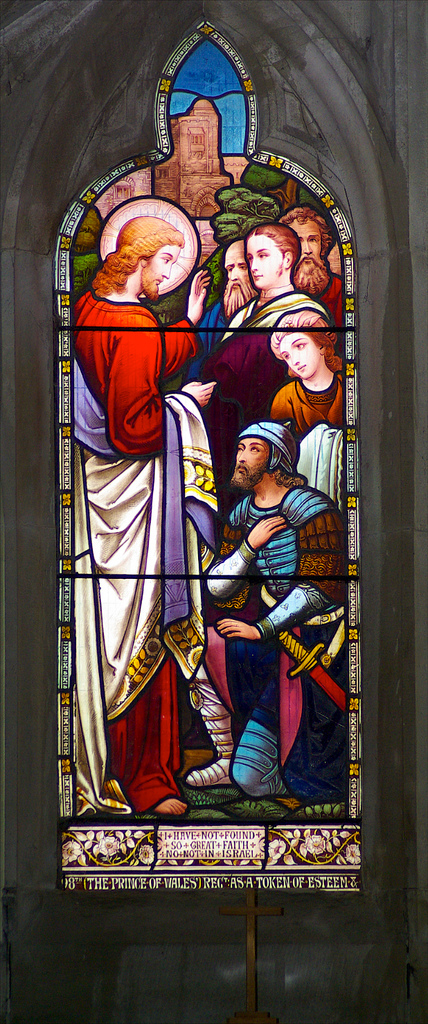
When Jesus had entered Capernaum, a centurion came to him, asking for help. “Lord,” he said, “my servant lies at home paralyzed, suffering terribly.” Jesus said to him, “Shall I come and heal him? The centurion replied, “Lord, I do not deserve to have you come under my roof. But just say the word, and my servant will be healed. For I myself am a man under authority, with soldiers under me. I tell this one, “Go,” and he goes; and that one, “Come,” and he comes. I say to my servant, “Do this,” and he does it.” When Jesus heard this, he was amazed and said to those following him, “Truly I tell you, I have not found anyone in Israel with such great faith…” Then Jesus said to the centurion, “Go! Let it be done just as you believed it would.” And his servant was healed at that very hour. Matthew 8:5–10, 13 (abridged)
Parish Church of St Michael, Mitcheltroy, Window. Credit: Keith Moseley, flickr
Following last week’s opener, Jesus continues to blow apart the people’s preconceptions as he exercises his authority, bringing healing to the Gentiles. When a Roman soldier asks for help, Jesus responds by asking if he should go to his house to heal the man. The soldier, however, wants to avoid Jesus becoming ceremonially unclean from entering a Gentile’s house. So the centurion applies the principles of faith and authority to the situation. As a man under authority who obeys the words of his superiors, and as one who has men serving under him, he believes that if Jesus just says the word, his servant will be healed.
And so it was. This miracle signals that the new kingdom is not limited to Jewish people but is available to Gentiles as well. It is also a stark warning to those in Israel who may have grown complacent in their status as the chosen people. Never, said Jesus, has he found someone of such great faith. Those listening must have felt stunned by this remark.
Do we take our faith for granted? How could you exercise faith this day? And how do you feel about being under authority?
For reflection: “I am not ashamed of the gospel, because it is the power of God that brings salvation to everyone who believes: first to the Jew, then to the Gentile” (Romans 1:5).
Today we’re starting a new devotional series, looking at the miracles of Jesus, via Matthew’s gospel. He’s on a mission to reveal the authority of Jesus. First he demonstrates that Jesus is the Son of God through his Sermon of the Mount, which left the crowds amazed. Then he moves from Jesus’ words to his actions, detailing in quick-fire succession miracle after miracle after miracle. Through these mind-blowing acts, Jesus takes authority over nature, sickness, sin, and demons, while pouring out his love and compassion on his people whom he calls “sheep without a shepherd” (Matthew 9:36). If the people were amazed at his teaching, imagine their reaction after witnessing sight restored or a leper cured.
Photo credit: Christ Healing the Sick, Washington Allston
Matthew’s account is concise; he leaves out details in the stories that other gospel writers fill in. With this brevity Matthew hammers home his message about the Son of God on earth who is ushering in God’s kingdom.
Jesus’ miracles tend to fall into three categories: those controlling nature, those eradicating sickness (and even death), and those casting out demons. But contrary to the expectations of the disciples, the teachers of the law, or his Jewish readers, Jesus extends his healing grace to the disaffected and outcast – even to the Gentiles. He stuns them with his words and his works and makes them wonder, ‘Who is this man?’
As I read through Matthew’s account of Jesus’ miracles, I was struck more than once by Jesus’ compassion. When he sees the suffering of the people, he immediately brings peace of body and soul. He then reinforces this with his call to peace, one he still issues: “Come to me, all you who are weary and burdened, and I will give you rest” (Matthew 11:28).
Yes, Jesus works miracles today. Physical healings are spectacular, but emotional healings can also be life-altering, bringing freedom, joy and fulfillment. Do we have the faith to believe that Jesus can and will work in our own hearts and lives? I pray we will encounter the stories of Jesus’ miracles with an attitude of expectancy, reverence and gratitude.
Be Clean
When Jesus came down from the mountainside, large crowds followed him. A man with leprosy came and knelt before him and said, “Lord, if you are willing, you can make me clean.” Jesus reached out his hand and touched the man. “I am willing,” he said. “Be clean!” Immediately he was cleansed of his leprosy. Then Jesus said to him, “See that you don’t tell anyone. But go, show yourself to the priest and offer the gift Moses commanded, as a testimony to them.” Matthew 8:1–4
The crowds were amazed by Jesus’ Sermon on the Mount, and now as he comes down the mountain, they will be bowled over by his works. This first miracle that Matthew recounts brings restoration to one who suffered from leprosy or another skin disease. In Jewish law, those so afflicted would be called “unclean” and would be banished from others to prevent further spreading of the disease. But the leprosy would continue to spread within the sufferers’ bodies, affecting limbs that would eventually fall off, until finally they would die.
So although the other miracles are called healings, this one is called a cleansing, for only Jesus could make the sufferer clean. Perhaps Matthew chose to recount this miracle first to show the Jewish people that Jesus is the fulfilment of the law (Mark and Luke first tell of Jesus driving out a demon in a man in Capernaum). After healing the man, Jesus tells him to show himself to the priest and offer the prescribed gift. By this he is signalling that one greater than Moses has come; he is ushering in a new order.
We could push this healing aside as not affecting us, but the spread of leprosy in a body is similar to the spread of sin in our lives. If we do not present ourselves to Jesus for cleansing, our sin will spread, separating us from each other and from God. Only Jesus can bring the cleansing that releases us into wholeness and makes us clean.
Prayer: Lord Jesus Christ, show me where sin may be lodging, that I may be cleansed by your healing hand.
 In his account, Matthew shows that Jesus is not only Lord over disease and demons, but over nature too. He is Immanuel, God with us, who rebukes the storm over the seas just as God in the Old Testament made the waters calm – see for instance, Psalm 104:7 (“at your rebuke the waters fled”) or Isaiah 50:2 (“by a mere rebuke I dry up the sea”). At his mere word the seas obey, causing the frightened disciples to wonder just who is in the boat with them. They had witnessed him healing the previously incurable diseases, but they hadn’t reckoned on him controlling nature. Being familiar with the references in the Old Testament mentioned above, they would have realized immediately the weight of Jesus’ actions.