“Christ with me, Christ before me, Christ behind me, Christ within me, Christ beneath me, Christ above me, Christ at my right, Christ at my left . . .” These hymn lyrics, written by the fifth-century Celtic Christian St. Patrick, echo in my mind when I read Matthew’s account of Jesus’s birth. They feel like a warm embrace, reminding me that I’m never alone.
Advent is a time of waiting and welcome. Waiting for the coming King, not only to celebrate his coming as a baby but for him to come again. Welcoming as we make room for him in our lives, a laughable thought for many as we juggle carol services, baking tasks, shopping for gifts… But some days we need snow days, like many in the UK have experienced, to make us slow down and ponder what this season is all about.
I am delighted to share another acrostic poem, following yesterday’s offering. This one is by another Amy, she a gifted storyteller and writer (Amy Robinson). You can view her wonderful poem that is a Christian take on the Santa story, inspired by the famous poem by Clement C. Moore, on her Facebook page – don’t miss it!
Here’s Amy’s acrostic poem as inspired by Mary’s song of praise to God, known as the Magnificat. Mary visits Elizabeth who is also pregnant, and when Elizabeth praises her for her great faith, Mary responds with her wonderful song. You can read the whole story in Luke 1.
My soul magnifies the Lord,
And my spirit rejoices in my saviour!
Generations will call me blessed,
Naming God as holy and mighty.
In strength he has scattered the proud,
Fed the hungry and left the rich empty.
Israel will see his mercy again.
Children of Israel, you know what he promised our fathers,
Abraham and his offspring for ever?
This is happening now.
How do you mark the season leading up to Christmas? It can be a mad and crazy time of parties, shopping, church services and baking. So much so, that we lose the reason for the season, to use that slightly cringey American phrase.
One Advent, in my quest to consider the season’s true meaning, I followed a Bible reading plan that moved from the Old Testament to the New as it revealed God’s greatest gift, his Son Jesus. As I played around with the biblical text, moving words here and there, some poems emerged. If you like to write, maybe you could do something similar this year for an Advent practice. Of course, you may not like writing at all – in which case, I trust you’ll find just the right thing to keep the gift of Jesus before you.
All this took place to fulfill what the Lord had said through the prophet: “The virgin will conceive and give birth to a son…” (Matthew 1:23)
Matthew’s concise account highlights the miracle of the virgin birth, which was foretold by the prophet Isaiah (7:14). God through his Holy Spirit overshadows Mary and conceives in her Jesus, who is both divine and human. It’s a mind-boggling concept of the Trinity at work: God, the creator of the universe, descends through his Holy Spirit to his creation in the person of Jesus, one who is God yet man, and thus one of the created. Being divine, Jesus can fulfill the meaning of his given name – Yahweh saves. Being human, Jesus can relate to us completely. Utterly brilliant.
But God doesn’t stop there, for following Jesus’ birth, death, and resurrection is Pentecost, when he pours out his Holy Spirit on his people. As the Holy Spirit overshadowed Mary and thus brought about the indwelling of Jesus, we too can host Jesus. Of course not physically, but Christ living in us will transform us, cleansing us and bringing forth the gifts and the fruits of the Spirit (including wisdom, understanding, knowledge, right judgment and love; joy, peace, gentleness, faith, and self-control). What better gifts this Christmas season?
Jesus dwelling in us, which is made possible through the incarnation, is echoed in Scripture. Jesus refers to it, such as when instructing his disciples before he dies: “…I am in my Father, and you are in me, and I am in you” (John 14:20) or his final prayer for them: “I in them and you in me” (John 17:23). The Apostle Paul reflects this new reality in his letters, such as “Christ in you the hope of glory” (Colossians 1:27) or “I have been crucified with Christ and I no longer live, but Christ lives in me” (Galatians 2:20).
Celebrating the incarnation is a wonderful opportunity to reflect on the reality of Jesus dwelling in us, and to rejoice.
Prayer: “I pray that out of his glorious riches he may strengthen you with power through his Spirit in your inner being, so that Christ may dwell in your hearts through faith” (Ephesians 3:16–17).
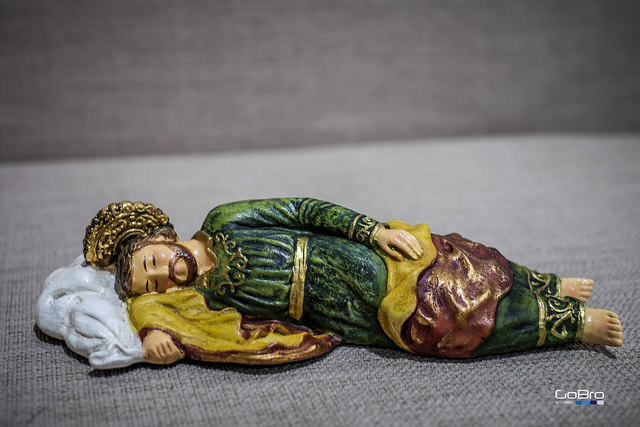
But after he had considered this, an angel of the Lord appeared to him in a dream and said, “Joseph son of David, do not be afraid to take Mary home as your wife, because what is conceived in her is from the Holy Spirit. She will give birth to a son, and you are to give him the name Jesus, because he will save his people from their sins” (Matthew 1:20–21).
After Joseph learned that Mary was pregnant, he despaired over the future. No doubt she told him about the child’s divine origins, but how was he to believe her? Such a story was inconceivable. So as we saw last week, Joseph chose the best of the unwelcome options – divorce. God, however, had different plans.
Joseph awakes from his dream and instantly knows the truth of Mary’s pregnancy. The night before his hopes for marriage had been shattered, but in the light of day he sees a whole new reality shaping up, including him being the legal father of one who will become the Savior to his people. Surely Joseph wakes up a changed man; no longer despairing, he embraces a new life.
When the angel called Joseph “son of David,” this was to establish Jesus’ divine lineage. (Incidentally, Joseph is the only one named thus in the New Testament other than Jesus himself.) Along this line, the angel also instructed Joseph to name Jesus, for that entails him formally acknowledging Jesus as his son, and thus a son of David. Joseph may not be the biological father of Jesus, but his role as earthly father is vital.
God speaking to his children hasn’t changed from biblical times – he still breaks through, whether through a dream, an insight gleaned from the Bible, wisdom from friends, our time of prayer, or through other means. How is God reaching out to you, when you might be finishing up work or school, buying last-minute presents, preparing food, reading Christmas missives, or generally being stressed? As you go forth, know that God will speak, even in the midst of all of this.
Prayer: Father, I am busy with many things. Help me to choose what is best.
This is how the birth of Jesus the Messiah came about: his mother Mary was pledged to be married to Joseph, but before they came together, she was found to be pregnant through the Holy Spirit. Because Joseph her husband was a righteous man and did not want to expose her to public disgrace, he had in mind to divorce her quietly (Matthew 1:18–19).
The betrothal had taken place, and Mary and Joseph were pledged to one another in marriage. But it didn’t turn out as they had planned, for before they “came together” (Matthew’s way of implying sexual relations), Joseph learned that Mary was expecting a child. At this time, she was probably four months pregnant, having spent time with her relative Elizabeth, who herself was expecting her son John the Baptist (as we learn in Luke’s account).
Courting and marriage were different in biblical times. Back then, young men and women would be betrothed to each other for about a year before they entered into marriage. The betrothal would involve exchanging gifts and signing a prenuptial agreement, which would give the man rights over the woman. To break these legal ties entailed divorce. This, then, is what Joseph faced.
Imagine what Joseph was feeling – shocked, angry, hurt, disappointed, indignant, deflated. His plans for spending his life with Mary were shattered. In an instant, everything changed. What was he to do?
He could marry her, but that would condone her sin of adultery, leaving him impure before God. He could demand a public divorce, but that would humiliate her publicly and perhaps even cause her death by stoning. He settled on a third option, a private divorce, which would ensure his holiness before God while safeguarding her life.
Your day may be filled with preparations for the feast of Christmas. Stop for a moment, however, put yourself in Joseph’s shoes and forget what comes next in the story. With Joseph, every cell cries out in anguish. Why? Why did she? Why me? Why, God? Oh, why?
For reflection: “As the heavens are higher than the earth, so are my ways higher than your ways and my thoughts than your thoughts” (Isaiah 55:9).
Today in my writing group video chat, I was introduced to the pantoum, a form of poetry I’d never heard of previously. With just 5 minutes of free writing, I created this, an evocative Advent poem:
Here we felt accepted; here we felt affirmed; here we felt known
The sky was dark
We waited in the car, shivering, while we waited for Mom
And off we went to church, us three kids waiting
The sky was dark
Saying the liturgy and singing the carols, all the time waiting
And off we went to church, us three kids waiting
And so we listened to the priest and we shuffled in our seats, waiting
Saying the liturgy and singing the carols, all the time waiting
We waited in the car, shivering, while we waited for Mom
And so we listened to the priest and we shuffled in our seats, waiting
Here we felt accepted; here we felt affirmed; here we felt known
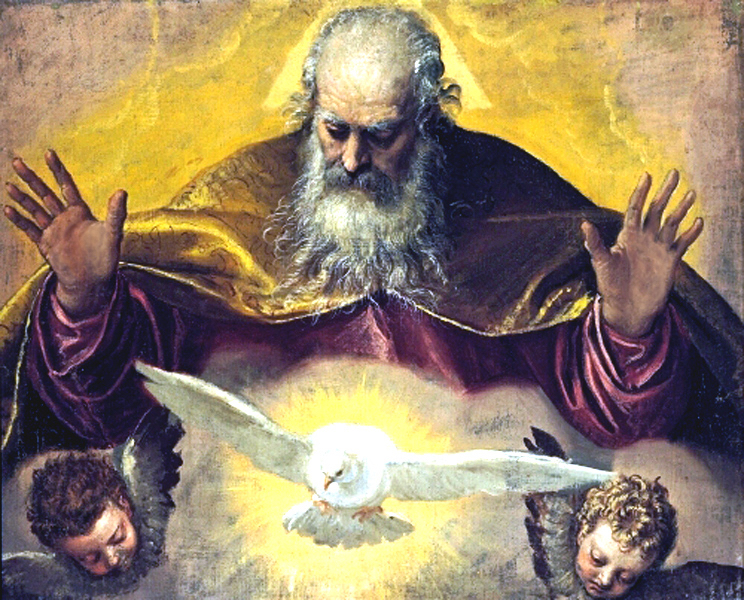
Photo: Waiting on the Word, God the Father, Flickr
…Matthan the father of Jacob, and Jacob the father of Joseph, the husband of Mary, and Mary was the mother of Jesus who is called the Messiah. (Matthew 1:15b–17, NIV)
What a difference a bit of grammar can make (so says Michael J. Wilkins in TheNIV Application Commentary: Matthew [Zondervan, 2004]). Throughout the genealogy we looked at last week, Matthew used the Greek verb gennao in the active voice, such as “Abraham fathered Isaac.” After forty instances of the active verb, he turns to the passive when describing Mary and Jesus – in the NIV, Joseph was the husband of Mary, “of whom was born Jesus…” Matthew’s readers would have noticed this shift, for it implies what many grammarians “call a divine passive, where God is the assumed agent of the action” (p. 63).
When I trained to be an editor, my teachers drummed into me always to use the active voice. But sometimes, as we see here, the passive is quite simply divine. In a simple shift of language, Matthew points to God at work. Watch out, he says, for what comes next is something new and completely different.
When it comes to his people, God is always the divine initiator. Mary responded to him, saying yes to God working literally in her body – “what is conceived in her is from the Holy Spirit” (v.20). Luke’s gospel records her humble and willing response when the angel announces that she will conceive a child through the “power of the Most High” (Luke 1:35): “I am the Lord’s servant… may it be to me according to your word” (v.38). Mary’s receptivity changed the world.
How does God want to break through to us? He may not want us to change the world, but rather parts of our world. Perhaps he is opening a new opportunity for service, or inviting us to mentor someone, or prompting us to extinguish anger and repair a broken relationship. Whatever it is, as we are still and listen for his voice, we will hear his words of love and guidance. May we be as Mary, responding with open hands and a receptive heart.
For reflection: The angel Gabriel to Mary: “For no word from God will ever fail” (Luke 1:37).
By Artfuldodger2013b (Own work) [CC BY-SA 3.0 (http://creativecommons.org/licenses/by-sa/3.0)]
Advent comes next week, ready or not. So it’s timely to delve into some of Matthew’s crisp account of the story of Jesus’s birth, the lesser-recounted version (in contrast to Luke’s). Matthew’s gospel has long been the first in the New Testament canon, and it forms a bridge between the Hebrew Bible and the New Testament. In the first two chapters alone Matthew hearkens back to the prophets four time, showing how Jesus is the fulfillment of their prophecies, the longed-for Messiah. He also begins his account with a genealogy that shows clearly how Jesus is God’s anointed one.
As we read Matthew’s account of Jesus’ birth, we see it through Joseph’s eyes, instead of Mary’s (as in Luke’s). God asked a lot of Joseph, and this humble man overcame his incredulity to become the earthly father of the Son of God. Quite often today Joseph gets pushed aside or even left out of the Christmas story, but as we will see, he plays a vital role.
May the Light of the world break through any darkness you may be experiencing; may he dispel any gloom as he brings joy, peace, and rejoicing. And may we move forward in a sometimes cloudy world as we glow with his resplendent light.
This is the genealogy of Jesus the Messiah the son of David, the son of Abraham: Abraham was the father of Isaac, Isaac the father of Jacob, Jacob the father of Judah and his brothers, Judah the father of Perez and Zerah, whose mother was Tamar, Perez the father of Hezron, Hezron the father of Ram, Ram the father of Amminadab, Amminadab the father of Nahshon, Nahshon the father of Salmon, Salmon the father of Boaz, whose mother was Rahab, Boaz the father of Obed, whose mother was Ruth, Obed the father of Jesse, and Jesse the father of King David. David was the father of Solomon, whose mother had been Uriah’s wife… (Matthew 1:1–6, NIV)
Did your eyes glaze over at this genealogy? So often when reading the Bible we skip over these unfamiliar names. Nahshon? Amminadab? Who are they to me?
But treasures are buried in the list (unearthed here with the help of biblical commentators), which the original readers would have understood. For instance, unlike most ancient genealogists, Matthew includes women: as well as Mary, Jesus’ mother, he names Tamar, Rahab, Ruth and Bathsheba (Uriah’s wife). He purposefully includes outcasts (Rahab was a Gentile prostitute), those wronged by men (Tamar had to trick her father-in-law so he would fulfil his legal obligation for her to marry his son) or those of the “wrong religion” (as a Moabite, Ruth would have been excluded from the synagogue).
With this, Matthew implies that although Jesus comes from royal stock (via King David), his roots and very DNA are in those who are marginalised and wronged. As Messiah, he is anointed to save those high in society – and those not. Including these so-called questionable women may also be Matthew’s way of preparing his readers for the unusual circumstances of Jesus’ birth, including that he was born to an unmarried woman.
The way Jesus comes to earth blows apart our preconceptions of how the King of the World should make himself known to his people. He may be high and mighty, but he is also lowly and humble.
Prayer: Lord Jesus Christ, as we prepare to celebrate your coming, open our eyes to those at the margins of society.
 “Christ with me, Christ before me, Christ behind me, Christ within me, Christ beneath me, Christ above me, Christ at my right, Christ at my left . . .” These hymn lyrics, written by the fifth-century Celtic Christian St. Patrick, echo in my mind when I read Matthew’s account of Jesus’s birth. They feel like a warm embrace, reminding me that I’m never alone.
 Advent is a time of waiting and welcome. Waiting for the coming King, not only to celebrate his coming as a baby but for him to come again. Welcoming as we make room for him in our lives, a laughable thought for many as we juggle carol services, baking tasks, shopping for gifts… But some days we need snow days, like many in the UK have experienced, to make us slow down and ponder what this season is all about.
![By Artfuldodger2013b (Own work) [CC BY-SA 3.0 (http://creativecommons.org/licenses/by-sa/3.0)]](https://amyboucherpye.com/wp-content/uploads/2015/11/Custom_family_tree_Genealogy_Art.jpg)