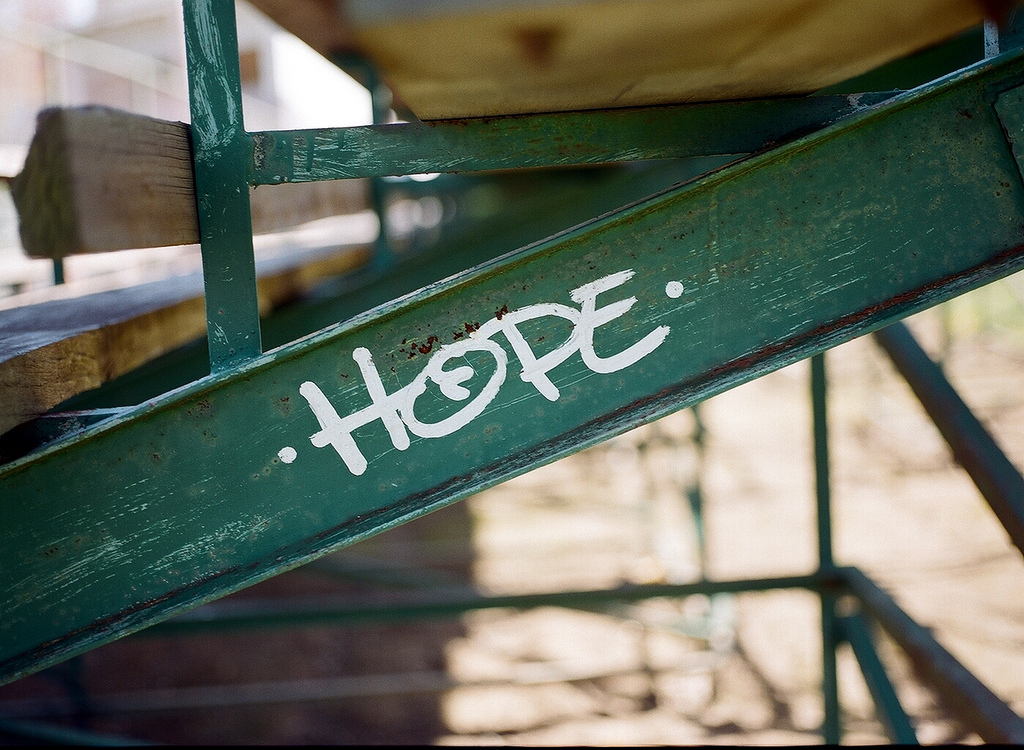
Against all hope, Abraham in hope believed and so became the father of many nations, just as it had been said to him, “So shall your offspring be.” Romans 4:18–25
Abraham and Sarah are two of my favorite characters in the Bible, partly because of what they experienced and felt. For instance, they faced the heartbreak of infertility for years before God promised Abraham that he’d be the father of many nations. Abraham’s biggest point of need – his desire for a son – was right where God met him. And not only met, but exceeded with mind-blowing abundance, for he promised that Abraham would have more descendants than the stars in the sky.
Abraham held on to God’s promise, even when it seemed impossible. In terms of him and Sarah conceiving a son, he believed God even though Sarah was long past her childbearing years. And God delivered; they had Isaac. Then Abraham held on to God’s promises through the heart-wrenching experience of being asked to sacrifice his beloved only son. Abraham knew that God would find a way to keep his promise, perhaps through the resurrection of the dead. For God had never failed him. And indeed, an angel of the Lord provided a ram in the place of Isaac.
Such hope and faith is modeled through a life of listening to and obeying God. As we mature in our faith, we learn to relinquish the requests that may not be of God or may not be for our best. We can ask God to change our hearts to align our desires with his. And our faith will grow as we look back and see how God has answered our prayers. I love reading through my old prayer journals, not only because they immediately and vividly transport me to times past, but because they reveal how faithful and loving is our God.
How might you be persuaded that God has the power to do what he has promised?
For reflection: “By faith Abraham, when called to go to a place he would later receive as his inheritance, obeyed and went, even though he did not know where he was going” (Hebrews 11:8).
Jesus replied, “Truly I tell you, if you have faith and do not doubt … you can say to this mountain, ‘Go, throw yourself into the sea,’ and it will be done. If you believe, you will receive whatever you ask for in prayer.” Matthew 21:18–22
Our passage comes during what was the original Holy Week of Jesus’ death and resurrection, although the disciples didn’t realize it then. (And yes, I’m a little out of sync with the church calendar with Lent starting tomorrow. Think of it as a taster of things to come…) Jesus and his friends were walking from Bethany to Jerusalem when he encounters an unfruitful fig tree. He makes it wither, which amazes the disciples. But the fig tree symbolized Israel, for neither were they reflecting God’s fruit.
Then Jesus says that we should have faith and believe. That if we hope and trust in God, looking to him for our fruitfulness, he will answer our prayer. Of course, this can get tricky if we believe it literally, in a mindless “The Bible says it; I believe it” sort of way. Then we become as a demanding child, insisting that God should give whatever we ask in prayer.
Those who care for young children can see this folly acted out. Of course we aren’t going to give kids endless sugar or let a toddler climb a ladder unaided. God might similarly turn down some of our requests. Perhaps our most poignant experiences of learning from and leaning on God have come through unanswered prayer. They certainly have for me.
But Jesus wants us to have faith and believe. While we become downhearted quickly, thinking that our circumstances or another person will never change. I know I’ve been prone to this stance of unbelief. For instance, a former colleague and I couldn’t reach a meeting of the minds in terms of expectations or delivery, and I wanted to give up. But I knew I had to examine my own attitude, so I asked God to help me see her as he created her. Slowly, and sometimes painfully, I began to change in my outlook. And our working relationship improved.
What mountains need moving in your life?
For reflection: “If I have the gift of prophecy and can fathom all mysteries and all knowledge, and if I have a faith that can move mountains, but do not have love, I am nothing” (1 Corinthians 13:2).
Therefore I tell you, do not worry about your life, what you will eat or drink; or about your body, what you will wear. Is not life more than food, and the body more than clothes? …Can any one of you by worrying add a single hour to your life? Matthew 6:25–34
We’re now halfway through our time together thinking about hoping and trusting in God, and today we come to the words of Jesus in the Sermon on the Mount. He is teaching the crowds, who are a mix of society but mainly peasants. They depended on their crops for their sustenance, and even when the harvest was small, they had to give their surplus to the rulers through tax. We could argue that their cause for worry was justified.
But Jesus turns the wisdom of the world on its head, saying that life is more than food and the body more than clothes. He points to his heavenly Father as the source of all life, asking his listeners to recognize God’s gracious abundance. For instance, even the flowers of the field display more beautiful clothes than King Solomon. And he points out the futility of worrying, for in the end it will seep life out of us.
I have a friend, Sarah, who is a self-professed worrier. She knows that it zaps her energy, but she struggles to give her concerns to God. Especially where her family is concerned. Some time ago one close to her had to undergo an emergency surgery, which we knew would be excruciating for Sarah. We texted back and forth, and although she was sometimes filled with anxiety, at other times she experienced the peace of God wrapped around her as if a warm coat. Her loved one came through the surgery well, and now she feels bolstered by the intimacy with God she found when clinging to him.
We don’t have to wait for a crisis to draw near to God. As we seek him, he will come running towards us with outstretched hands while reassuring us not to worry.
Prayer: Lord Jesus, help us to seek you and your kingdom this day.
But blessed is the one who trusts in the Lord, whose confidence is in him. They will be like a tree planted by the water that sends out its roots by the stream. It does not fear when heat comes; its leaves are always green. Jeremiah 17:5–8
We see a theme developing in the prophets, as they exhort the people of Israel and Judah to trust in the Lord and not in humans. We are so easily tempted to trust in that which we see or feel or touch; we find it harder to trust in what is unseen but real.
But when we do, when we put our hope and trust in God, we become like a tree planted by a stream of water. Our roots go down far into the earth of God’s word. As we feed on his light and life, we can’t help but to grow. Branches and leaves and flowers burst forth from us, and we are amazed that we’re even able to provide shade and a place for birds and animals to make their home.
You might be thinking, okay, that’s lovely imagery, but what does that mean for me? I’m home with my kids and they’re driving me crazy. I’m older and I’m looking for a job but I suspect my age is hindering me. I’m at uni and wondering what to do with my life. What comes to my mind in these disparate life situations is abiding in Jesus, as he says in John 15. He is the vine and we are the branches. As we rest/remain/live in him, his Spirit will move in and through us. He will give us the strength to love our children and provide a soothing word to their tantrums. He will give us the hope and perseverance to keep trying for just the right job. He will show us how to depend on him for the next steps in our life. Especially as we come together in prayer, we see that he leads, guides, encourages and affirms us.
Prayer: Father, Son and Holy Spirit, you provide us with the living water that brings life and fruitfulness. Flow through us this day.
You will keep in perfect peace those whose minds are steadfast, because they trust in you. Trust in the Lord forever, for the Lord, the Lord himself, is the Rock eternal. Isaiah 26:1–9
Each January I ask the Lord to reveal a special word and/or verse of Scripture for the upcoming year. In my twenties, when I was entering a new season of intimacy with God, he sparked the above verse from Isaiah. I felt like shouting it from the rooftops, for the words of the prophet from thousands of years before spoke electrically into my life.
I had been learning to hear God’s voice, but as I mentioned previously, I got into trouble when I misheard the Lord. That made for a roller-coaster of emotions, with my feelings up sky-high one day and dashed the next. I saw that Isaiah’s words would provide the balance that my emotions so desperately needed. As I trusted in the Lord, keeping my mind steadfast and centered on him, he would keep me in perfect peace. I would no longer be hit by any passing wave of emotion, but would be anchored in God’s word. To change the metaphor, he would be my rock forever.
It turns out that having this steadfast mind means having a capacity for imagining in the Hebrew, according to John N. Oswalt in the NIV Application Commentary: Isaiah (p. 304). As we fill our imaginations with God and his word, our lives are changed. We might decide not to expose our minds to certain books or movies so to keep our hearts fixed on God. For example, I concluded I couldn’t watch any more of a television show about a medical coroner. Please know that I’m not making a blanket statement here, but I realized that the dead bodies were filling my imagination and I needed to stop. The line of what is acceptable for you may be different; God directs as we stop and ask.
How’s your level of peace today?
Prayer: Lord, you are our rock and we trust in you. Fill our minds, hearts and imaginations with your sweet images of your true riches.
Stop trusting in mere humans, who have but a breath in their nostrils. Why hold them in esteem? Isaiah 2:22
The book of Isaiah is one of my favorites in the Bible, and I love the last half of the book especially, where the prophet employs glorious imagery as God promises to bring his people back to himself. The words from those chapters come easily to me: the Lord has chosen us and not rejected us; the waters will not sweep over us; the Maker is our husband.
But before the prophet was given these promises, the Lord first addressed the human arrogance and sin. As we see in this week’s reading, God named the Israelites’ sin of trusting in themselves. And he revealed the folly in doing so – they “have but a breath in their nostrils.” We may not live as if our lives are fleeting, believing instead that we are invincible as we move from one important activity to another. But if we stand back and consider the sweep of time, we see that our lives here on earth are just a blip.
That might sound depressing. I don’t mean it to be, for as we know from Scripture, the two things to remain are the word of God and his redeemed people who will live with him forever. So while we do have breath, may we trust not in ourselves or others, but in God. We can consciously turn to him for the big questions and the small. What shall I do next? What should our church’s mission be? How can I love my neighbor? As we turn our faces to the Lord, we can see in our mind’s eye him showering us with his wisdom, as if gold dust floating down to us in the sky.
Reflection: “There are no ‘ordinary’ people. You have never talked to a mere mortal… It is immortals whom we joke with, work with, marry, snub and exploit – immortal horrors or everlasting splendors.” CS Lewis, The Weight of Glory
Hope deferred makes the heart sick, but a longing fulfilled is a tree of life. Proverbs 13:12
A friend prayed this proverb for me when major life plans were dashed. I had thought the Lord was guiding me to move to another city to work with a Christian organization there. Conveniently, in that city lived a man whom I was sure the Lord had told me I would marry. But in the space of a week, I knew that neither would happen – neither would I work there nor marry that wonderful man.
My friend realized that I had seriously misheard the Lord, but she didn’t pass judgment on me. Rather she ministered to me through this proverb, for she saw that what my heart hoped for – marriage and being involved in an organization I loved – was now not coming true. And if I let my deferred hope fester within, my heart could become sick with sadness and disappointment.
She prayed with me, and helped me to release some of the pain and disbelief to God. I started to understand that I needed to mature in my listening; to test what I was hearing not only against the Bible but with trusted prayer partners.
It’s interesting that Solomon in this proverb simply observes the effects of hope deferred and longing fulfilled. He’s not pointing fingers at causes or behaviors that may have brought about the hope deferred. Sometimes merely stating the situation can bring healing and clarity – as with my friend who saw what was happening in my heart but didn’t tear me down for the mess I’d made.
Through my painful experience, I learned to give the Lord my dreams and plans. I became more rooted in his word and more mature in discerning his voice. And eventually my longings fulfilled became a tree of life.
Prayer: Root us in your word, Lord, that we might drink of your nourishment and feed on your good food.
Trust in the Lord with all your heart and lean not on your own understanding; in all your ways submit to him, and he will make your paths straight. (Proverbs 3:5–6)
We might be tempted to think that this famous proverb is a prophecy. That is, if we put our trust in God, he will make everything work out – according to what we think is best. But the obvious fallacy there is that God is God and we are not. In contrast, when we trust fully in God, we bow to him with our plans, our hopes, our dreams, our futures. We seek his wisdom rather than our own.
And yet, amazingly, the Lord invites us to collaborate with him. He’s ahead of us, making our paths straight, but he’s also alongside us, as we join our hand in his. Throughout the day we can be engaged in a conversation with him, seeking his will and wisdom. When we are tempted to fly off the handle at our colleague, our child, or our neighbor, we can heed that quiet voice inside us as the Holy Spirit urges us to respond to their harsh words with kindness. Or we can enjoy the spark of inspiration as we create a tasty new dish, an insightful poem, or when we realize we know just what to say to a hurting friend.
And as we trust in God, he’s also behind us, as in Isaiah 30:21: “Whether you turn to the right or to the left, your ears will hear a voice behind you, saying, “This is the way; walk in it.’” The Lord wants to guide us, but he also wants us to use the initiative and creativity that he’s given to us. And so when we turn to the left or the right, we’ll hear his affirming voice saying that we’re walking his way.
How can you submit to and trust in the Lord today?
Prayer: Lord God, we might know that proverb word for word in our heads. Please make it come alive to us today in our every thought, word and deed.
Surely the righteous will never be shaken; they will be remembered forever. They will have no fear of bad news; their hearts are steadfast, trusting in the Lord. (Psalm 112:6–7)
You may not be surprised to learn that I read a lot of books. I’m drawn especially to those real-life testimonies of triumph over tragedy, where the author overcomes – with God – heartache, sickness, pain, and death of a loved one. With tears streaming down my face, I read of their challenges and am heartened by their courage and trust in God.
But it’s easier to read another’s story in a book than to live an unwelcomed “new normal.” The heart-stopping moment when the phone rings and you sense that the voice on the other line has bad news can be paralyzing and fear-inducing. When I was nineteen, one of my closest friends was killed in a car accident. Grief overtook me, and I questioned how the Lord could have allowed a young woman with such promise to die. It was the first time I had to face an altered reality, where something that wasn’t supposed to happen did.
I couldn’t echo the psalmist that I had no fear of bad news. In fact, just six months later another friend (although not as close to me) died of a brain aneurysm, and seven months later my beloved grandfather died. My faith was shaken, but all the rocking landed me in the everlasting arms of God. Through the months and years after, I explored the big questions of why God allows such suffering and pain. Seeking the answers helped me to develop a steadfast heart, as the psalmist says, of one who trusts the Lord. I began to see the crucial difference between God allowing something to happen and the Lord causing it. Of course I won’t fully understand the reasons why this side of heaven, but I began to know from deep within that the One whom I trusted was indeed trustworthy.
Prayer: Lord Jesus, sometimes our hearts are here and there and certainly not fixed on you. Help us in the bad and the good times to trust in your goodness.
At the start of a new year, after what was for many a difficult 2016, I thought it appropriate to look at some passages from the Bible on hoping and trusting in God. What has struck me time and time again is just how much God wants us to look to him as our life’s foundation. We might be tempted to trust in other people such as our family or our friends, money, status, work, or ourselves. But the Lord wants us to relinquish the throne and instead look to him for guidance, meaning, sustenance, and life.
As we move from the Old Testament to the New, we see themes emerge. Trusting the triune God can be challenging because he is unseen – yet real. But as we look to him, our faith grows when we see how he answers our prayers. We begin to realize that the foundation of our life is built on the hope of his promise of a life everlasting. But as especially the letters of Paul reveal, a component to hope in our world is suffering. The world is not now as God made it, and thus we will face pain, mistreatment, testing, trials and death. But as we look to God and seek his strength through his indwelling Holy Spirit, he will strengthen our hope and resolve. And even in the midst of suffering, he will give us joy.
A gratitude journal can be a practical way of bringing to mind the mercies of God, which are new every morning. Throughout the day, we could write down one, two, three or more things for which we give thanks. The crunch of the snow under our feet. Tea with a friend. A hot water bottle to warm our toes. The smile of a stranger. As we name these little things, they will over time turn into a big thing, as Ann Voskamp found as she committed to making a list of one thousand reasons she was thankful (see One Thousand Gifts).
As we become mindful of God’s mercy and moving in our lives, we will begin to trust in him even more. The snowball will gather more snow. May we look expectantly to God the Father, God the Son and God the Holy Spirit to bestow on us his true riches.
And now, over to our first devotional in this series.
Photo: Tito & Eva Marie Balangue, flickr
How long, Lord? Will you forget me forever? How long will you hide your face from me? …But I trust in your unfailing love; my heart rejoices in your salvation. I will sing the Lord’s praise, for he has been good to me. (Psalm 13:1–6)
When we feel that God is silent, we can find it difficult and disheartening to keep the conversation going with him. We might decide it’s easier to curl up under the duvet and ignore him, or lose ourselves in our work, our kids, our volunteering, our leisure pursuits. Or if we’re really hurting, we may turn to addictive behaviour – eating, shopping, gossiping – to mask the pain.
But look what King David does in this psalm. It’s only six verses long, and he spends the first two-thirds saying, basically, “Hey God – are you there? I’m here talking to you and you don’t answer! My enemies are winning and you’re silent!” But he suddenly changes his tone, saying that he’s going to trust in God forever. And not only that, but that he’s even going to rejoice and praise God, for the Lord has been good to him.
I don’t know about you, but I don’t so easily make the jump from asking God where he is to affirming my trust in him. I more readily let my feelings rule my thoughts, and either keep up the whinge-fest or shut down the conversation all together. But here I’m reminded of “stop thoughts.” We can train ourselves to cease our complaining and ask God through his Holy Spirit to change our feelings. We can remind ourselves of a favorite verse; perhaps even a modification of Psalm 13:6: “The Lord has been good to me.” We might still feel rotten, but as we remind ourselves of God’s loving attributes and how he’s created us for himself, we might see our emotions catch up and change. Even as putting a smile on our face can actually make us feel joy, so too can affirming God’s truth help us reorient ourselves emotionally.
Prayer: Father God, I’m sorry when I let emotions get the best of me. Please help me change, that I might reflect your goodness and love.