Category: Devotionals

  • Weekly Devotional: Be Still (5 in Sabbath and Rest series)

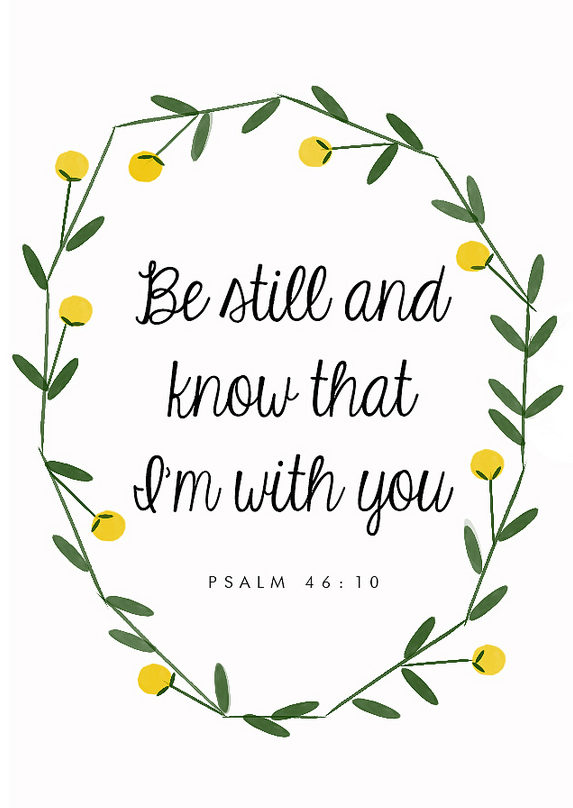
    “Be still, and know that I am God; I will be exalted among the nations, I will be exalted in the earth.” Psalm 46 (NIV)

    When we face trials of many kinds, often our temptation is to talk. To ask advice of those around us; to process the meaning of the situation before us; to wonder and lament and perhaps complain a bit. We need to feel we are seen and heard.

    Our loving Lord always sees us and hears us. He welcomes us to converse with him and others when we find ourselves in tough (and happy) situations. But as we see in the psalm we are reading today, at times God also tells us to cease on the chattering front and to be still. Biblical commentators believe the “Be still” in verse 10 probably means “Enough!” The Lord will speak and we must listen.

    For the Lord is God and we are not. He made us and formed us, and has the power to still the marauding nations and to make the wars to cease. He can and does intervene in our lives, supremely through his Word, Jesus Christ, coming to earth to bear our sins. And through his Holy Spirit, who lives in and through us, bringing us comfort, healing, affirmation, and love.

    The next time you face a trial, why not stop and be still? Wait on the Lord, putting your hand on your heart as you acknowledge that Another lives inside you. As you ask for peace to flow like a river, know that the Lord is your refuge and strength, the One who is ever-present and who will never leave you. As you wait in the silence, open your heart and mind to hear the gentle words the Holy Spirit may impart to you. You might want to jot them down, so that you can chew them over and test them out.

    Lord, when it feels the mountains are shifting around me, I need your reassurance that all will be well. Send me, I pray, the peace that passes all understanding. Amen.


  • Weekly Devotional: Right Paths (4 in Sabbath and Rest series)

    A lovely local path for me is next to a brook. An oasis of peace in a suburban area.

    He guides me along the right paths for his name’s sake. Psalm 23 (NIV)

    Have you noticed that sometimes we put a huge amount of effort and energy into a project, but it never moves past the planning stage? While other times something just barrels into existence, without much of our insight or care? A Christian writer friend noted this principle as she reviewed the past year. Seven projects that she had cultivated had all fallen flat, but three were birthed without much advocacy from her.

    I thought about this Christian writer as I read through Psalm 23 recently, for I realized that God’s guiding us along the right paths can mean that we spin fewer plates. If we trust him and his word, including his admonition to take a Sabbath rest, we trust that he’ll lead us the right way for the other six days, whether through our paid employment, volunteer work, caring for children or grandchildren or loving our neighbors.

    Another Christian writer friend faces a change in her working circumstances as one of her regular sources of income comes to an end. Can she trust the Lord to lead her by the quiet waters as she considers the way forward, knowing that the true refreshment to her soul lies only in him? And that he will be faithful and will lead her to the right projects for his glory and praise – and her well-being?

    We all face the challenge of which words we’ll believe – the quiet whisper of the Good Shepherd as he beckons us to follow him, or the fear that can bubble up in our soul, or the skeptical views that colleagues or family members might cast our way when we announce our purposes and plans. May we hear and heed the still, small voice today.

    Prayer: Lord Jesus Christ, I want to believe that you will lead and guide me, but sometimes I struggle. Give me faith and help me to believe. Amen.

  • Weekly Devotional: Rule Number Four (3 in Sabbath and Rest series)

    Remember the Sabbath day by keeping it holy. Six days you shall labor and do all your work, but the seventh day is a sabbath to the Lord your God. Exodus 20:8–11 (NIV)

    God gave Moses the law as his best plan for his people – not only to bring himself glory, but for the good of his children. That is, he designed his commandments for our benefit. After the first three commands to honor the Lord God above all else, he moves to the fourth – to keep the Sabbath holy.

    The Lord here writes in stone the principle that he has embodied from right back at creation – that six days are for work (work being good and coming before the fall of humanity), and the seventh day for rest. He rested, and he wants his people to follow his lead. He wants them to remember his deeds and set apart the day as holy.

    The fourth commandment sheds more light on the Sabbath principle, designating that all observe it – daughters and sons, servants and free, citizens and foreigners. To take the day off requires preparation, just as the people in the desert had to gather extra manna on the day before. The Lord wants his people to learn how to plan ahead, so that later they can reap the rewards.

    In the West, we’ve largely lost the culture of keeping Sunday special. Shops are open, enticing us to browse and buy, and children’s activities encroach more and more, meaning that parents have to decide between, say, their child going to a birthday party or attending church. To observe the day – to fill it with soul-feeding activities – requires us to stand against the cultural winds. We might need to find a creative approach to celebrating Sabbath, including taking off a day other than Sunday (which is especially true for those who work on a Sunday, such as ministers or health-care professionals).

    How can you plan for this week’s Sabbath?

    Prayer: Lord God, help me to understand how you designed this command from so many years ago for my flourishing. Amen.

  • Weekly Devotional: Bread from Heaven (2 in Sabbath and Rest series)

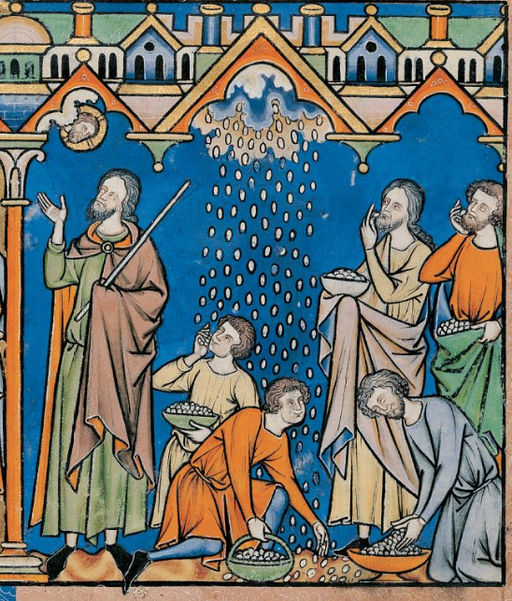
    Manna reigning from heaven on the Israelites, circa 1250, Maciejowski Bible

    “Bear in mind that the Lord has given you the Sabbath; that is why on the sixth day he gives you bread for two days.” Exodus 16:1–30 (NIV)

    The Lord God rescued his people from slavery in Egypt with dramatic measures as he sent down the plagues on the hard-hearted Pharaoh and he parted the Red Sea for the Israelites to escape the Egyptian army. But the people of God had a short memory, for as they wandered in the desert, fueled by hunger, they began to despair, saying, “Oh, if only we had stayed in Egypt.”

    The Lord, not tiring of their complaints, devises a solution – he sends quails and sweet-tasting bread from heaven to feed them. Their only work is to gather the riches set before them, enough daily bread for the day. And for the celebration of the Sabbath, the Lord instructs them to gather on the sixth day enough for two days.

    We see in the Lord’s provision and instruction his love for his people. Not only is he establishing a seven-day week (some biblical commentators believe the Egyptians held to a ten-day week), but he provides a day of rest for all classes of society – including the servants and slaves. He knows their limitations and provide them with a way of living that will help them to thrive. But do they listen? No – some gather too much during the week, and the bread turns moldy. Others go out on the seventh day, looking for food but not finding any.

    How are we like the Israelites? Do we understand how God gives us not only bread to eat but meat to feast on? Do we stop and rest, acknowledging that he is God and we are not? May today we ask Jesus, the living bread, to fill us with his sustenance and help us order our lives according to God’s wisdom and plans.

    For reflection: Read through the story again, this time imagining you are a slave girl in the story. How does the shift in perspective shed light on the narrative?


  • Weekly Devotional: God Rested (1 in Sabbath and Rest series)

    Time for a new devotional series! I unintentionally took most of the Easter season off from posting – I think with my work on my MA studies along with the usual deadlines and lovely family life, I’ve been exerting more than I realized. I have about three more months of intensive work on the MA, and then – Lord willin’ and the creek don’t rise – I’ll be done.

    It seems fitting on many levels, not least for my own personal season, to explore the theme of Sabbath and rest. It can be a forgotten or overlooked command, but God wants us to switch off for our own good. Join me for this week’s introduction and first engagement with Scripture.
    “Come to me, all you who are weary and burdened, and I will give you rest. Take my yoke upon you and learn from me, for I am gentle and humble in heart, and you will find rest for your souls. For my yoke is easy and my burden is light” (Matthew 11:28–30). So says Jesus, our friend and our example, the One who not only redeems us but gives us life.

    After the fall of humanity in the Garden of Eden, sin and disease came into our world. Now we find it hard to rest, forever tempted by the distractions of our devices, the pain of unfulfilled hopes and dreams, the physical ailments that plague us. We wake too early in the morning, longing for sweet sleep, or find we can’t switch off our minds at night. We need the rest Jesus promises.

    Part of achieving this rest flows out of our own planning and preparation as we approach the Sabbath. During this series over the next months, we’ll see how God created the Sabbath as a gift to us, as a means of giving us a rhythm of work and rest, for he knows we are his fragile human creation. As we set aside as holy one day for worship of the Lord and the enjoyment of his gifts and people, we begin to realize just how we need this time to renew and recharge. We are not machines that can keep on running; we need to stop and acknowledge our smallness in comparison with his greatness. He is God and we are not.

    And as with Jesus’ words above, as we accept God’s command to rest, we see that it’s a gentle yoke and a light burden. The benefits are great as we learn to feast and switch off and enjoy true recreation – that is, the renewal of our souls and minds and bodies. We see rest as a life-giving gift.

    I pray your love of the Sabbath will increase ever more as we engage together in a journey through God’s word, seeing how he created us and formed us, and how much he loves and adores us. May this pattern of living be one that gives you life.

    Then God blessed the seventh day and made it holy, because on it he rested from all the work of creating that he had done. Genesis 1—2:1–3 (NIV)

    Many of us associate the word Sabbath with a killjoy list of restrictions: no shopping, no work, no, no, no. But what if we saw the Sabbath as a thing of joy as we imitate our Creator and find rest for our bodies, minds and souls?

    Reading the creation account may sound all-too-familiar, but as you do so today, think about the story from God’s point of view – well, as much as you can, being his created one. God, in the beginning, forms the heavens and the earth. Then the light and dark; the skies and the earth and waters and dry land; the plants and vegetation; the sun and the moon and the stars, the living creatures, the livestock. And he sees that it is good. Then he makes humanity in his image, giving them authority over the earth and animals, and he sees that it is very good.

    As this story reveals, being the Creator is part of God’s nature; it flows in and out of him. And we are the pinnacle of his creation, formed in his image, called to create and collaborate with him. We are to rule over all the creatures, whether in the air, sea or land, and to cultivate the vegetation for food.

    Made in God’s image, bearing his mandate, we are also called to rest as he rested. Had Adam and Eve not disobeyed the Lord in the Garden of Eden, I’m guessing our ability and desire to rest would come naturally. But with the consequences of the fall of humanity, we live in an imperfect world. And now we can struggle to switch off and find true Sabbath rest. May we, with the help of the Holy Spirit, find a spacious place to rest today.

    Prayer: Creator God, you have made me in your image. Help me to reclaim the ability to find your peace and release as I rest in your love. Amen.
  • Weekly Devotional: Spurring on to hope (14 in Hope and Trust in God series)

    Let us hold unswervingly to the hope we profess, for he who promised is faithful. And let us consider how we may spur one another on toward love and good deeds… Hebrews 10:19–25

    Tenacity. Holding unswervingly. My children can both display tenacity and commitment. My daughter can get lost in her world of imaginative play, creating worlds and relationships for long swathes of time. Similarly, give my son a football game and he’s happy to commit his focus and attention. But sometimes my Sweetie Pyes remain unswervingly committed to a bad attitude or thinking that they’ll never be able to achieve a certain longed-for goal.

    Yes, I too can convince myself that someone will never change or that a certain situation is hopeless. I might stew, descending into a mire of mud and sludge. To get free I have to look up and out to God, asking him to send me a life-belt and haul me out while pouring over his cleansing, living water to wash away my dirt and gunk. As he sprinkles me clean, he reminds me of the hope to which I should hold unswervingly. The hope that is the message of the gospel, namely release from our sins by the work of Jesus on the cross.

    When our eyes are no longer aiming down, we can lose ourselves in worshiping the triune God or in serving others. Indeed, as the writer to the Hebrews exhorts his recipients, may we not give up encouraging each other in these last days. We need on another, for when one person wavers in unbelief, another can come alongside and spur her on to faith and hope. Sometimes a listening ear is needed, or perhaps practical support such as running errands or washing up the dishes. Or maybe what is most needed is the promise of prayer.

    May we too hold unswervingly to our hope that will never fail us. For our hope is personified in the person of Jesus.

    To reflect: Who could you encourage today? How could you show them love and good deeds?

  • Weekly Devotional: The power of prayer (13 in Hope and Trust in God series)

    The Father’s hands, by Beverley

    On him we have set our hope that he will continue to deliver us, as you help us by your prayers. Then many will give thanks on our behalf for the gracious favor granted us in answer to the prayers of many. 2 Corinthians 1:8–11

    Again we look at hope; again we look at suffering. In the New Testament, Paul writes about these interlinked topics the most. And here he emphasizes the importance of prayer.

    A couple of years ago my husband and I experienced the fear that is borne of one’s child being ill. Our son, who had gone to sleep without complaint, was barely able to breathe at midnight. As we wondered what was wrong, we made the necessary calls and almost reflexively gave our son over to God’s care. We waited for the emergency medics and I prayed over my son with words from deep within – while trying not to frighten him further. Soon help arrived and he was breathing oxygen and feeling better. A middle-of-the-night trip to the hospital was necessary, but the crisis passed with a diagnosis of croup and tonsillitis. He will recover, praise God.

    My suffering was short-lived but intense, as fleetingly I wondered how I would cope if my son ceased to breathe. But I knew I had to put those thoughts aside and turn to prayer. Similarly, Paul, through speaking of his experiences, exhorts the believers at Corinth not to give up as they suffered but to pray. Again Paul is not downplaying suffering, but shows how through it we can increasingly rely on God instead of ourselves. And he emphasizes how God lovingly answers prayer.

    As we see God move in our lives, we build our faith on his solid foundation. In this instance, our son soon was well – praise God. But if God had allowed him to die, I pray we too would not have despaired unto death but somehow held onto our sure hope of heaven. I pray you and I will be spared such heartbreaking trials, by God’s mercy.

    Prayer: Lord, we remember the many children in many lands of the world who are suffering today and have no access to medical care. Lord, have mercy.

  • Weekly Devotional: Welcoming from afar (12 in Hope and Trust in God series)

    Hope embodied in the new life at Springtime…

    For in this hope we were saved. But hope that is seen is no hope at all. Who hopes for what they already have? But if we hope for what we do not yet have, we wait for it patiently. Romans 8:18–27

    I have an amazing friend whose husband works in the oil industry. When he got a job in Dubai some years ago, she moved to a country she had never before visited. She trusted and believed that this was right. And it has been, for their sons have experienced the riches and challenges of a country far different from that of their parents. Then after some six years their time in the Middle East ended, and again they moved to a city she and the boys had never visited, this time Houston in Texas.

    My friend reminds me of this passage from Romans, as well as Hebrews 11 with its list of the heroes of faith who welcomed from a distance the things they were promised. They couldn’t see what they hoped for, but they kept believing. Their hope was not a vague thing, such as “I hope my team will win.” Rather it referred to something solid, as we saw last week – something on which to build our lives.

    Paul here speaks again of the suffering we will endure on earth. Yet because we have God’s Spirit living in us, as a deposit, we have this solid hope. Hope for things to come – our redemption, and the redemption of the world. Hope that helps us to endure and wait patiently for God to come good on his promises.

    Living in the light of the hope of heaven can infuse our lives with joy in the midst of trials. For as Jesus said to his disciples, “In this world you will have trouble. But take heart! I have overcome the world” (John 16:33). And though we suffer, even the finality of death is tempered by the forthcoming grand reunion at the wedding supper of the Lamb (Revelation 19:9).

    Prayer: Lord Jesus Christ, make me into a person of hope, who believes that you will do what you promise.

  • Weekly Devotional: Beacons of hope (11 in Hope and Trust in God series)

    Photo: Phil Warren, flickr

    We also glory in our sufferings, because we know that suffering produces perseverance; perseverance, character; and character, hope. And hope does not put us to shame, because God’s love has been poured out into our hearts through the Holy Spirit, who has been given to us. Romans 5:1–5

    This passage from Paul’s letter to the Romans reminds me of the old hymn, “My hope is built on nothing less than Jesus’ blood and righteousness.” For it is through the death of Jesus on the cross that we base our hope of redemption, grace, and life everlasting. As Paul says, through Jesus we gain access to the grace on which we stand.

    But after affirming the tenets of our faith, Paul turns suddenly to the subject of suffering. It can seem jarring, but Paul knows that we live in a world that is not as God made it to be. Thus he tells the Romans that even as they hope and look to the coming kingdom of God, they must expect suffering. And that through their suffering they will gain the Christ-like attributes of perseverance, character, and hope. As the Holy Spirit fills their hearts, they will have the strength to make it through their suffering, whether it be persecution, pain, mistreatment, or other.

    Suffering is not something we welcome, and perseverance is a trait we’d rather God simply gave us as a gift, instead of something we develop over time. But our character is formed day in and day out: through the sometimes hard conversations with family members; through how we treat the person at work we find particularly grating; through learning to give of ourselves selflessly, even when it’s not convenient; through holding back on flinging hurtful words to those near us. With the Holy Spirit living in us and empowering us, we can increasingly bring glory to God and peace to those whom we meet. As we do so, we will become beacons of hope – perhaps while not realizing just how much God’s light is shining through us.

    Prayer: Lord, help us as we suffer that we might persevere. Fill us with your Spirit that we might rest in hope.

  • Weekly Devotional: Holding onto God (10 in Hope and Trust in God series)

    Against all hope, Abraham in hope believed and so became the father of many nations, just as it had been said to him, “So shall your offspring be.” Romans 4:18–25

    Abraham and Sarah are two of my favorite characters in the Bible, partly because of what they experienced and felt. For instance, they faced the heartbreak of infertility for years before God promised Abraham that he’d be the father of many nations. Abraham’s biggest point of need – his desire for a son – was right where God met him. And not only met, but exceeded with mind-blowing abundance, for he promised that Abraham would have more descendants than the stars in the sky.

    Abraham held on to God’s promise, even when it seemed impossible. In terms of him and Sarah conceiving a son, he believed God even though Sarah was long past her childbearing years. And God delivered; they had Isaac. Then Abraham held on to God’s promises through the heart-wrenching experience of being asked to sacrifice his beloved only son. Abraham knew that God would find a way to keep his promise, perhaps through the resurrection of the dead. For God had never failed him. And indeed, an angel of the Lord provided a ram in the place of Isaac.

    Such hope and faith is modeled through a life of listening to and obeying God. As we mature in our faith, we learn to relinquish the requests that may not be of God or may not be for our best. We can ask God to change our hearts to align our desires with his. And our faith will grow as we look back and see how God has answered our prayers. I love reading through my old prayer journals, not only because they immediately and vividly transport me to times past, but because they reveal how faithful and loving is our God.

    How might you be persuaded that God has the power to do what he has promised?

    For reflection: “By faith Abraham, when called to go to a place he would later receive as his inheritance, obeyed and went, even though he did not know where he was going” (Hebrews 11:8).