For there is no difference between Jew and Gentile – the same Lord is Lord of all and richly blesses all who call on him, for, “Everyone who calls on the name of the Lord will be saved.” Romans 10.1–17 (NIV)
I wonder how Paul felt when he came against his people’s unbelief of Jesus as the Messiah. He could understand their reluctance – after all, he had been united with them in disbelief previously – and yet now that he knows the riches of Jesus as the Savior he must yearn for them to understand and believe. He writes to the predominately Gentile church, which had Jewish believers too, to remind them that all are one in Christ. There is no dividing wall; no division between them any longer (see Ephesians 2:14). As he says in the letter to the church at Colossae, “Here there is no Gentile or Jew, circumcised or uncircumcised, barbarian, Scythian, slave or free, but Christ is all, and is in all” (Colossians 3:11).
Today in the body of Christ we don’t have the divisions of Jew or Gentile, but we face different issues that divide. For instance, as an American living in Britain, I often am flummoxed when I come across statements of class divisions in society or even in the church. They stand out to me as foreign, and I find them difficult and sad. Whereas in America, many people point out the problems of racial disunity as a sort of besetting sin. Whether we are influenced by class or race or another issue in the country in which we live, we can work together for unity as we cling to Paul’s words that the “same Lord is Lord of all” (v. 12).
How could Christ working through you help you to dismantle
any dividing walls in your church or community?
For reflection: “Therefore, as God’s chosen people, holy and dearly loved, clothe yourselves with compassion, kindness, humility, gentleness and patience… And over all these virtues put on love, which binds them all together in perfect unity” (Colossians 3:12, 14).
For we know that our old self was crucified with him so that the body ruled by sin might be done away with, that we should no longer be slaves to sin – because anyone who has died has been set free from sin. Romans 6:1–23 (NIV)
The apostle Paul speaks often in his letters about the old
self and the new self, as we see here in Romans. It’s not surprising, for his
conversion was so radical – one day he was persecuting the new church to the
point of death, and the next he was blinded while traveling to Damascus as he
encountered the risen Jesus. He turned from a murderous antagonist to the
gospel to one of its biggest proponents.
Paul tells the Roman church that no longer do they need to
be slaves to their old life of sin, but now, empowered by the Holy Spirit, they
can live out of the new self. No longer do they have to be at the mercy of sin
and wickedness, for they live united with the resurrected Jesus.
We might read this and lose heart, thinking that we never
will win the battle with the besetting sin we face, whatever it may be. But God
transforms our character day by day as we seek to live for him, and often we may
not even be aware of the subtle changes that are happening within us. For
example, I remember years ago in my weekly small group when we each named how we
noticed God working in and through the members of the group. I was surprised and
heartened to hear some of the lovely things people said about everyone.
We can be encouraged to know that no longer are we tied to
the things of sin, but that Jesus dwelling within us makes all things new. We
who have been baptized into Christ Jesus live a new life.
For reflection: “You were taught … to put off your old self … to be made new in the attitude of your minds; and to put on the new self, created to be like God in true righteousness” (Ephesians 4:22–24, abridged).
Therefore, since we have been justified through faith, we have peace with God through our Lord Jesus Christ, through whom we have gained access by faith into this grace in which we now stand. And we boast in the hope of the glory of God. Romans 5:1–11 (NIV)
“Therefore.” Paul uses this word in his letters to signify a
change or a climax or a conclusion. Here in the letter to the Romans, he uses
it to signal that he’s moving from his discussion of how people find redemption
through Jesus to the benefits of living as those who are transformed and
redeemed. We who have “peace with God” now can “boast in the hope” of God’s
glory – our salvation is assured and we are free to embrace life empowered by
God’s Spirit living within us. No longer do we need to be shackled to the ways
of sin. And all of this through Christ’s death – he who died not only for good
people, but for the ungodly.
We hold onto the hope of glory, which helps us when we
suffer and things go wrong. Because we live in a fallen world which is not as
God intended it, we experience pain and the death of loved ones and disease and
betrayal and so on. The Lord redeems our pain, and through our suffering we
learn to persevere, our character is strengthened, and we find hope that does
not disappoint.
And yet sometimes some Christians seem to put such a
positive spin on suffering or pain that they almost seem to welcome it. Yet how
can we rejoice in cancer or heartache or any of the horrible things we
experience and witness on a regular basis? I believe the Lord doesn’t send these things to us, but when they
happen in this fallen world, he’s right there with us, holding us and helping
us.
Today, know the assurance of the Lord that he will never leave you and that through Jesus’ sacrifice you are his redeemed one whom he loves.
For reflection: “Even though I walk through the darkest valley,I will fear no evil, for you are with me; your rod and your staff, they comfort me” (Psalm 23:4).
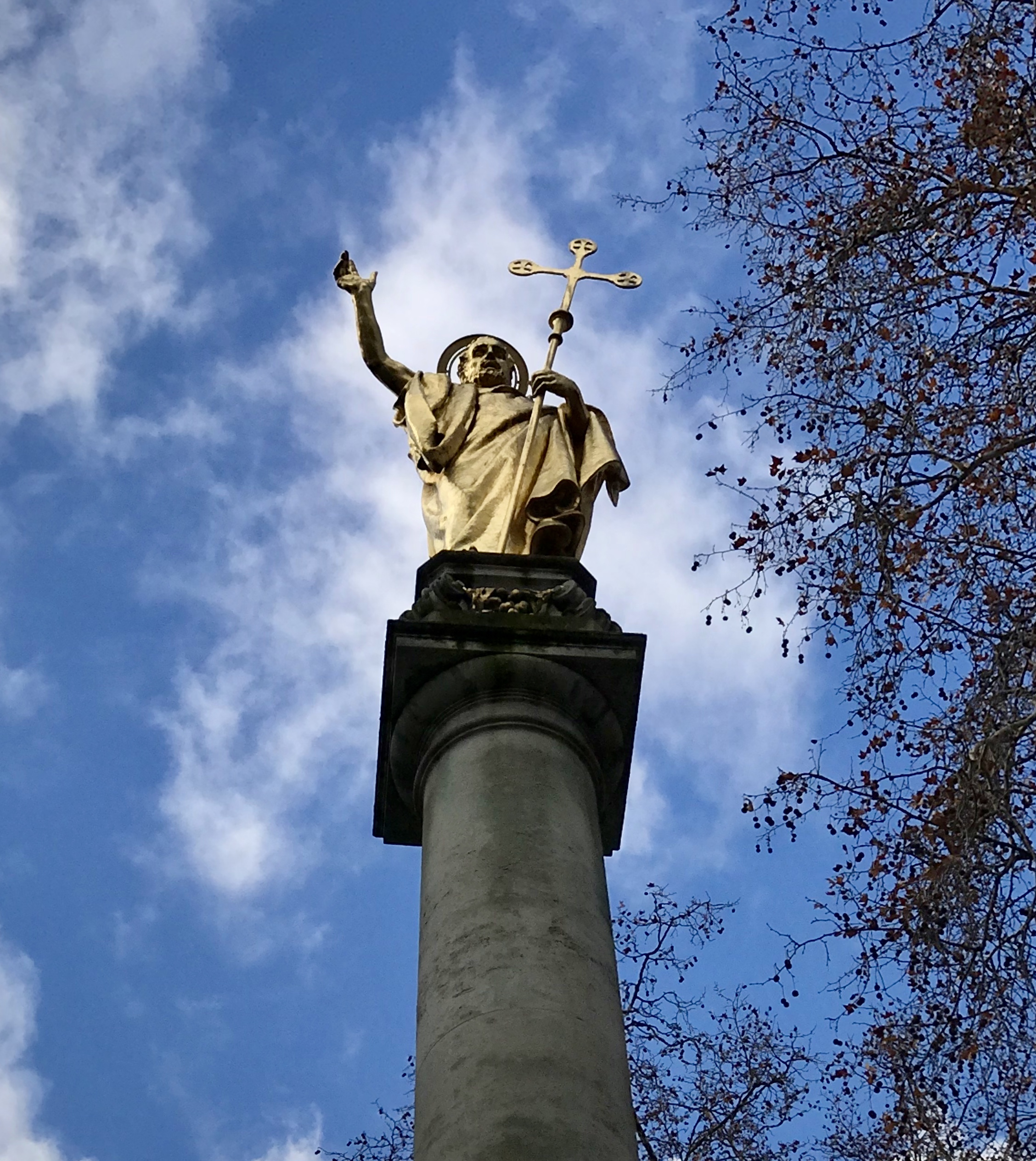
A statue of St Paul at the cathedral in London bearing his name.
This righteousness is given through faith in Jesus Christ to all who believe. There is no difference between Jew and Gentile, for all have sinned and fall short of the glory of God, and all are justified freely by his grace through the redemption that came by Christ Jesus. Romans 3:21–31 (NIV)
In the sixteenth century, Martin Luther read the book of
Romans again and again in his quest to understand God’s grace and the role of
our works in the role of our redemption. In the margin of his Bible he wrote that
this passage was “the chief point, and the very central place of the Epistle,
and of the whole Bible.” We might disagree that this section is the very most
important part of the Bible, but I think we can agree that from it we can learn
so much.
We encounter here the central themes of God’s plan of
salvation (and do read the full section if you have time) – that God sees us as
righteous through Jesus Christ, that we all have sinned and done wrong, that
Jesus atones for this wrongdoing through his blood shed on the cross. To use
more technical language, we are justified by faith in Jesus. That simply means
we have been set free from the consequences of our sin – in the kingdom of God
on earth and in heaven.
The gospel is a wonderful leveler, for as Paul says we all fall short of God’s glory – we all
need Jesus to save us. We cannot think ourselves superior to our family or neighbors,
for we know that our hearts can lead us to temptation and sin just as much as
the person we see caught in a cycle of destruction. We’re led not to pride but
to thanksgiving for the amazing way God sets us free – and we want to share
this good news with others.
Read through the passage again if you can, and try to put it into your own words. Maybe you’ll encounter someone today who needs to hear of God’s love for them.
Prayer: Lord Jesus Christ, I think about your sacrifice of love and mercy on the cross and I am profoundly grateful. May your love mark my going-out and coming-in this day.
Whatever the law says, it says to those who are under the law… Therefore no one will be declared righteous in God’s sight by the works of the law; rather, through the law we become conscious of our sin. Romans 3:9–20 (NIV)
As we saw last week, Paul writes to the Jewish and Gentile Christians in Rome with his radical message of God’s saving plan. No matter what our racial heritage, we all fall under the curse of sin. As Paul says, God’s law reveals our sinful hearts and actions, and we don’t find freedom and grace through observing the law. Rather it shows us how we fall short of God and his standards – and thus how we need a Savior.
We so-called New Testament Christians can misunderstand God’s law, thinking of it as commandments and strictures that the Lord gave in the Old Testament to keep his people in line. But God’s people saw it as a source of life and joy and hope, for through it they found guidance for living life to the full. As the Psalmist cried out, “Oh, how I love your law! I meditate on it all day long” (Psalm 119:97).
I made this mistake when I was writing my BRF Lent book The Living Cross, and was gently corrected by the wonderful writer Michele Guinness, who combines her Jewish roots with her vibrant Christian faith. She showed me how Jesus relieves us from the curse of our sin, not from the law. After all, in Jesus’ greatest commandment, he quotes from the law that God’s people love the Lord with all of their heart, soul and strength (see Mark 12:29–30, in which Jesus references Deuteronomy 6:4–5).
I’m grateful for Michele elucidating this for me, for I’m
reminded that the depth of God’s wisdom is so great that we will keep discovering
it to be a well of living water that cleanses and fortifies us. The law brings
life!
Prayer: Father God, your words help us to walk in your way, and your Spirit leads us into all truth. Show me today how I can follow your life-giving law, that I might be your ambassador of love and peace.
Image from page 40 of “The Epistle of Paul the Apostle to the Romans : with notes, comments, maps, and illustrations ..” (1888). Found on Flickr.
Many Christian figures in history named Romans as their
favorite book of the Bible. For instance, John Stott tells in his commentary
that the great reformer Martin Luther said of Romans that not only “should
every Christian know it word for word, by heart,” but that they should occupy
themselves with it “every day, as the daily bread of the soul.” William
Tyndale, a translator of the Bible, also urged his readers to learn it by heart,
for “the more it is studied, the easier it is; the more it is chewed, the
pleasanter it is.” Others who were affected by reading it were Augustine of
Hippo and John Wesley. (As cited in John Stott, The Message of Romans, IVP, 1994, pp. 19–22.)
Romans has been so important over the centuries because of
the deep and rich theological truths about salvation and sin that Paul shares
in it. And not only that, but the latter part of his letter contains practical
instructions on how to live. We can find much to stretch and encourage us as we
read what the apostle wrote to the church in Rome.
Paul had never visited this church, but heard of the
divisions in it, especially among the Jewish and Gentile believers that formed
it. He desired that they would find unity across their differences, and that
mutual respect and love would mark their lives. After all, they were all sinners in need of Jesus’ grace and
redemption. And they were all one in Christ.
When you read, keep in mind that Paul’s letter is half of
the story. We don’t hear the other side of the conversation – the issues that
he was addressing in the church there in Rome – but we can made an educated
guess. And although he wrote this letter such a long time ago to this
particular context and place, yet we can find God’s truth in it speaking to us
and to our situation.
The wrath of God is being revealed from heaven against all the godlessness and wickedness of people, who suppress the truth by their wickedness, since what may be known about God is plain to them, because God has made it plain to them (Romans 1:16–32 NIV).
The wrath of God – not a very cheery way to open up our set
of readings on Romans, now is it? As modern people, we often shy away from
speaking of God’s wrath, for it feels so hard and final, especially for us who
live in a relativistic society that rails against judgement and black-and-white
truth. But Paul doesn’t hesitate to name the major problem at the heart of the
human condition – we’re all sinners who need God’s redeeming love and grace (as
we will see in Romans 3:23: “for all
have sinned and fall short of the glory of God”). So although this passage can
make for uncomfortable reading, we also can find hope in it, for it names the
truth of what we know through our actions – we fail God and others and need the
Lord’s grace and help.
Paul in this passage explores what happens when people rebel
against God and his laws. When they follow their own desires and refuse to bow
the knee to their Maker, their minds and hearts become darkened and they become
fools (vv. 21–22). No longer are they infused with God’s wisdom and
understanding. As the Lord gives them over to their lusts, they become
imprisoned by these wrongful desires and become filled with wickedness and
evil, as we see in the list in verses 29–30: “envy, murder, strife, deceit and
malice. They are gossips, slanderers, God-haters, insolent, arrogant and
boastful…”
But we can escape the consequences of our sinful actions through Jesus’ sacrificial act on the cross. No longer are we defined as gossips or boasters, but as God’s redeemed who are filled with his Holy Spirit as they spread his love and grace. Thanks be to God!
For reflection: “My hope is built on nothing less, than Jesus’ blood and righteousness. I dare not trust the sweetest frame, but wholly lean on Jesus’ name” (Edward Mote, 1797–1874).
I should have posted this final devotional in the 1 and 2 Timothy series long ago! Odd to be doing so at the beginning of January, when it’s time for a fresh start, but life can be like that, can’t it. Sometimes we have to finish off the old things before we can embrace the new. Happy new year!
For I am already being poured out like a drink offering, and the time for my departure is near. I have fought the good fight, I have finished the race, I have kept the faith. Now there is in store for me the crown of righteousness, which the Lord, the righteous Judge, will award to me on that day – and not only to me, but also to all who have longed for his appearing (2 Timothy 4:6–8).
When one of my mentors died, I saw it as a severe mercy.
Never filled with glowing good health, and longing for heaven, she felt she had
come to the end of her earthly life. She had completed her mission – having
passed over her Christian organization to other gifted people – and was ready
to die. I imagine she could have echoed with Paul about having been “poured out
like a drink offering” as the time for her departure grew near.
When he was writing this letter, Paul must have known that
he wouldn’t escape imprisonment and that he would soon be executed. He again
employs the language of an athlete as he says he’s finished the race and fought
the good fight, and that soon he will receive the crown of righteousness. He
seems content even though his earthly life is drawing to a close.
As we conclude our fortnight with Paul, with him writing
right before his death, consider how in our culture we often do all that we can
to avoid thinking about dying – including employing such terms as someone has “passed
away” or “gone to be with Jesus.” We may feel ambivalent about dying, or would
be sad to not fulfil our dreams if we were to die soon. But we can ask the Lord
for peace and reassurance, and that like Paul, we’ll one day be able to echo
that we’ve run the good race and finished our mission. May it be so.
For reflection: “The Spirit and the bride say, ‘Come!’ And let the one who hears say, ‘Come!’ Let the one who is thirsty come; and let the one who wishes take the free gift of the water of life” (Revelation 22:17).
You can find the rest of this series on 1 and 2 Timothy here.
In the presence of God and of Christ Jesus, who will judge the living and the dead, and in view of his appearing and his kingdom, I give you this charge: Preach the word; be prepared in season and out of season; correct, rebuke and encourage – with great patience and careful instruction. For the time will come when people will not put up with sound doctrine. Instead, to suit their own desires, they will gather round them a great number of teachers to say what their itching ears want to hear. They will turn their ears away from the truth and turn aside to myths. But you, keep your head in all situations, endure hardship, do the work of an evangelist, discharge all the duties of your ministry (2 Timothy 4:1–5).
As we come to the end of Paul’s letter, he lays out his final commands to Timothy, underlining their importance as he calls upon the Father and Son as his witnesses. His exhortations reflect his understanding that Timothy in his ministry will again encounter false teaching – he is to preach, be prepared, correct, rebuke, encourage. As we saw earlier, Timothy should do this with love – with great patience.
“Keep your head,” Paul says. A simple charge, but one we all should heed, for when we lose our cool, we can descend into words we shouldn’t speak and actions we should avoid. Anger can turn into bitterness and rage as we lose our self-control, which can quickly negate our good work of sharing the gospel. I think with shame of the times when I have lost my cool.
Instead, taking Paul’s advice, we can be prepared “in season and out,” training ourselves with the help of the Holy Spirit to exercise self-control in times of ease and abundance, so that later in moments or seasons of stress and hardship, our character reflects Christ.
My prayer is that we would be given great patience, and great love.
Lord God, may our teachers bring you glory with sound teaching, winsome words and a deep reservoir of patience, and may we love to learn.
But as for you, continue in what you have learned and have become convinced of, because you know those from whom you learned it, and how from infancy you have known the Holy Scriptures, which are able to make you wise for salvation through faith in Christ Jesus. All Scripture is God-breathed and is useful for teaching, rebuking, correcting and training in righteousness, so that the servant of God may be thoroughly equipped for every good work (2 Timothy 3:14–17).
Many Christians memorize 2 Timothy 3:17, and I can understand why, for it’s the strongest statement about the Bible made in the Bible. But reading this statement on its own, out of the context of Paul’s letters to Timothy, dilutes its impact. As we’ve spent many a week considering these missives, we can gain a sense of the power of Paul’s view of the Bible – this crescendo at the end of the two letters reveals how he knows its worth and necessity in church life, especially when dealing with false teaching.
We can take comfort and courage knowing that Scripture is “God-breathed” and, as Hebrews 4:12 says, “alive and active. Sharper than any double-edged sword, it penetrates even to dividing soul and spirit, joints and marrow…” With the inspiration of the Holy Spirit, when we read the Bible we can hear God speaking to us: words of love and affirmation; words of conviction and direction. As Paul says, we will find teaching there, and sometimes the sense of being rebuked and corrected; through it we will be prepared and given the tools to do the works of God.
Dallas Willard, a renowned writer on the spiritual disciples, prized the practice of memorizing Scripture, and would regularly commit large passages to memory. He even said if one had to choose between a “quiet time” and memorizing, he’d choose the latter. When we do so, we find God’s word more readily available in our hearts and minds.
May we become wise for salvation through faith in Jesus Christ.
Prayer: Lord Jesus Christ, you are the Word made flesh. May you bring us wisdom as we read the Scriptures that we may serve you and reach out to those in need.
Keep reminding God’s people of these things. Warn them before God against quarreling about words; it is of no value, and only ruins those who listen. Do your best to present yourself to God as one approved, a worker who does not need to be ashamed and who correctly handles the word of truth. Avoid godless chatter, because those who indulge in it will become more and more ungodly. Their teaching will spread like gangrene. Among them are Hymenaeus and Philetus, who have departed from the truth. They say that the resurrection has already taken place, and they destroy the faith of some. Nevertheless, God’s solid foundation stands firm (2 Timothy 2:14–19).
Seemingly without taking a breath, Paul’s tone changes and he’s back to the brisk warnings against false teaching that he made in 1 Timothy and Titus. He may be making his final remarks in this letter, but he reserves the right to warn Timothy against the distractions which idol talk and endless controversies can “spread like gangrene,” in his memorable image. And although God’s truth is the solid foundation never to be worn down by rust or mold – or eaten away by gangrene – those in church leadership can become infected, with their focus diverted from the teaching, preaching and serving that should occupy them. Paul yearns that Timothy, and those who follow after him, would be saved from those trials.
I’ve heard stories about, and have witnessed, church conflict, including “godless chatter” and quarrels over words. Soon the arguments seem to descend into character assassinations, with those on opposite sides leaving behind the language of love as they slaughter each other with words. How the Holy Spirit must grieve at the splits and division.
Consider taking a few moments to review in your mind and heart, and before God, any conflicts at church you’ve been involved in. May we echo King David, who said how good and pleasant it is when people dwell together in unity (Psalm 133:1).
Prayer: Lord Jesus, you became man and died that we might find you and friendship with our neighbors. May your grace oil the wheels of communication in our homes, schools, places of work, churches and community meeting places.