Going on from that place, he went into their synagogue, and a man with a shriveled hand was there. Looking for a reason to accuse Jesus, they asked him, “Is it lawful to heal on the Sabbath?” He said to them, “If any of you has a sheep and it falls into a pit on the Sabbath, will you not take hold of it and lift it out? How much more valuable is a human being than a sheep! Therefore it is lawful to do good on the Sabbath.” Then he said to the man, “Stretch out your hand.” So he stretched it out and it was completely restored, just as sound as the other. But the Pharisees went out and plotted how they might kill Jesus. (Matthew 12:9–14)
As we move through Matthew’s gospel during this series on the miracles of Jesus, the clash between the Pharisees and Jesus intensifies. His claims and acts of authority incense the Pharisees. Seeking to trap him, they ask him about healing on the Sabbath and present to him a man with a withered hand. But Jesus again detects their secret thoughts. When he asks about a sheep falling into a pit, he refers to a long debate that the Pharisees were having about what was lawful on the Sabbath.
Jesus shows how he is more concerned with mercy than empty ritual, and with human beings over animals. With one command he tells the man to stretch out his hand. The man had been a pawn of the Pharisees, but Jesus makes all things new.
Of course, the Pharisees aren’t overjoyed. Instead of rejoicing that the man can now use his arm, they plot to kill Jesus. They were probably remembering how God restored Moses’ arm with one command (Exodus 4:6–7), realizing that Jesus with this action was claiming his Messiahship.
Who are we most like in today’s passage? Jesus, blowing preconceptions and healing (and no, I’m not encouraging a Messiah-complex)? The man, argued over and yet restored? Or the experts in the law, who couldn’t overcome their prejudice to see the new work of God?
For reflection: “‘I desire mercy, not sacrifice.’For I have not come to call the righteous, but sinners” (Matthew 9:13).
Jesus went through all the towns and villages, teaching in their synagogues, proclaiming the good news of the kingdom and healing every disease and sickness. When he saw the crowds, he had compassion on them, because they were harassed and helpless, like sheep without a shepherd. Then he said to his disciples, “The harvest is plentiful but the workers are few. Ask the Lord of the harvest, therefore, to send out workers into his harvest field.” (Matthew 9:35–38)
This week in our text we aren’t focusing on one particular miracle, as in past weeks, but rather we’ll look at one of the broad statements about Jesus’ ministry. As we see in Matthew’s gospel, he has come to teach, proclaim, and heal, his ministry fueled by his great compassion on the crowds who clamor to hear him speak and to receive his healing touch. The word in the Greek for compassion indicates a deep feeling in the gut, so strongly does Jesus feel for his people.
Jesus longs to be their shepherd, a common picture in the Old Testament of God to his people. In doing so Jesus will provide protection and sustenance, meeting their voiced and unvoiced needs. He then changes the metaphor to another familiar one from the Hebrew Scriptures, telling his disciples that the harvest is ripe but more workers are needed.
What is our role? One is prayer – “ask the Lord of the harvest.” So often we put prayer low on our list of priorities, sometimes by default due to the busyness of life. But for some amazing and mysterious reason, God wants to hear us cry out to him, and he acts on those prayers. As Lord Alfred Tennyson said, “More things are wrought by prayer than this world dreams of.”
What would intentional prayer look like for you this week? Is someone coming to mind even as you read this, for whom you should pray and perhaps fast? Maybe you could turn on a timer to signal the hours, then pause for a moment and pray for that person. God delights in the cries of his people, however we choose to make them.
For reflection: “Preach the Gospel always, and if necessary, use words.” St. Francis of Assisi
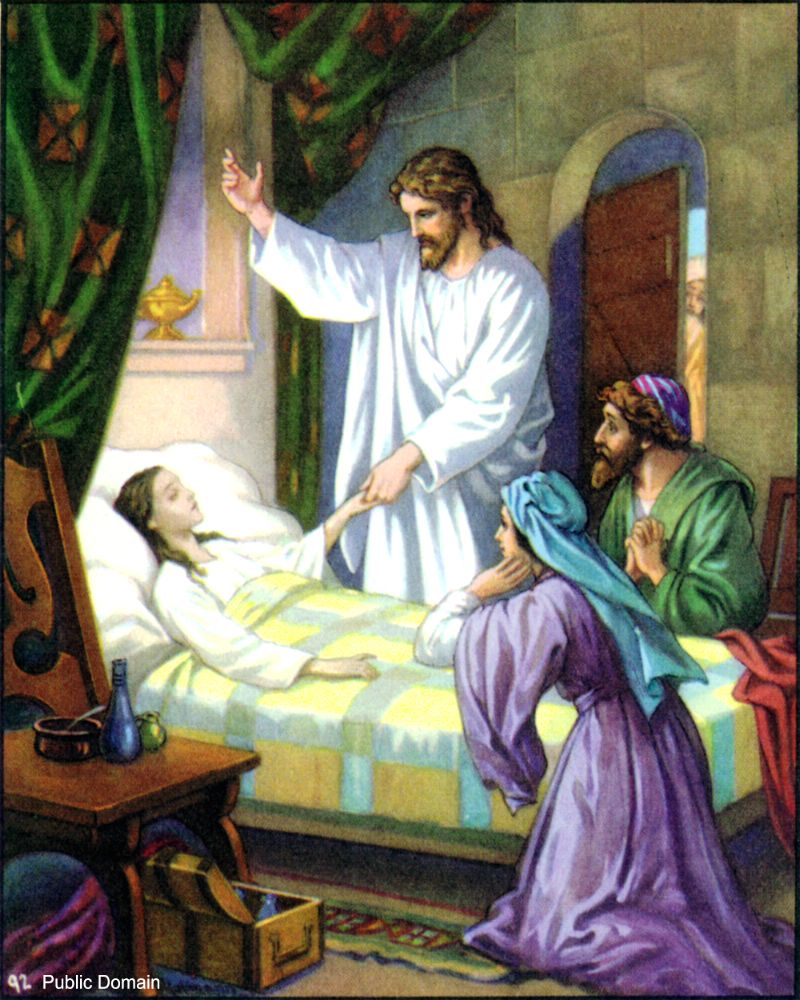
A synagogue leader came and knelt before him and said, “My daughter has just died. But come and put your hand on her, and she will live.” Jesus got up and went with him, and so did his disciples. Just then a woman who had been subject to bleeding for twelve years came up behind him and touched the edge of his cloak. She said to herself, “If I only touch his cloak, I will be healed.” Jesus turned and saw her. “Take heart, daughter,” he said, “your faith has healed you.” And the woman was healed from that moment. When Jesus entered the synagogue leader’s house and saw the noisy crowd and people playing pipes, he said, “Go away. The girl is not dead but asleep.” But they laughed at him. After the crowd had been put outside, he went in and took the girl by the hand, and she got up (Matthew 9:18–25).
Photo: pcstratman on flickr
Utterly desperate, a leader in the synagogue approaches Jesus for help because his daughter has died. Jesus agrees to go to his house, and as they do so a woman touches the hem of Jesus’ cloak, believing that her nonstop bleeding will stop. Jesus responds with compassion: the woman is healed; the girl was only asleep.
Both situations were desperate. Jarius has tried everything but his daughter still died. But he holds out hope that this miracle man can save her. So too the woman who has been bleeding for a dozen years. That’s twelve years of being an outcast from her community, for the bleeding made her unclean. She had tried every type of medical cure available, to no avail.
Jesus has compassion on those at the margins of society. He doesn’t penalize them for coming to him as a last resort but responds quickly and powerfully. His actions signal a new kingdom, one in which grace upon grace is poured on God’s children – all of God’s children, whether women, little girls, the blind or leprous, or the elite of society. May we enter into this grace this day.
Prayer: Lord Jesus, help me to see those who might feel ostracized or lonely, and let me be your agent of love and grace.
Jesus stepped into a boat, crossed over and came to his own town. Some men brought to him a paralyzed man, lying on a mat. When Jesus saw their faith, he said to the man, “Take heart, son; your sins are forgiven.” At this, some of the teachers of the law said to themselves, “This fellow is blaspheming!” Knowing their thoughts, Jesus said, “Why do you entertain evil thoughts in your hearts? Which is easier: to say, “Your sins are forgiven,” or to say, “Get up and walk”? But I want you to know that the Son of Man has authority on earth to forgive sins.” So he said to the paralyzed man, “Get up, take your mat and go home.” Then the man got up and went home. (Matthew 9:1–7)
News of Jesus’ healing was spreading, so concerned friends of a paralyzed man decide to take him to Jesus for healing. Matthew doesn’t tell us about the extraordinary measures the friends took to get the man to Jesus – lowering him through a hole in the roof – for he wants to focus on the conversation between Jesus and the teachers of the law.
Jesus tells the man that his sins are forgiven, and this immediately sets off alarm bells in the scribes and experts in Judaism. Forgiving sins can only be done by God, they know, which is why they accuse Jesus of blasphemy. Jesus, however, knowing their unspoken evil thoughts, responds. He knows that they believe that people won’t be healed unless their sins are forgiven. A way to show them his power as the Son of Man is to heal the paralyzed man – and to forgive his sins.
Receiving forgiveness can bring about healing, sometimes even physical, but that doesn’t mean that people who are struggling with disease or deformity are riddled with unconfessed sin. We’ll only fully be free when we enter the land of no more tears or crying or death. Until then, may we continue to present ourselves to Jesus, confessing our sins and receiving his cleansing forgiveness.
Prayer: Lord Jesus, what friends that man had to care for him so deeply. Show me this day how I can show love to my friends.
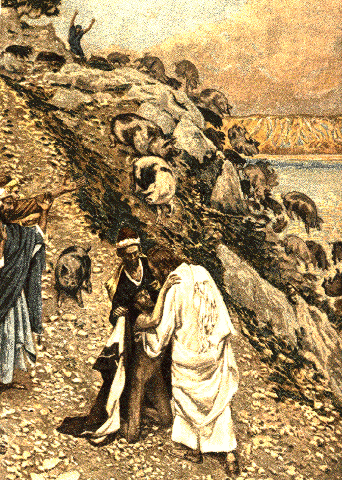
When he arrived at the other side in the region of the Gadarenes, two demon-possessed men coming from the tombs met him. They were so violent that no one could pass that way. “What do you want with us, Son of God?” they shouted. “Have you come here to torture us before the appointed time?” Some distance from them a large herd of pigs was feeding. The demons begged Jesus, “If you drive us out, send us into the herd of pigs.” He said to them, “Go!” So they came out and went into the pigs, and the whole herd rushed down the steep bank into the lake and died in the water. (Matthew 8:28–32)
Sickness, blindness, stormy lakes, and now demons. Jesus and his friends arrive in a Gentile area, which is why a herd of pigs was grazing. Again Matthew cuts out excess details as he points squarely to Jesus’ action of release instead of giving a lot of background information about the possessed men.
The demons knew immediately who they were encountering – the Son of God. They recognized his authority, and pleaded to be released into the pigs (two thousand, according to Mark’s gospel). He tells them to go, and they do so dramatically, sacrificing the pigs in the process. The Jewish people with Jesus wouldn’t have been bothered by this loss, for they so disliked pigs that they would have put them in the same category as the demons. The Gentiles, however, were troubled and asked Jesus to leave. As one commentator says pointedly, “all down the ages the world has been refusing Jesus because it prefers the pigs” (quoted in NIV Application Commentary: Matthew, p. 354).
We can feel bad for the squashed pigs, but if we focus too much on them we’ll miss the point of the story – the authority of the Messiah over demons, and freedom and restoration for troubled men. Also, we can ponder that Jesus allowed the demons to transfer to the pigs because it wasn’t the appointed time. We don’t know why he didn’t eradicate the evil then, but we know that one day he will.
Prayer: Lord Jesus Christ, Son of the living God, have mercy on me, a sinner.
Then he got into the boat and his disciples followed him. Suddenly a furious storm came up on the lake, so that the waves swept over the boat. But Jesus was sleeping. The disciples went and woke him, saying, “Lord, save us! We’re going to drown!” He replied, “You of little faith, why are you so afraid?” Then he got up and rebuked the winds and the waves, and it was completely calm. The men were amazed and asked, “What kind of man is this? Even the winds and the waves obey him!” Matthew 8:23–27
In his account, Matthew shows that Jesus is not only Lord over disease and demons, but over nature too. He is Immanuel, God with us, who rebukes the storm over the seas just as God in the Old Testament made the waters calm – see for instance, Psalm 104:7 (“at your rebuke the waters fled”) or Isaiah 50:2 (“by a mere rebuke I dry up the sea”). At his mere word the seas obey, causing the frightened disciples to wonder just who is in the boat with them. They had witnessed him healing the previously incurable diseases, but they hadn’t reckoned on him controlling nature. Being familiar with the references in the Old Testament mentioned above, they would have realized immediately the weight of Jesus’ actions.
The storm was no ordinary storm. This is hinted at by the Greek word seismos, which usually means an earthquake, or literally, a “shaking” (RT France, Matthew, IVP, 1985, p. 161). A force from outside brought chaos; that is, a squall came upon the lake violently and suddenly. Jesus demonstrates his authority by calming it with a rebuke.
Jesus wants us to believe in his power to still the storms in our lives, whether created from outside or from within. Sometimes they appear suddenly, taking us by surprise and perhaps flattening our faith. As we turn to him in fear or faith, asking him to save us, he brings calm and peace, creating order from disorder.
Prayer: Lord, I confess that when I see the waves leaping at my boat, I react with fear. Come and save me, and increase my faith in your goodness and grace.
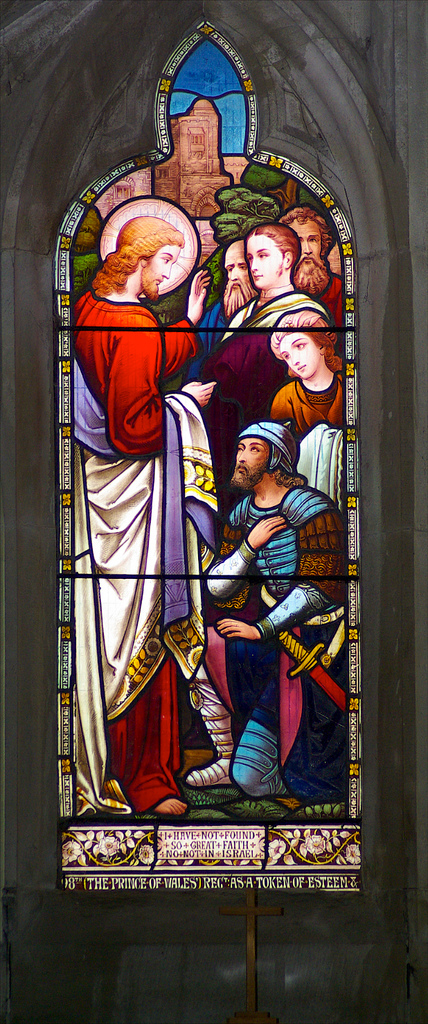
When Jesus had entered Capernaum, a centurion came to him, asking for help. “Lord,” he said, “my servant lies at home paralyzed, suffering terribly.” Jesus said to him, “Shall I come and heal him? The centurion replied, “Lord, I do not deserve to have you come under my roof. But just say the word, and my servant will be healed. For I myself am a man under authority, with soldiers under me. I tell this one, “Go,” and he goes; and that one, “Come,” and he comes. I say to my servant, “Do this,” and he does it.” When Jesus heard this, he was amazed and said to those following him, “Truly I tell you, I have not found anyone in Israel with such great faith…” Then Jesus said to the centurion, “Go! Let it be done just as you believed it would.” And his servant was healed at that very hour. Matthew 8:5–10, 13 (abridged)
Parish Church of St Michael, Mitcheltroy, Window. Credit: Keith Moseley, flickr
Following last week’s opener, Jesus continues to blow apart the people’s preconceptions as he exercises his authority, bringing healing to the Gentiles. When a Roman soldier asks for help, Jesus responds by asking if he should go to his house to heal the man. The soldier, however, wants to avoid Jesus becoming ceremonially unclean from entering a Gentile’s house. So the centurion applies the principles of faith and authority to the situation. As a man under authority who obeys the words of his superiors, and as one who has men serving under him, he believes that if Jesus just says the word, his servant will be healed.
And so it was. This miracle signals that the new kingdom is not limited to Jewish people but is available to Gentiles as well. It is also a stark warning to those in Israel who may have grown complacent in their status as the chosen people. Never, said Jesus, has he found someone of such great faith. Those listening must have felt stunned by this remark.
Do we take our faith for granted? How could you exercise faith this day? And how do you feel about being under authority?
For reflection: “I am not ashamed of the gospel, because it is the power of God that brings salvation to everyone who believes: first to the Jew, then to the Gentile” (Romans 1:5).
Today we’re starting a new devotional series, looking at the miracles of Jesus, via Matthew’s gospel. He’s on a mission to reveal the authority of Jesus. First he demonstrates that Jesus is the Son of God through his Sermon of the Mount, which left the crowds amazed. Then he moves from Jesus’ words to his actions, detailing in quick-fire succession miracle after miracle after miracle. Through these mind-blowing acts, Jesus takes authority over nature, sickness, sin, and demons, while pouring out his love and compassion on his people whom he calls “sheep without a shepherd” (Matthew 9:36). If the people were amazed at his teaching, imagine their reaction after witnessing sight restored or a leper cured.
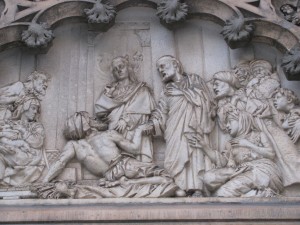
Photo credit: Christ Healing the Sick, Washington Allston
Matthew’s account is concise; he leaves out details in the stories that other gospel writers fill in. With this brevity Matthew hammers home his message about the Son of God on earth who is ushering in God’s kingdom.
Jesus’ miracles tend to fall into three categories: those controlling nature, those eradicating sickness (and even death), and those casting out demons. But contrary to the expectations of the disciples, the teachers of the law, or his Jewish readers, Jesus extends his healing grace to the disaffected and outcast – even to the Gentiles. He stuns them with his words and his works and makes them wonder, ‘Who is this man?’
As I read through Matthew’s account of Jesus’ miracles, I was struck more than once by Jesus’ compassion. When he sees the suffering of the people, he immediately brings peace of body and soul. He then reinforces this with his call to peace, one he still issues: “Come to me, all you who are weary and burdened, and I will give you rest” (Matthew 11:28).
Yes, Jesus works miracles today. Physical healings are spectacular, but emotional healings can also be life-altering, bringing freedom, joy and fulfillment. Do we have the faith to believe that Jesus can and will work in our own hearts and lives? I pray we will encounter the stories of Jesus’ miracles with an attitude of expectancy, reverence and gratitude.
Be Clean
When Jesus came down from the mountainside, large crowds followed him. A man with leprosy came and knelt before him and said, “Lord, if you are willing, you can make me clean.” Jesus reached out his hand and touched the man. “I am willing,” he said. “Be clean!” Immediately he was cleansed of his leprosy. Then Jesus said to him, “See that you don’t tell anyone. But go, show yourself to the priest and offer the gift Moses commanded, as a testimony to them.” Matthew 8:1–4
The crowds were amazed by Jesus’ Sermon on the Mount, and now as he comes down the mountain, they will be bowled over by his works. This first miracle that Matthew recounts brings restoration to one who suffered from leprosy or another skin disease. In Jewish law, those so afflicted would be called “unclean” and would be banished from others to prevent further spreading of the disease. But the leprosy would continue to spread within the sufferers’ bodies, affecting limbs that would eventually fall off, until finally they would die.
So although the other miracles are called healings, this one is called a cleansing, for only Jesus could make the sufferer clean. Perhaps Matthew chose to recount this miracle first to show the Jewish people that Jesus is the fulfilment of the law (Mark and Luke first tell of Jesus driving out a demon in a man in Capernaum). After healing the man, Jesus tells him to show himself to the priest and offer the prescribed gift. By this he is signalling that one greater than Moses has come; he is ushering in a new order.
We could push this healing aside as not affecting us, but the spread of leprosy in a body is similar to the spread of sin in our lives. If we do not present ourselves to Jesus for cleansing, our sin will spread, separating us from each other and from God. Only Jesus can bring the cleansing that releases us into wholeness and makes us clean.
Prayer: Lord Jesus Christ, show me where sin may be lodging, that I may be cleansed by your healing hand.
I did not tell you this at first because I was with you. John 16:4
PyelotBoy, about the time he went to school for the first time…
The first day I left PyelotBoy at nursery (UK; US: pre-school), I wondered how he would fare and if he would be lonely or afraid. My husband and I had tried to prepare him for the good things to come, such as new friends, engaging play, and increased independence. But I hadn’t prepared myself for the wrenching separation I felt as I realised that this was merely the start of a long journey of releasing my son. A few years on, we’re both back from a week away, and I try not to ply him with too many questions, so eager I am to hear all about his school trip.
I wonder if Jesus felt any of this sadness as he prepared his disciples to be apart from him. He knows of the trials that are ahead – not only for him but for them – so he warns them of things to come. Indeed, shortly after this conversation Jesus is arrested and brought before the high priest. He will no longer be with them physically, but he will give them an amazing life-changing gift – his very presence living in them through the indwelling of his Holy Spirit.
We never need to be far from Jesus, for he lives within us. his presence changes us, helping us to forgive the gossiping friend, to love the colleague we find difficult, to trust when we are feeling helpless and alone, to release our children into his care. In the words of the sixteenth-century monk, Brother Lawrence, we need only to pause and “practice the presence of God.” He is with us.
Prayer: Lord Jesus, I thank you that through you I live and move and have my being. Transform me, I pray.
And you also must testify, for you have been with me from the beginning. John 15:27
Photo: by Chris Yarzab, flickr
When I was an editor at HarperCollins I commissioned the memoirs of Canon Michael Green. Sharing the good news of the gospel seems to pour out of him naturally, with his winsome words accompanied by a bright smile. I, however, am not a natural evangelist like Michael. In fact, the thought of city-center evangelism sends chills down my spine.
But Jesus tells his disciples here that they must testify. In the Greek, the “you” is emphatic, underscoring that we are not off the hook. Sharing our faith with friends, family or strangers may be out of our comfort zone, but God has entrusted his message to us. We may stammer or feel incompetent, but the Holy Spirit will strengthen us and give us just the right words to speak.
We aren’t limited to the ways we can testify about Jesus. We might encourage a friend who finds it hard to trust God with examples of his faithfulness in our own life. We might extend a listening ear to an older neighbor who is lonely. Or indeed we might tell a friend about how Jesus died on the cross to take away our sins, that she might live in freedom. God’s ways of reaching out to his needy world are endless, and we have the privilege of being the conduits.
Prayer: Lord Jesus, I’m amazed that you use me to share your love and grace. Work through me, I pray.
 As we move through Matthew’s gospel during this series on the miracles of Jesus, the clash between the Pharisees and Jesus intensifies. His claims and acts of authority incense the Pharisees. Seeking to trap him, they ask him about healing on the Sabbath and present to him a man with a withered hand. But Jesus again detects their secret thoughts. When he asks about a sheep falling into a pit, he refers to a long debate that the Pharisees were having about what was lawful on the Sabbath.