Category: Devotionals

  • Devotional of the week: Unclean

    “Woe to me!” I cried. “I am ruined! For I am a man of unclean lips.” Isaiah 6:5

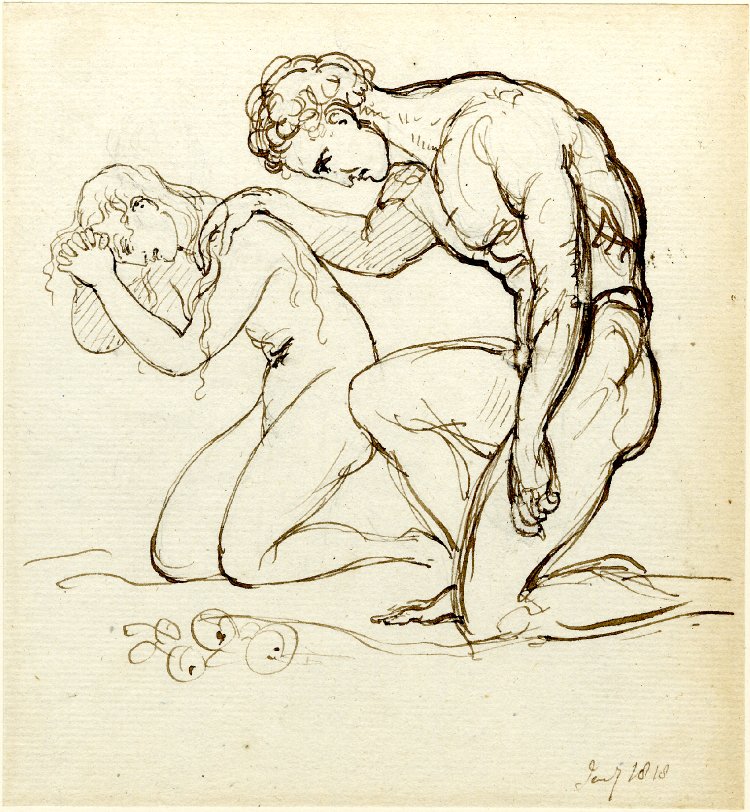
    "Adam and Eve" by George Hayter - British Museum (public domain)
    “Adam and Eve” by George Hayter – British Museum (public domain)

    My kids are still young enough that when they have done something wrong, they usually confess straight away. They (thankfully) haven’t yet learned how to hide their shame or guilt. But at some point they will probably acquire this practice, whether as a coping strategy in the tough world or for more self-interested reasons. May the Lord help my husband and me to train them in keeping a pure heart.

    Isaiah, when faced with the holiness of God, comprehends immediately the depth of his sin. He had been warning the Israelites about their transgressions, but here before the holy God he sees that neither is he worthy. Isaiah knows what God has been saying about the sins of his people, for he has been the conduit of his message. Surely, he thinks, he is ruined.

    Jesus later told the Pharisees that “the things that come out of a person’s mouth come from the heart, and these defile them” (Matthew 15:18). Likewise Isaiah realizes, as he looks on the holiness of God, that out of his lips come the impurities of his heart. But as we will see next week, God sends him help for his redemption – just as he has for us.

    Have you experienced an utter realization of the depth of your sin? If so, how did you respond? And how did God?

    Prayer: Heavenly Father, we repent for the sins of our heart and our mouths. Live in and through us, that our words would be as sweet as honey.

  • Devotional of the week: Holy Times Three

    “Holy, holy, holy is the Lord Almighty; the whole earth is full of his glory.” Isaiah 6:3

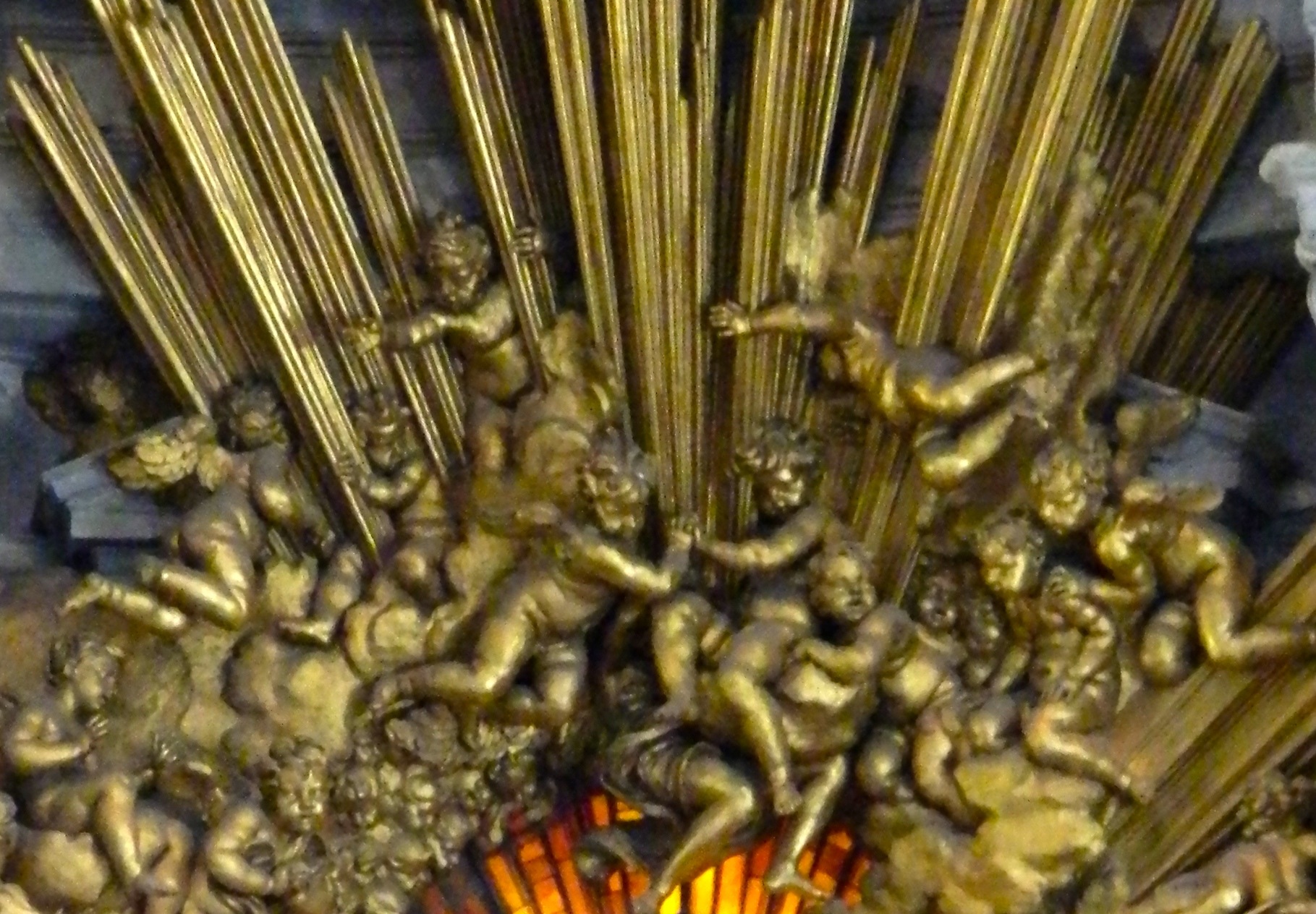
    Not six-winged, but not a cuddly rendition of an angel either... This one found in a church in Rome.
    Not six-winged, but not a cuddly rendition of an angel either… This one found in a church in Rome.

    The six-winged creatures in Isaiah’s vision aren’t the cuddly angles that grace today’s greeting cards and posters. No, these that Isaiah sees are solid and huge, for when they speak the walls and foundations reverberate and the temple fills with smoke. They cry out, “Holy, holy, holy!” Why three times? Because Hebrew, the original language, has no superlative such as we have in English: “holy,” “holier” and “holiest.” And although a double emphasis is sometimes employed in Hebrew, a triple repetition is more rare. God deserves the top praise.

    The vision that Isaiah sees is similar to that glimpsed by Jesus’ disciple John on the island of Patmos. There the six-winged creature had “eyes all around, even under its wings” and never ceased to say, “‘Holy, holy, holy is the Lord God Almighty,’ who was, and is, and is to come” (Revelation 4:8).

    These creatures have a rightful fear of the Lord, which is a concept that has fallen out of favor today. But a healthy fear implies awe, reverence, a hatred of evil and a desire for holiness and purity to reign. It doesn’t preclude intimacy with God. Rather, we can develop a deeper relationship with him when we love what he loves and weep with him over the sin in this world – and in our hearts.

    May we continue to grow in a rightful fear and deep praise for our superlative God.

    Prayer: Lord, you are holy, holy, holy! May our praises echo those of the six-winged creatures forever crying, holy.

  • Devotional of the week: Angel wings

    Above him were seraphim, each with six wings: With two wings they covered their faces, with two they covered their feet, and with two they were flying. Isaiah 6:2

    St. Peter's Basilica, Vatican City
    St. Peter’s Basilica, Vatican City

    Our view of God can swing from one extreme to another. At one end, we might so favor intimacy with him that we speak only of “Jesus as my best friend,” or similar. But at the other end, we might see the triune God as so other that he is distant and not approachable.

    In the prophet Isaiah’s vision, the curtain opens and he sees God on his throne. So majestic is he that even just the train of his robe fills the temple. And around him are these seraphim, which are creatures with six wings. As Matthew Henry, the seventeenth-century biblical commentator, says, they are known as “burners,” for they “burn in love to God, and zeal for his glory against sin.” God, who is known as a holy flame elsewhere in the Bible (see for example Hebrews 12:29), is surrounded by creatures who would burn as flames. And even though they have not been marred by sin, they deem themselves unworthy to gaze upon the Lord. These creatures – to whom humans fall in awe – yet bow before God.

    I’m grateful that we can run to God as Abba, our Father. Never would I want to relinquish an intimate relationship with him. But neither do I want to lose a sense of reverence and wonder over the hugeness of our God – he who defines holiness.

    Prayer: Holy and living God, reveal your holiness to me, that I might cultivate a healthy sense of awe over your wonder and majesty.

  • Devotional of the week: Our King

    A new devotional series, this one based in one of my favorite Old Testament books, from the prophet Isaiah (6:1-8).

    In the year that King Uzziah died, I saw the Lord, high and exalted, seated on a throne… Isaiah 6:1

    Photo: Creative Commons, David Jones. The Imperial Crown of Austria in the Schatzkammer, Vienna
    Photo: Creative Commons, David Jones. The Imperial Crown of Austria

    As an American living in the UK, I’ve often harbored mixed feelings about the British royalty – after all, the colonists in the New World fought a war to be free of King George III. But living here for sixteen years, I’ve grown in respect and admiration for Queen Elizabeth II. She has exhibited seemingly tireless grace and diplomacy for over sixty years, which we rightly celebrated during her Jubilee in 2012.

    King Uzziah was another faithful ruler, who wielded more power in his day than British royalty do today. But at the end of his life his pride ruined him. He decided that he wanted to involve himself in matters at the temple and burned incense at the altar (which was the job of the priests). The Lord struck him with leprosy and he died. This was the year Isaiah received his commission as a prophet, which we will be reading about in this seven-week series.

    In contrast to the human king, Isaiah glimpses the true King who is seated on his throne of judgement. The people of Israel had been swayed by powerful King Uzziah and had, little by little, began to trust in him more than God. And so the Lord commissions a man – Isaiah – to bring his dual message of judgement and mercy to his people.

    Whatever your view of royalty, today consider the mighty King of all Kings who never slumbers nor sleeps.

    Prayer: King of Kings and Lord of Lords, we pay you homage. Reign in our lives today. Amen.

  • Weekly devotional: “My Son, whom I love” (13 in Jesus’ miracles series)

    After six days Jesus took with him Peter, James and John the brother of James, and led them up a high mountain by themselves. There he was transfigured before them. His face shone like the sun, and his clothes became as white as the light. Just then there appeared before them Moses and Elijah, talking with Jesus… While he was still speaking, a bright cloud covered them, and a voice from the cloud said, “This is my Son, whom I love; with him I am well pleased. Listen to him!” When the disciples heard this, they fell facedown to the ground, terrified. But Jesus came and touched them. “Get up,” he said. “Don’t be afraid.” (Matthew 17:1–3, 6–8)

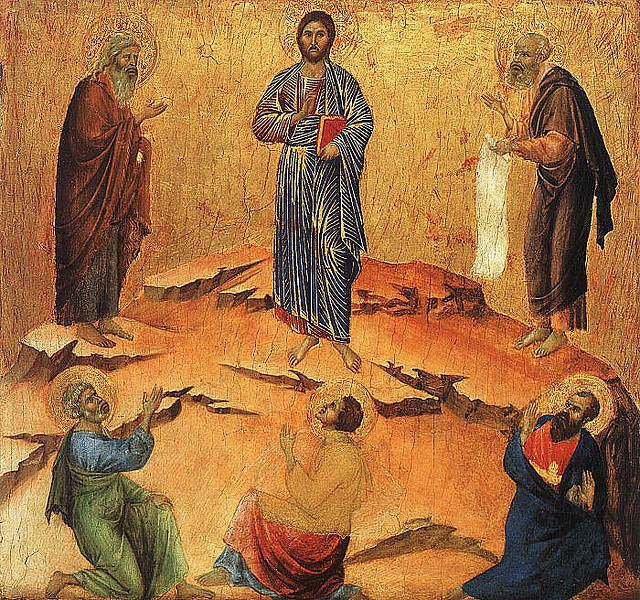
    Photo: Creative Commons, carulmare. DUCCIO di Buoninsegna Transfiguration, 1308-11
    Photo: Creative Commons, carulmare. DUCCIO di Buoninsegna Transfiguration, 1308-11

    During this series on Jesus’ miracles, we’ve seen Jesus healing the sick, raising the dead, overcoming nature, and exorcising demons. Our final miracle to consider today is the transfiguration, when the divine nature of Jesus is revealed. Whereas the other miracles are ones that Jesus performs, this one is performed on Jesus.

    Jesus has taken his inner circle of disciples – those who would be future church leaders – up a mountain to pray. It’s as if the heavens open and the scales fall from their eyes as they glimpse Jesus as God the Son, with his face shining and his clothes as white as light. Then they hear God say that this is his beloved son, and that they should listen to him. As with all mortals who come in contact with the living God, they are terrified. But Jesus touches them, reassuring them. They are changed, but they are to fear not.

    “Listen,” says God the Father. Are we listening to Jesus? Do we stop to pause and wait for his words and his directions, in things big and small? Have we aligned our lives in submission to his loving will?

    As we do so, Jesus will work miracles in us. As God’s beloved Son he promises to bring reconciliation, healing, and restoration. May we enjoy the new kingdom that he is ushering in to its fullness, sharing his joy and peace with our families and those whom we meet.

    For reflection: “For in him we live and move and have our being” (Acts 17:28).

  • Weekly devotional: How many loaves have you? (12 in Jesus’ miracles series)

    Great crowds came to him, bringing the lame, the blind, the crippled, the mute and many others, and laid them at his feet; and he healed them. The people were amazed when they saw the mute speaking, the crippled made well, the lame walking and the blind seeing. And they praised the God of Israel. Jesus called his disciples to him and said, “I have compassion for these people; they have already been with me three days and have nothing to eat. I do not want to send them away hungry, or they may collapse on the way.” His disciples answered, “Where could we get enough bread in this remote place to feed such a crowd?” “How many loaves do you have?” Jesus asked. “Seven,” they replied, “and a few small fish.” He told the crowd to sit down on the ground. Then he took the seven loaves and the fish, and when he had given thanks, he broke them and gave them to the disciples, and they in turn to the people. They all ate and were satisfied. Afterward the disciples picked up seven basketfuls of broken pieces that were left over. (Matthew 15:30–37)

    Photo: Steve Cadman, Creative Commons. Stained glass by Helen Moloney in St Michael's Creeslough (1971) by Liam McCormick, County Donegal
    Photo: Steve Cadman, Creative Commons. Stained glass by Helen Moloney in St Michael’s Creeslough (1971) by Liam McCormick, County Donegal

    Jesus has been healing and teaching the crowds in Gentile territory. Seeing that they are tired and hungry, he’s moved with compassion. He wants to meet not only their spiritual needs, but their physical ones too. And although the disciples have already witnessed Jesus feeding the five thousand, they still wonder how Jesus will feed these four thousand men, plus women and children.

    Jesus takes what the people give – seven small loaves and two fish – and makes it sufficient for all. He multiplies their meager offering into a feast that satisfies.

    Note two things regarding this familiar miracle. First is that Jesus performs it in Gentile territory. Although he came first for the Jewish people, he also yearns that non-Jews would eat and be satisfied with his food.

    The second is how Matthew indicates that this miracle hearkens to Jesus’ breaking of the bread during his last supper – Jesus takes, breaks the bread, gives thanks, and offers it to the disciples. They in turn offer it to the people. So too should we offer what we have to Jesus for distribution among his people. It might seem far too small or insignificant for the needs, but as we see here, Jesus has a way of multiplying our bread beyond our wildest imagination.

    Prayer: Lord God, we lift before you the needs of hungry people today – in Haiti, South Sudan, the Holy Land. Where we have loaves and fish to offer, let us give that you may multiply.

  • Weekly devotional: ‘I believe; help my unbelief’ (11 in Jesus’ miracles series)

    When they came to the crowd, a man approached Jesus and knelt before him. “Lord, have mercy on my son,” he said. “He has seizures and is suffering greatly. He often falls into the fire or into the water. I brought him to your disciples, but they could not heal him.” “You unbelieving and perverse generation,” Jesus replied, “how long shall I stay with you? How long shall I put up with you? Bring the boy here to me.” Jesus rebuked the demon, and it came out of the boy, and he was healed from that moment. (Matthew 17:14–18)

    IMG_0020A desperate father seeks the help of Jesus’ disciples but meets with frustration. We don’t know what the disciples were doing for the boy, but Jesus sees immediately their lack of faith. And this faithlessness is what Matthew wants to highlight in his gospel, for he again gives a sparse account in comparison with the other synoptic gospels.

    I can feel this father’s pain, for it has been the burden of my own father (and mother). My brother has suffered from epilepsy since he was just three years old, and although my parents have sought healing from the Lord, my brother still has this disease. Why God heals at times and at other times does not is one of the biggest mysteries of our faith. I can only put it down to the fall of humanity, when our first parents chose their own way and thus sin, disease, and death entered the universe.

    So in terms of my brother and this story, I believe that he is not demon-possessed but afflicted by our fallen nature. We ask God to heal and desire that he would do so. But when he does not we continue to ask him to increase our faith. And to give us the wisdom to know when to accept that healing may not come this side of heaven.

    How about you? Have you pleaded with the Lord for something but your cries seemed to fall on deaf ears? May your trust in him continue to grow, and may he give you wisdom and understanding.

    Prayer: Father God, we don’t always understand. Enlarge our grasp of your truth and your love, and give us your peace.

  • Weekly devotional: Dogs, crumbs, healing (10 in Jesus’ miracles series)

    A Canaanite woman from that vicinity came to him, crying out, “Lord, Son of David, have mercy on me! My daughter is demon-possessed and suffering terribly.” Jesus did not answer a word. So his disciples came to him and urged him, “Send her away, for she keeps crying out after us.” He answered, “I was sent only to the lost sheep of Israel.” The woman came and knelt before him. “Lord, help me!” she said. He replied, “It is not right to take the children’s bread and toss it to the dogs.”  “Yes it is, Lord,” she said. “Even the dogs eat the crumbs that fall from their master’s table.” Then Jesus said to her, “Woman, you have great faith! Your request is granted.” (Matthew 15:22–28)

    Photo: Creative Commons, Waiting for the Word.
    Photo: Creative Commons, Waiting for the Word.

    I struggle to understand why Jesus took so long to heal the poor woman’s daughter, and why he may have employed the Jewish derogatory term of “dogs” to describe the Gentiles. But as theologian Michael Green comments in The Message of Matthew, we don’t know Jesus’ inflection or delivery of his words, for in the Greek, punctuation is inferred and not written. So Jesus could have been musing, asking the question if he was sent only to Israel. As Green says, “I believe this was a soliloquy of Jesus” (p. 172).

    However we interpret it, we know that Jesus’ first mission is to save Israel. His actions here tell us, however, that he doesn’t limit his grace. As with the Roman centurion who sought healing for his servant, Jesus admires this woman’s faith and tenacity, and heals her daughter.

    The early church would have been encouraged by this encounter, for it shows how amazed Jesus was by a Gentile’s faith. The story would have also served as a warning to those in Israel who were complacent in their privileged status. What Jesus yearns for, as we see here, is great faith.

    Passages like this remind us that as much as we’d sometimes like to put Jesus into a neat and tidy box, we simply cannot. But we can follow the example of the Gentile woman, who was motivated by her maternal love and persevered in seeking healing for her daughter. And we can trust that God’s love and mercy is sufficient – whatever our ethnicity, race or tribe.

    Prayer: Lord, thank you for the tenacity of this mother and your loving response. Help us to hold on to you, as you hold on to us. Amen.

  • Weekly devotional: Water walking (9 in Jesus’ miracles series)

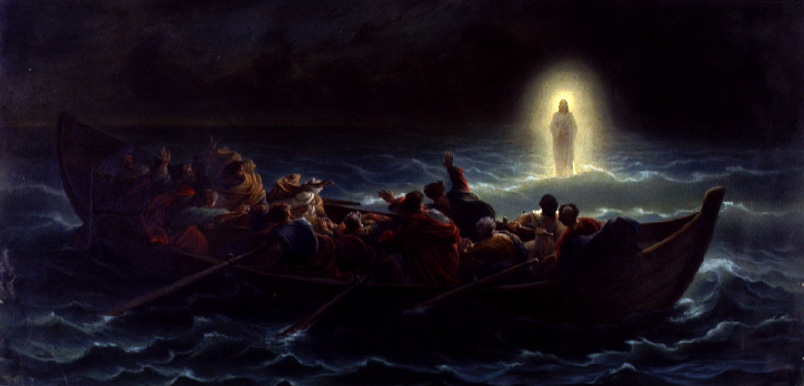
    Shortly before dawn Jesus went out to them, walking on the lake. When the disciples saw him walking on the lake, they were terrified. “It’s a ghost,” they said, and cried out in fear. But Jesus immediately said to them: “Take courage! It is I. Don’t be afraid.” “Lord, if it’s you,” Peter replied, “tell me to come to you on the water.” “Come,” he said. Then Peter got down out of the boat, walked on the water and came toward Jesus. But when he saw the wind, he was afraid and, beginning to sink, cried out, “Lord, save me!” Immediately Jesus reached out his hand and caught him. (Matthew 14:25–31)

    Painting by Amédée Varint; Creative Commons
    Painting by Amédée Varint; Creative Commons

    Having just fed a hungry crowd of five thousand after a day of teaching, Jesus was exhausted. He sent the disciples to find shelter on the other side of the lake while he went to pray. But the disciples encounter a squall and spend much of the night trying to cross the lake. Whereas Jesus was in the boat when a storm arose previously, this time they are on their own. But by now they know that Jesus is interceding for them, and will come to them.

    And he does so in a miraculous way, walking on the water. The disciples are depleted from the day’s ministry and a night of slapping on the waves; in their exhaustion they wonder if they’ve seen an apparition. But Jesus reassures them, and his “It is I” could hearken back to Yahweh’s statement of “I am” from the Hebrew scriptures.

    Then Peter asks to walk to Jesus. Jesus commands him to come, and – amazingly – he does. Only when he takes his eyes off Jesus does he realize that this isn’t normal. Then he starts to sinks, but knows immediately to cry out to Jesus for help.

    The feeding of the multitude and the amazing aqua balancing act bring forth a unified response from the disciples: “Truly you are the Son of God” (v. 33). Likewise, may we give him the authority and rule in our lives, turning to him when we are exhausted or sinking – or when we are flying high.

    Prayer: “I do believe; help me overcome my unbelief!” (Mark 9:24)

  • Weekly devotional: Mercy, not sacrifice (8 in Jesus’ miracles series)

    Going on from that place, he went into their synagogue, and a man with a shriveled hand was there. Looking for a reason to accuse Jesus, they asked him, “Is it lawful to heal on the Sabbath?” He said to them, “If any of you has a sheep and it falls into a pit on the Sabbath, will you not take hold of it and lift it out? How much more valuable is a human being than a sheep! Therefore it is lawful to do good on the Sabbath.” Then he said to the man, “Stretch out your hand.” So he stretched it out and it was completely restored, just as sound as the other. But the Pharisees went out and plotted how they might kill Jesus. (Matthew 12:9–14)

    800px-Christ_heals_tne_man_with_paralysed_handAs we move through Matthew’s gospel during this series on the miracles of Jesus, the clash between the Pharisees and Jesus intensifies. His claims and acts of authority incense the Pharisees. Seeking to trap him, they ask him about healing on the Sabbath and present to him a man with a withered hand. But Jesus again detects their secret thoughts. When he asks about a sheep falling into a pit, he refers to a long debate that the Pharisees were having about what was lawful on the Sabbath.

    Jesus shows how he is more concerned with mercy than empty ritual, and with human beings over animals. With one command he tells the man to stretch out his hand. The man had been a pawn of the Pharisees, but Jesus makes all things new.

    Of course, the Pharisees aren’t overjoyed. Instead of rejoicing that the man can now use his arm, they plot to kill Jesus. They were probably remembering how God restored Moses’ arm with one command (Exodus 4:6–7), realizing that Jesus with this action was claiming his Messiahship.

    Who are we most like in today’s passage? Jesus, blowing preconceptions and healing (and no, I’m not encouraging a Messiah-complex)? The man, argued over and yet restored? Or the experts in the law, who couldn’t overcome their prejudice to see the new work of God?

    For reflection: “‘I desire mercy, not sacrifice.’For I have not come to call the righteous, but sinners” (Matthew 9:13).