Peace I leave with you; my peace I give you. I do not give to you as the world gives. Do not let your hearts be troubled and do not be afraid. John 14:1-27
I love this part of the Bible. It’s called Jesus’ Final Discourse, because he and the disciples have eaten their last supper together and Judas has gone off to plan his betrayal. Soon Jesus and his friends will make their way to the Mount of Olives, where the soldiers and officers will arrest him. The setting and timing makes Jesus’ words all the more important.
The disciples have just learned that Jesus is going to die, and of course they react with fear and trepidation. But Jesus reassures them, telling them not to be afraid. Then he shares with them a great truth of the Christian faith, the dance between the three members of God (the Father, the Son and the Holy Spirit) and us, his children. Jesus says, “I am in my Father, and you are in me, and I am in you.” And that he is sending the Spirit, the Advocate of truth, to be with us forever.
What does this mean for us, that the Trinity dwells in each other and in us? It’s a great mystery, to be sure, but has practical implications. For one, we are never alone. Jesus lives within, and we can just pause and practice his presence, to quote the phrase from Brother Lawrence of centuries ago. As we are quiet, we can call to mind the fact that God has descended not only to earth as the man Jesus, but that he dwells in us when we have welcomed him in. He can quicken our thoughts; bring to mind someone who is hurting for whom we can pray and reach out to; bring comfort and peace… the list is endless. No longer are we alone.
May the peace of Christ surround us this day.
For reflection: “And the peace of God, which transcends all understanding, will guard your hearts and your minds in Christ Jesus” (Philippians 4:7).
I love this section of the Bible so much that I have written a month of daily notes on John 14 to 17 for Inspiring Women Every Day. Look for it in September!
“Do not be afraid of those who kill the body and after that can do no more. But I will show you whom you should fear: Fear him who, after your body has been killed, has authority to throw you into hell. Yes, I tell you, fear him.” Luke 12:1-12
The title of a book captured my imagination when I was introduced to it some twenty years ago: psychologist O Hobart Mowrer’s You Are Your Secrets. I often think of that book when I catch a horrific news headline, such as the death of a young television presenter through asphyxiation in a solo sex game gone wrong. A secret act is made public, and along with grieving for the person involved, I can’t help but think how horrified they would have been at the revelation, had they lived.
Here Jesus is teaching the crowds, warning them against the hypocrisy of the Pharisees and telling them that their secrets will be made known. He alerts them to the arrows of the evil one, warning them to be on guard against his schemes. We need not fear our heavenly Father, who cares for us more than even the smallest and least significant of birds, for whom he also provides. But we need to fear the enemy of our souls. He who could keep us in eternal separation from God is one we should keep our distance from.
Yet some Christians seem to be fascinated with the devil, seeing him under every bush while binding him and casing out demons. Satan is active in the world; I’m not wanting to discount our need to put on the armor of God and to stand against his evil schemes. But neither should we become so focused on his activities that we become distracted from all that is true, good and beautiful. After all, we want to further God’s kingdom.
If “you are your secrets,” how would a headline sum you up?
Prayer: Lord Jesus, shine your light in my life that I might confess any hidden secrets. Thank you for setting me free and making me whole.
[Simon Peter] fell at Jesus’ knees and said, “Go away from me, Lord; I am a sinful man!” For he and all his companions were astonished at the catch of fish they had taken… Then Jesus said to Simon, “Don’t be afraid; from now on you will fish for people.” Luke 5:1-11
As Jesus calls his disciples to follow him, we see their fear. Jesus has been teaching the crowds, and uses Simon Peter’s boat to give him some space from the many people. Then he tells Peter to let down his net; Peter protests but obeys, and hauls in such a large number of fish that his nets start to break. Immediately Peter is shot through with fear, realizing the depth of his sinfulness.
When we come into God’s presence, his Holy Spirit burns as a refining fire, revealing to us where we have let God, others, or ourselves down. As with Peter witnessing the acts of Jesus, we who have his presence dwelling within us can ask him anytime to reveal what sins we might need to confess. Having received his forgiveness, we can follow him in joy.
Like Peter, we might respond to God’s prompting in our lives with skepticism. “Lord,” we might say, “I do so love my friend, and try to share your love with her, but the time never seems right.” But one day you sense the Lord’s prodding to send her a text. So you do, and she rings back, recounting a crisis through a veil of tears. Timidly you ask if you can pray for her, and she says yes. Afterwards you say to God, “Wow, Lord. I really don’t know what’s going on in the lives of my friends like you do. Thank you that you care even more than I. Let me not stop praying for them.”
How might the Lord be asking you to set down your nets?
Prayer: Father God, so often my faith seems weak and I am quick to discount your working in my life. Enlarge my vision and strengthen my faith.
Do not fear, for I have redeemed you; I have summoned you by name; you are mine. When you pass through the waters, I will be with you; and when you pass through the rivers, they will not sweep over you. Isaiah 43:1-7
The prophet Isaiah had to mete out many words of judgment to God’s people (especially in the first two-thirds of his book), but in the last third, his message changes to promises of hope, redemption, and love. God may have been angry with his people, but he will not give up on them. He wants to save them from their lives of sin and separation from him.
Though our passage for this week was written thousands of years ago, yet it speaks today of God’s loving mercy. Often when I am praying with people, we pray these words back to God as a way of setting their truth into our lives. If one of us is experiencing something that is particularly difficult, we ask God to help us push back our fears through these affirmations. For we know that God has created us, knows us by name and that we are his (v.1). We might feel that the waters are creeping over our heads, yet we know that with God’s help we won’t become submerged (v.2). Or that the flames that seem to be snapping at our feet won’t burn us (v.2). For we are precious and honored in God’s sight, and he loves us (v.4).
God’s word is rich and deep; I love how it speaks into our situations and those of so many years ago. For instance, verse 2 about passing through a river might refer to when Moses led the Israelites out of Egypt through the parting of the Red Sea. And the flames that don’t burn (also in verse 2) could hearken back to the days of Daniel, when Shadrach, Meshach and Abednego were thrown into the fiery furnace.
Truly our God is a God who saves. Never shall we fear.
Prayer: Lord Jesus, you were there with Daniel’s friends amid the flames. When I feel their heat encroaching on me, please save me and help me.
The Lord is my light and my salvation – whom shall I fear? The Lord is the stronghold of my life – of whom shall I be afraid? Psalm 27 (NIV)
King David, as the accepted author of many of the Psalms, reveals in them his great faith in God that was forged through lots of adversities. For example, he was on the run from his best friend’s dad, King Saul, who became jealous of his popularity with the people. After Saul and Jonathan were killed in battle, David faced other challenges as King of Israel and Judah, namely his people’s enemies such as the Philistines and the Moabites.
Some of David’s trials were self-created, however. Such as one spring, when other kings were off fighting wars but he stayed home, to rest and take it easy. The beautiful wife of one of his army men catches his eye and he commits adultery with her. When she becomes pregnant, he has her husband killed in war. Psalm 51 is his heart-rending cry of repentance.
The psalm we read this week is a confident affirmation of God’s presence in his life. David knows he need not fear the arrow that flies by day nor the terror of the night, for God is with him. The Lord is his light and salvation; the Lord is his place of refuge and protection.
Echoing David’s songs of trust and faith to the Lord may not feel natural at first. We might struggle to believe that the Lord will light our way or set us in a spacious place. But as we relinquish more of what we claim as ours over to him, we see how he leads us – and how he gives us back in abundance. Our faith grows and we can affirm with David that we will dwell in the house of the Lord all the days of our lives.
What rooms can you invite the Lord to inhabit today?
Prayer: Father God, we know that you are a jealous God, and that you want all of us. Help us to live wholly for you.
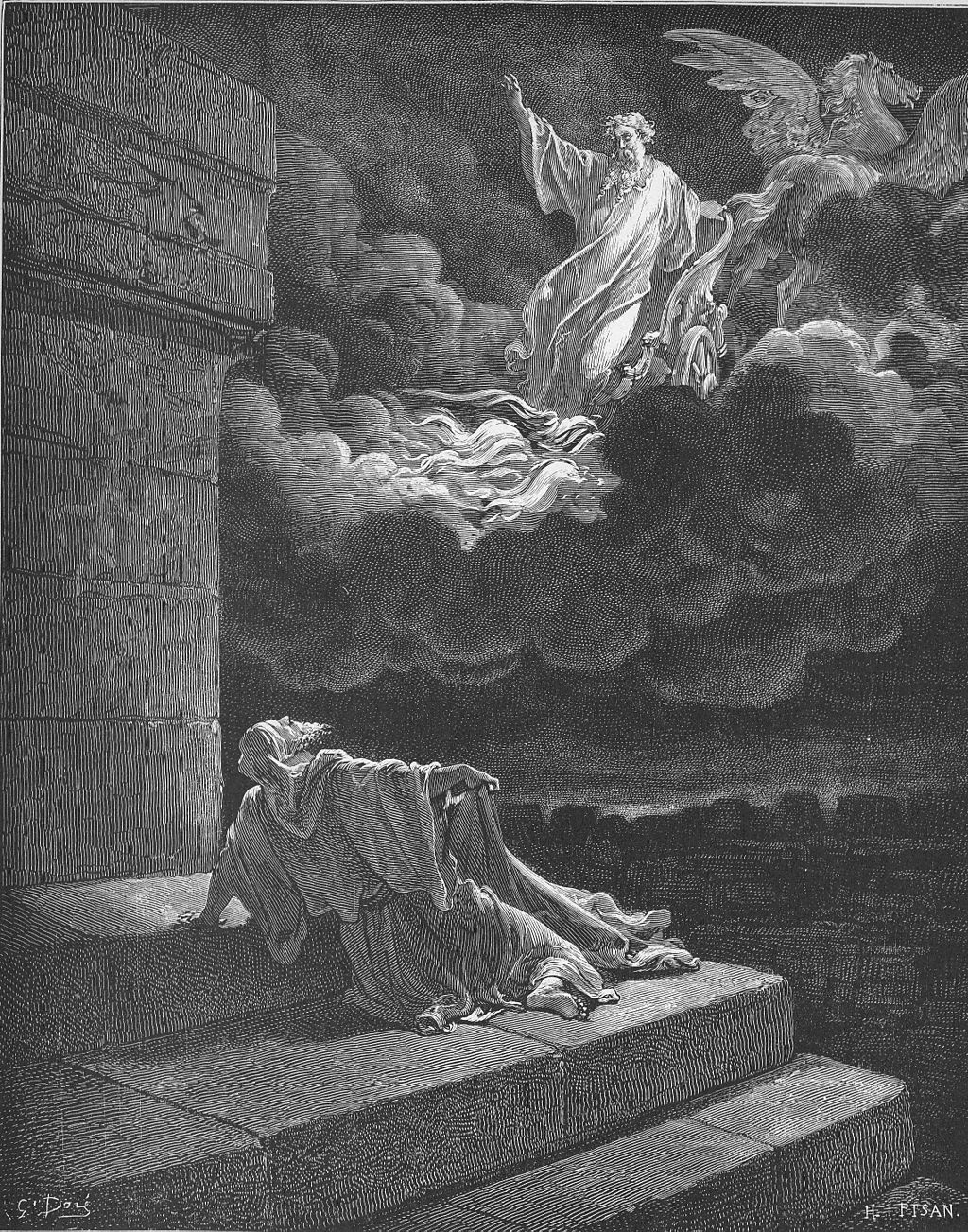
Elijah ascends to heaven in a chariot of fire. Gustave Doré.
“Don’t be afraid,” the prophet answered. “Those who are with us are more than those who are with them.” 2 Kings 6:8-23
Some years ago, I prayed regularly with a friend who was going through an excruciating time. She had experienced betrayal and she feared for her safety. Each week we would pray for God’s mercy, love, and protection into their lives. One morning while we prayed, I felt the verse above bubble up within me. I couldn’t remember where it was in the Bible, but quickly located it with the help of an internet search. “Ah, the chariots of fire!” I exclaimed.
We read through the story with new eyes, for we felt that God was reassuring her that he had erected around her an unseen army. She could rest and be at peace, even though a battle might be raging.
Elisha was a wise prophet, and through years of faithfulness had honed his spiritual vision. He knew that the armies of the Lord were far greater than the ones bearing down on him as sent by the king of Aram. And he knew that the Lord Almighty was more powerful than any human warrior. But his servant feared, so he asked God to open his eyes to what was unseen but real. Then Elisha asked God to strike the army blind, and they were. But amazingly he didn’t have his enemies killed. Instead he put on a great feast for them and sent them back to their master. They then stopped troubling him.
A prayer I often repeat is that God would open my spiritual eyes, that I might witness his power and mercy. What is going on in the heavenlies is real, though we, living in a materialistic age, might be skeptical. Or fear might keep us from trusting God. But as we witness his saving grace, as with Elisha, our faith becomes a firm foundation.
Prayer: Lord of the heavens and the earth, open our eyes that we might glimpse the saving work you are effecting in our lives, and in those around us.
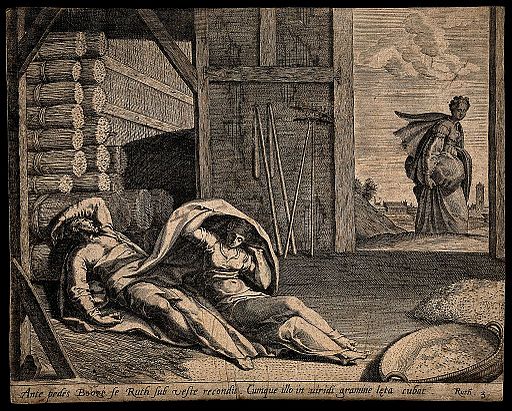
Ruth comes to take shelter under Boaz’s cloak. Engraving.
And now, my daughter, don’t be afraid. I will do for you all you ask… Although it is true that I am a guardian-redeemer of our family, there is another who is more closely related than I… If he is not willing, as surely as the Lord lives I will do it. (Ruth 3-4:10)
When I first moved to the UK with my new English husband, verses from the book of Ruth floated through my mind: “Your people will be my people and your God my God.” I knew I had left my home in the States – at least for the first five to seven years, as was our agreement (writes she, now eighteen years later!). But I hadn’t thought about adopting my husband’s people as my own. As with adopting children, we find that we have not only enough love for the children currently in our family, but an abundance with which to love the new member too. So has it been with adopting a nation – as I write in Finding Myself in Britain.
Ruth too was living in a foreign land, but she has seemingly lost everything when her husband dies. Yet she commits herself to her mother-in-law Naomi and says she will not leave her. Naomi then hatches a plan to provide for Ruth. It’s risky – Ruth presenting herself on the threshing floor where Boaz slept could have ruined her reputation. Ruth has reason to fear, but Boaz tells her not to. He will act honorably towards her, becoming her kinsman-redeemer in marrying her and thereby providing for her a place of safety and protection.
What a balm those words from Boaz must have felt to Ruth – don’t be afraid. With them she knew that her future was secure and that she wouldn’t be a rejected widow. She would have life and family and joy.
As I reflect on this story, I think of the apostle Paul’s letter to the Corinthians: “For no matter how many promises God has made, they are ‘Yes’ in Christ” (2 Corinthians 1:20). Boaz said yes to Ruth. What “Yeses” might God have in store for us?
Prayer: Lord God, we sometimes gaze into the unknown with fear. As with Ruth, may we walk forward with faith and hope.
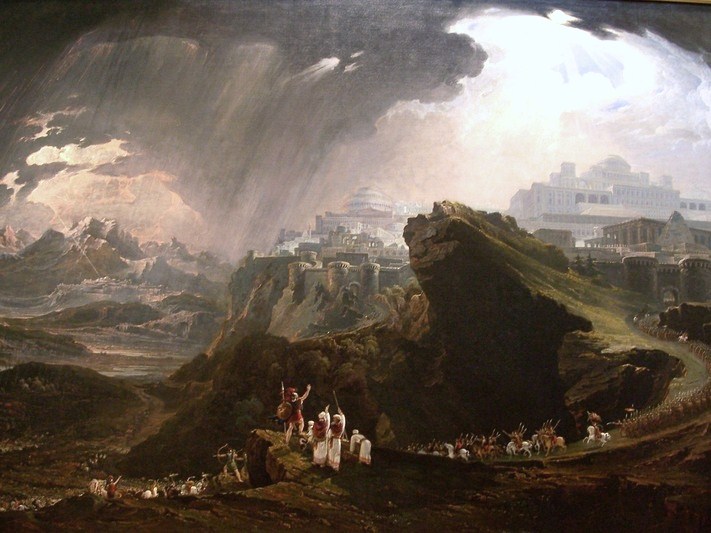
Joshua Commanding the Sun to Stand Still upon Gibeon by John Martin. Public domain.
“Be strong and courageous. Do not be afraid; do not be discouraged, for the Lord your God will be with you wherever you go.” Joshua 1
A church leader had these opening verses of Joshua impressed on him by the Lord as he settled into life in a new parish. Little did he know that he would be facing strife, assault, accusation, and anguish in what became a church divided. Sensing from the Lord that he needed to be strong and courageous, that he shouldn’t be afraid or discouraged, he kept on with the challenge of clarifying the core beliefs of the church. Later he acknowledged that he could have handled some things differently, with more loving grace, yet now he delights in a church transformed. Out of the ashes have come sprouts of new growth.
Joshua has a tough act to follow – as do church ministers when taking over the leadership of a church from one greatly admired. Moses has died and now Joshua faces the challenge of his lifetime, to lead his people to claim the land God had promised them. The Lord assures him that he will be with him, just as he was with Moses, and tells him repeatedly to be strong and courageous. Not to fear. To obey God’s commands. To meditate on the Book of the Law.
As we see with Joshua, the Lord promises never to leave us, but we have to step forward in faith. We might face challenges we never dreamed were possible, such as betrayal by our closest prayer partner or a whispering campaign that cuts us to the heart. Though we suffer, the Lord will not abandon us. With God’s indwelling Spirit, he brings comfort, peace and even the ability to forgive those who wrong us. And he will show us where we have sinned, lifting the lid of self-deception and convicting us to repent. May we rejoice in God’s mercy this day.
For reflection: Consider a church leader you know, perhaps your own. How might you encourage and uphold them today?
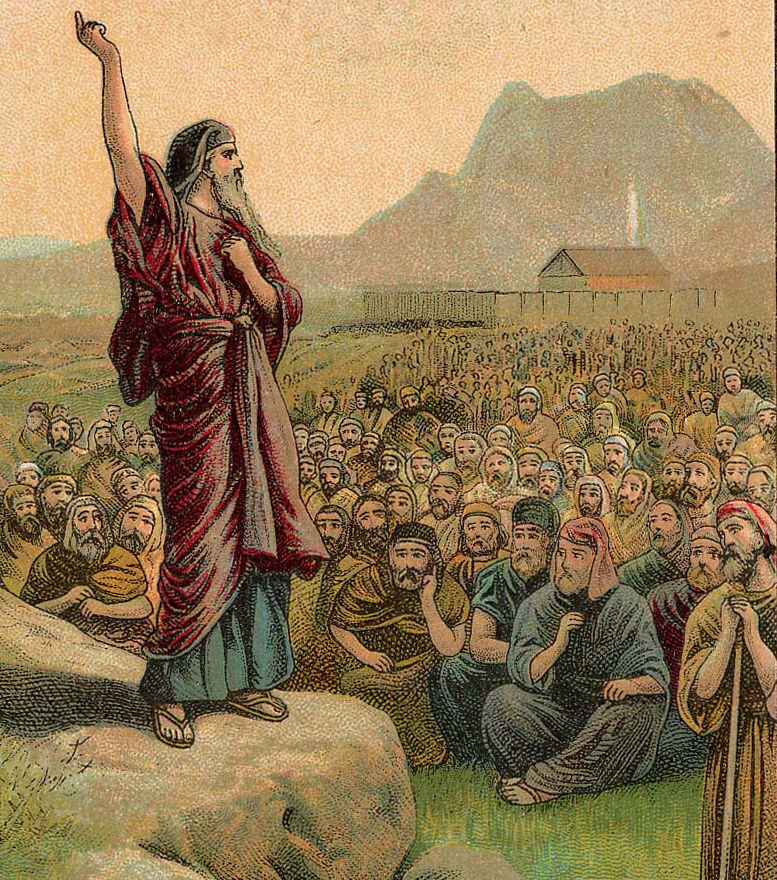
Moses Pleading with Israel, illustration from a Bible card published 1907 by the Providence Lithograph Company.
Then Moses went out and spoke these words to all Israel:“I am now a hundred and twenty years old and I am no longer able to lead you. The Lord has said to me, ‘You shall not cross the Jordan.’The Lord your God himself will crossover ahead of you. He will destroy these nations before you, and you will take possession of their land. Joshua also will cross over ahead of you, as the Lord said.And the Lord will do to them what he did to Sihon and Og, the kings of the Amorites, whom he destroyed along with their land.The Lord will deliver them to you, and you must do to them all that I have commanded you.Be strong and courageous. Do not be afraid or terrified because of them, for the Lord your God goes with you; he will never leave you nor forsake you.”
Then Moses summoned Joshua and said to him in the presence of all Israel, “Be strong and courageous, for you must go with this people into the land that the Lord swore to their ancestors to give them, and you must divide it among them as their inheritance.The Lord himself goes before you and will be with you; he will never leave you nor forsake you. Do not be afraid; do not be discouraged.” Deuteronomy 31:1–8
Some years ago, my daughter woke up complaining that her legs hurt and that she couldn’t walk. Witnessing her crawling around, fighting pain, struck fear in my heart. As it turns out, she had a common childhood ailment – irritable hip – that sorted itself out within a fortnight. My momentary fears that she would never walk again were thankfully unfounded.
But some of us do have children (or friends or family) who are paralyzed. Living in a fallen world, we face sickness and hardships, just as the Israelites met challenges as they entered Canaan – the land promised to Abram, as we read yesterday. Moses knows they fear what lies ahead, and seeks in his farewell address to calm their anxiety. Mainly he assures them that the Lord goes with them, and will never leave nor forsake them. Twice he tells him not to fear; twice he says to be strong and courageous. And not in their own strength, but because the Lord is with them.
Moses’ faith has been sharpened and strengthened over many decades, from his own wandering in exile after killing the Egyptian to witnessing God’s plagues against Pharaoh and their subsequent miraculous crossing of the Red Sea. He has grown from one who stammered and used his brother as his mouthpiece to a leader of mammoth stature. He has learned that with God he need not fear.
I don’t know what you’re facing today or this week; it might be a draining situation at work where you feel maligned and misunderstood. Or you weep for a child who has seemingly rejected God. Or you struggle with your marriage, or that you’re not married. Whatever faces you today, may you hear the words of centuries ago: Be not afraid nor discouraged, for the Lord your God is with you.
Prayer: Triune God, you travel with me throughout each day. May I know that you are before and behind me, on my right and on my left.
A new devotional series! I welcome you to join me in exploring the most common phrase uttered on behalf of the triune God when angels, prophets or the Lord Jesus appeared to people: “Fear not…” It is not a surprising remark, for when people encounter the holiness of God, they fall down in fear and reverence. The sinfulness that they might have carefully pushed down to an overlooked compartment is exposed in a flash. But although the Lord wants to convict us of our sin, he does so as a loving father who gathers us in his arms. Fear not, he whispers, for I am with you. I will never leave or forsake you. Come and be clean, and live a life free of fear. I am with you, beloved; I love you.
We all harbor fears of some kind. When I originally wrote this set of devotionals (they appeared previously in Day by Day with God), I had before me the cares and concerns of family and friends. My daughter was been complaining that it hurts to walk. A close family member had just come out of the hospital after a heart-related blood clot (that thankfully went to her kidney and not to her brain). Another close to me who was seemingly fit and healthy (and only forty-seven) recently had a heart attack. I had friends who were facing surgery on a daughter after a freak accident, another whose father seemed to be losing the will to live, another whose husband had just left her for another woman, another who was escaping an abusive marriage but who was also enduring a long and protracted divorce… the list goes on. In each case, the Lord says to us, “Fear not. I am with you.”
Harboring fear can be like letting a wild animal into our house. It roams where we know not, crouching at the end of our beds in the middle of the night and popping up when we’re having our morning cuppa. If we’ve let fear camp in our rooms, we can find it difficult to make it leave. But with the power of the Holy Spirit, we can cleanse our homes and our hearts, asking God to dwell with us and to bring his peace, hope and love. When we feel fear taking over, we can cry out to God, perhaps simply through calling on the name of Jesus. As we put our concerns and fears into his outstretched hands, we will receive the peace that passes all understanding.
After this, the word of the Lord came to Abram in a vision: “Do not be afraid, Abram. I am your shield, your very great reward.” (Genesis 15)
Can you hear Abram’s tone of voice? The Lord appears and tells him not to fear, promising protection and provision. Abram replies in turn, perhaps with some indignation: “How? You’ve not given me the one thing I need – a child – so what can you possibly give me as a reward?”
Abram’s fear is speaking. I don’t think he means to lash out at the Creator of the universe, but he’s feeling sore and doubtful. The Lord had previously promised to make him into a great nation (Genesis 12:2–3), but Sarai remains barren and for an heir they have only a servant. Yet the Lord seeks to build Abram’s faith and assuage his fears: “See all of the stars? So will your offspring be.” Then God makes a covenant with him, not only that Abram will have countless descendants, but that they will (eventually) inhabit the Promised Land.
So too will the Lord meet us as our greatest points of need, whether it be for love, companionship, meaning, peace, beauty, or grace. We might think that the Lord will or should answer our prayers in a particular way – for that person to be our spouse; for a particular job; for a child; for our loved ones to succeed. Although God doesn’t always give us what we ask, eventually we can see his purposes and plans. Yet it might be four hundred years later, as with Abram.
I write this knowing that unanswered prayer can be a huge stumbling block to faith; it certainly was a hurdle I nearly tripped over. If you’re struggling in this area, I recommend Pete Greig’s God on Mute. And I pray for us all, that God will enlarge our imaginations to know his neverending love and kindness.
Prayer: Father God, you changed Abram and Sarai into Abraham and Sarah, the parents of many. We surrender to you our desires and fears, asking you to meet our needs.