Category: Ephesians devotionals

  • Devotional of the week: The armor of God (12 in Ephesians series)

    6722414889_80d450052f_b
    Photo: Mike Bishop, Flickr

    Stand firm then, with the belt of truth buckled round your waist, with the breastplate of righteousness in place, and with your feet fitted with the readiness that comes from the gospel of peace. In addition to all this, take up the shield of faith, with which you can extinguish all the flaming arrows of the evil one. Take the helmet of salvation and the sword of the Spirit, which is the word of God. And pray in the Spirit on all occasions with all kinds of prayers and requests. With this in mind, be alert and always keep on praying for all the Lord’s people. (Ephesians 6:14–18)

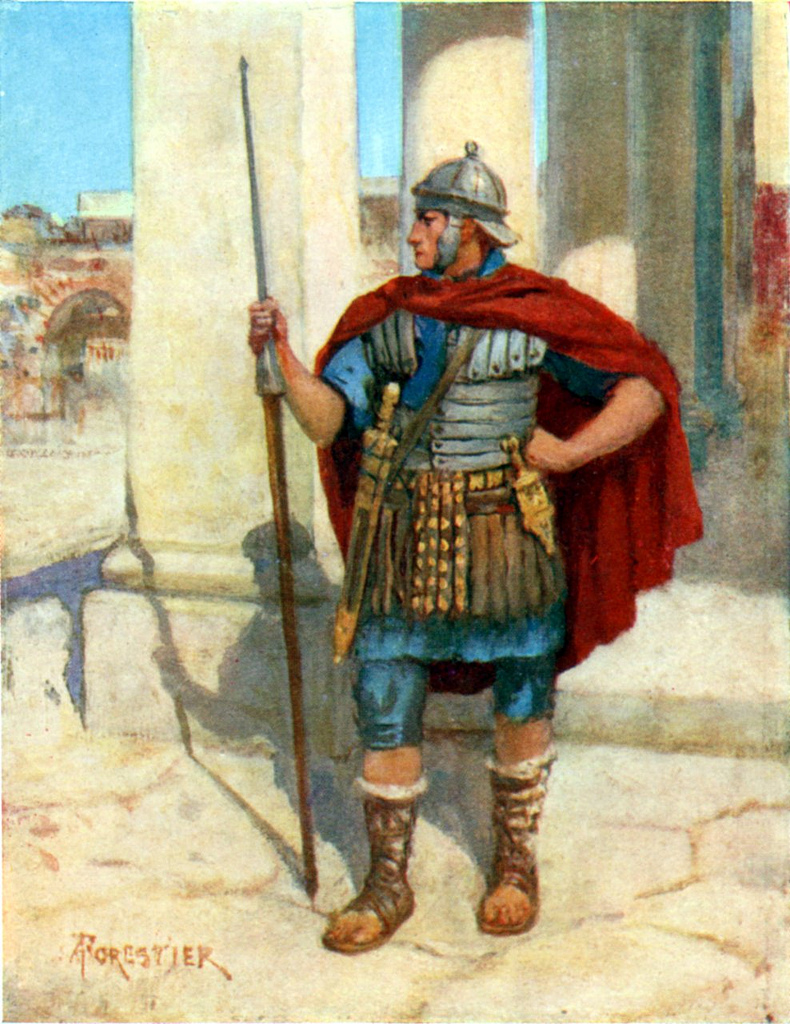
    Paul was writing his letter to the Ephesians while in chains, so a Roman soldier may have been standing next to him, decked out in his full armor. Paul employed this military imagery and also drew on the language of battles in the Old Testament, in particular Isaiah. For example, in Isaiah 11:5, the Messiah has righteousness as his belt and faithfulness as the sash round his waist. Righteousness is also his breastplate in Isaiah 59:17, along with the helmet of salvation. And the “feet fitted with the readiness…” hearken back to Isaiah 52:7: “How beautiful on the mountains are the feet of those who bring good news…”

    Paul’s use of this imagery is much more memorable than if he had said, “Stand firm with truth, righteousness, faith, salvation, the word of God and prayer.” Indeed, I know of one minister who before she goes into a potentially fraught or difficult meeting, prepares by putting on each piece of armor, complete with the physical motions. By doing so she reclaims the Lord’s resources that she needs to stand against any evil forces while she seeks to usher in the gospel of peace and righteousness.

    Paul’s instructions, as with his whole letter, are not just for individual believers but for us as a community. We are strengthened as we stand together, holding our shields of faith against the flaming arrows of the evil one. While doing so, we pray for ourselves and for all the Lord’s people, that we might stand firm in him.

    Prayer: Lord, thank you for this journey through Paul’s letter to the Ephesians. May your words of truth permeate our beings, that we might bring you glory.

  • Devotional of the week: Filled with the Spirit (11 in Ephesians series)

    Be very careful, then, how you live—not as unwise but as wise, making the most of every opportunity, because the days are evil. Therefore do not be foolish, but understand what the Lord’s will is. Do not get drunk on wine, which leads to debauchery. Instead, be filled with the Spirit, speaking to one another with psalms, hymns and songs from the Spirit. Sing and make music from your heart to the Lord, always giving thanks to God the Father for everything, in the name of our Lord Jesus Christ. Submit to one another out of reverence for Christ (Ephesians 5:15–21).

    Many modern translations of today’s passage lose the original structure. They start a new section at verse 21 (“Submit to one another…”) instead of having verses 18–21 as one sentence, as they are in the Greek (starting with “Do not get drunk…”). When we understand how the text fits together, according to Klyne Snodgrass in The NIV Application Commentary, we see that Paul is telling his readers five ways to be filled by the Spirit: speak to one another with psalms, sing, make music, give thanks, submit to one another in fear of Christ.

    Why does this matter? As Snodgrass says, “Failure to understand the structure has made this section one of the most misappropriated texts in the Bible” (p. 286). The “house codes” that follow about how wives and husbands, children, and parents, slaves and masters should treat each other all fall under the command of mutual submission under Christ. Because we live in holy fear of God, we submit to each other. This entails humility, sacrificial love, and putting others above ourselves.

    As we cast away our old selves and put on the new, we may live a life controlled not by wine, but by the Spirit. The careful living that Paul describes entails the filling of the Holy Spirit, that we might be empowered to act in a holy way that is pleasing to God. Through his Spirit we can sing, make music, give thanks – and submit to others.

    For reflection: “Your attitude should be the same as that of Christ Jesus: Who, being in very nature God, did not consider equality with God something to be grasped, but made himself nothing, taking the very nature of a servant, being made in human likeness” (Philippians 2:5–8).

  • Devotional of the week: How much is enough? (10 in Ephesians series)

    But among you there must not be even a hint of sexual immorality, or of any kind of impurity, or of greed, because these are improper for the Lord’s people. Nor should there be obscenity, foolish talk or coarse joking, which are out of place, but rather thanksgiving. For of this you can be sure: No immoral, impure or greedy person—such a person is an idolater—has any inheritance in the kingdom of Christ and of God… For you were once darkness, but now you are light in the Lord. Live as children of light (for the fruit of the light consists in all goodness, righteousness and truth) and find out what pleases the Lord. (Ephesians 5:3–5, 8–10)

    Leo Tolstoy posed an age-old question in his 1886 short story: “How Much Land Does a Man Need?” His protagonist is bitten by the land bug; once he completes one purchase, he seeks out the next deal. Then one day he is given a chance to stake out as much land as he can cover by foot, as long as he returns to the starting point by sundown. He greedily runs farther and farther, only turning back when he realizes the sun is setting. He makes it back to the starting point just in time, but drops dead from exhaustion. How much land does a man need? Just six feet for a grave.

    Paul knows that greed, when left unchecked, can grow and flourish like a weed. He wants to stamp out even a hint of it, along with other sins such as sexual immorality and obscenity. Sexual sin was rife in biblical times, including prostitution, sexual misuse of slaves, and promiscuity. Our culture, too, remains sex-craved and sex-saturated. We are not immune; impurity can enter our minds and bodies like a worm, growing ever stronger as it feeds on our fleshly desires.

    No longer can we dwell in that darkness; now we are actually light in the Lord. Light dispels the darkness, so as we live before, in, and through Christ, we will glow in his holy light. And we will bear the fruit Paul mentions, namely goodness, righteousness, and truth.

    May we be content with his riches, not desiring more than he has chosen to bequeath to us.

    Prayer: Lord, give me peace in your presence, and help me to be content.

  • Devotional of the week: How to live (9 in Ephesians series)

    I’ve been taking a bit of a hiatus from the blog as my wonderful web designer, Tina Grobler, and I chop and change things around. It’s still a work in progress, but let’s get back to Paul’s letter to the church at Ephesus.

    Therefore each of you must put off falsehood and speak truthfully to your neighbor… “In your anger do not sin”: Do not let the sun go down while you are still angry, and do not give the devil a foothold. Those who have been stealing must steal no longer, but must work, doing something useful with their own hands… Do not let any unwholesome talk come out of your mouths, but only what is helpful for building others up… And do not grieve the Holy Spirit of God, with whom you were sealed for the day of redemption. Get rid of all bitterness, rage and anger, brawling and slander, along with every form of malice. Be kind and compassionate to one another, forgiving each other, just as in Christ God forgave you. (Ephesians 4:25–32, abridged)

    After exploring theological concepts, such as how we live in Christ, Paul turns to a practical set of instructions as he continues teaching on the old versus the new. Each of these commands, as John Stott says in his commentary God’s New Society, addresses our relationships. Holiness does not occur in a vacuum, but in the real world we inhabit with those around us.

    Stott also shows how each of the commands starts off with a negative prohibition, followed with a positive action. For example, do not lie, but speak the truth to your neighbor. Have righteous anger, but don’t nurse your anger. Stop stealing; make your hands useful by working. Don’t speak unkindly, but build others up with your words. Don’t grieve the Holy Spirit, for you are sealed with him. Eradicate any bitterness, rage, fighting, and malice; instead be kind and filled with compassion as you forgive each other.

    Old habits can die hard; we need God’s grace and help to change our ways. Today why not take Paul’s list and ask God to help you change just one thing. Adjust your expense report to make it reflect reality. Instead of tearing down your spouse or friend, pay them a compliment. Ask the Lord to give you compassion for someone who annoys you.

    May God help us live out of our new selves as we put off the old.

    Prayer: Lord, sometimes I speak before I think about what I’m saying. Reign in my tongue, that I might bring glory to you.

  • Devotional of the week: Old versus new (8 in Ephesians series)

    So I tell you this, and insist on it in the Lord, that you must no longer live as the Gentiles do, in the futility of their thinking. They are darkened in their understanding and separated from the life of God because of the ignorance that is in them due to the hardening of their hearts. Having lost all sensitivity, they have given themselves over to sensuality so as to indulge in every kind of impurity, and they are full of greed. That, however, is not the way of life you learned… You were taught, with regard to your former way of life, to put off your old self, which is being corrupted by its deceitful desires; to be made new in the attitude of your minds; and to put on the new self, created to be like God in true righteousness and holiness. (Ephesians 4:17–20, 22–24)

    Photo: Prayitno on flickr
    Photo: Prayitno on flickr

    When I started a job as a acquisitions/commissioning editor in London, I was overwhelmed by the many new things to learn. Some were obvious, such as the names of colleagues, a different computer system, unfamiliar publications. Some, however, lurked below the surface, such as the working culture, personalities and relationships, expectations and emotions. I returned home those early days utterly exhausted. But before long, my new editorial life felt comfortable and familiar.

    Here Paul is urging his readers to leave their old lives of sin behind. Though the new converts were still living next to the Gentiles, they were not to mimic their actions or their hardness of heart. Instead, they were to put on their new self, in which they would reflect God’s righteousness and holiness.

    Paul speaks of the old and new selves throughout his letters. To name a few: Romans 6:6: “…our old self was crucified with him…”; Colossians 3:9: “Do not lie to each other, since you have taken off your old self…”; Romans 13:14: “Clothe yourselves with the Lord Jesus Christ.” Employing this baptismal language, he yearns that the new believers would commit themselves fully to the ways of Christ, leaving greed and impurity behind.

    What do we need to leave behind from our old selves? A not-too-edifying television drama? A spirit of complaining? A lack of thankfulness? Join me in asking the Lord to illuminate those areas where we are corrupted, that our minds and hearts may be renewed.

    Prayer: Lord, we want to be made clean and holy. Help us to embrace the new life you are forming in us.

  • Devotional of the week: The bond of peace (7 in Ephesians series)

    Original artwork by Beverley Grace.
    Original artwork by Beverley Grace.

    As a prisoner for the Lord, then, I urge you to live a life worthy of the calling you have received. Be completely humble and gentle; be patient, bearing with one another in love. Make every effort to keep the unity of the Spirit through the bond of peace. There is one body and one Spirit, just as you were called to one hope when you were called; one Lord, one faith, one baptism; one God and Father of all, who is over all and through all and in all. (Ephesians 4:1–6)

    Up until this week’s text, Paul has not given correction or made demands on his readers. Then in just a few lines, he lays out a series of directives for right living. Because Christ has made his home within us and we are rooted in his love, we are able to live in a way that brings glory to him. Namely being humble, gentle, and patient, putting up with others in love and seeking to keep unity.

    Today these attributes are counter-cultural. Humbleness can be seen as weakness, as an invitation for others to run riot over us. Gentleness can disappear like a vapor in the rough and tumble of life, as we rush from one important matter to the next. Patience wears thin when we have too many demands and feel inadequate. Selfishness often supersedes loving each other. And unity breaks down at the first whiff of conflict.

    And yet, this is what we are called to and what we are equipped for with Christ at our center. We were made for others, and only experience the true riches of Christ when we live in community. Here we work out our faith, sometimes with fear and trembling. If we pause in the heat of the moment, reflecting that Christ lives within, we can apportion his grace to make us gentle and loving as we put our fellows before ourselves.

    As you seek the one God and Father, the one Lord and the one Spirit, may you have hope and faith in him who is over, through and in all.

    For reflection: “Do nothing out of selfish ambition or vain conceit, but in humility consider others better than yourselves. Each of you should look not only to your own interests, but also to the interests of others” (Philippians 2:3–4).

  • Devotional of the week: My heart, Christ’s home (6 in Ephesians series)

    For tDSCN2807his reason I kneel before the Father, from whom every family in heaven and on earth derives its name. I pray that out of his glorious riches he may strengthen you with power through his Spirit in your inner being, so that Christ may dwell in your hearts through faith. And I pray that you, being rooted and established in love, may have power, together with all the Lord’s people, to grasp how wide and long and high and deep is the love of Christ, and to know this love that surpasses knowledge—that you may be filled to the measure of all the fullness of God. Ephesians 3:14–19

    This must be one of the most inspiring passages of Paul’s letter, showing how Christ takes residence in the believer, making his home in our inner being. It is Trinitarian, for Paul prays that the Father would strengthen his children through his Spirit so that Christ may dwell in us. Christ lives in us, and we live in Christ. He changes our outlook, attitudes, and emotions, making us more like him. We then yearn for justice and mercy; we pray for those who wrong us; we can rest and be at peace.

    Why and how? All though love. Love that is wide, long, high, and deep, beyond our knowing. Some commentators dismiss these geographical descriptions as a mere poetical flourish, but I think they give a rich image of the all-surpassing vastness of God’s love. John Stott tells of the ancient commentators who saw these dimensions illustrated on the cross of Christ: “For its upright pole reached down into the earth and pointed up to heaven, while its crossbar carried the arms of Jesus, stretched out as if to invite and welcome the world” (John Stott, God’s New Society, IVP, p. 137). As he says, it may be fanciful, but it is true.

    With Christ dwelling within, we are rooted and established in his love – rooted, as if a tree or a vine, and established, as if the foundation of a well-built building. May this love permeate your being today.

    Prayer: “Now to him who is able to do immeasurably more than all we ask or imagine, according to his power that is at work within us, to him be glory in the church and in Christ Jesus throughout all generations, for ever and ever! Amen” (Ephesians 3:20–21).

  • Devotional of the week: Heirs together (5 in Ephesians series)

    Photo: Carla Vasquez, flickr
    Photo: Carla Vasquez, flickr

    In reading this, then, you will be able to understand my insight into the mystery of Christ, which was not made known to people in other generations as it has now been revealed by the Spirit to God’s holy apostles and prophets. This mystery is that through the gospel the Gentiles are heirs together with Israel, members together of one body, and sharers together in the promise in Christ Jesus… Although I am less than the least of all the Lord’s people, this grace was given me: to preach to the Gentiles the boundless riches of Christ, and to make plain to everyone the administration of this mystery, which for ages past was kept hidden in God, who created all things. (Ephesians 3:4–6, 8–9)

    Years ago I was visiting a pastor and his family, and I remember my surprise when he remarked at how much he enjoyed his church council meetings. His voice was filled with delight as he marveled over the creative ways God was using his body of believers. Too often, however, this is not the case. You can probably recall acrimonious church meetings as clearly as I can, when words are used as weapons and people’s character is called into question or even maligned. How God must weep at these divisions and strife.

    In contrast, Paul preaches God’s peace and grace in his letter. He has moved from speaking of Christ’s work of individual salvation and his work of reconciliation to God’s formation of the Church, which is equally for all, whatever one’s race. In verse 6 Paul stresses this aspect of unity with his repetition of the word together: Gentiles are heirs together with Israel; together they are members of one body; together they share in the promise of Christ.

    That the Gentiles were equal with their fellow Jewish believers was a surprise, for the newcomers would not have expected this level of equality. But through Christ all divisions cease and Paul is pointing the way for a new order. He is making known what was once hidden, administering the grace of God to the least in his Kingdom.

    This week, join me in praying for peace and unity among believers, that we would be God’s sweet fragrance in the world, inviting them back to their Creator.

    For reflection: “Just as a body, though one, has many parts, but all its many parts form one body, so it is with Christ” (1 Corinthians 12:12).

  • Devotional of the week: Change agents (4 in Ephesians series)

    Photo: Matt Brown, flickr
    Photo: Matt Brown, flickr

    [Christ Jesus] came and preached peace to you who were far away and peace to those who were near. For through him we both have access to the Father by one Spirit. Consequently, you are no longer foreigners and strangers, but fellow citizens with God’s people and also members of his household, built on the foundation of the apostles and prophets, with Christ Jesus himself as the chief cornerstone. And in him you too are being built together to become a dwelling in which God lives by his Spirit. (Ephesians 2:17–22)

    Many years ago I was transplanted to my husband’s country, the UK. All of the sudden I felt helpless, disorientated, and like a little child. Even going to the post office was a trial, as I tried to remember which were the correct words or how much money the coins denoted. I was a foreigner and a stranger, and didn’t feel that I belonged. But two women who had experience of both countries befriended me, assisting me in the process of assimilation. They were God’s agents, preaching peace and helping me to look outside of my culture shock to God’s greater purposes.

    Paul in his letter also acts as an agent of change and peace. He moves from his emphasis on individual salvation, as we saw last week, to the divisions that had existed between Jewish believers and the new converts, the Gentiles. Whereas alienation once reigned, now Christ had smashed the dividing wall of hostility, ushering in unity and peace. Those who were warring with each other now could have enriching relations.

    Through Christ we also have access to the Father through the Spirit, and therefore we are citizens and members of his household. No longer are we foreigners or strangers, for now we belong to the household of God. We know that he welcomes us and will hear us.

    Christ has dismantled the wall of division, and he also has become the chief cornerstone of the building that is the people of God. Through him we too are part of this dwelling, interconnected and dependent on him and those around us. How can you be an agent of peace this day?

    Prayer: Lord, we celebrate your ascension, rejoicing that you have not left us, but live in and through us. Dwell in us, we pray.

  • Devotional of the week: God’s masterpiece (3 in Ephesians series)

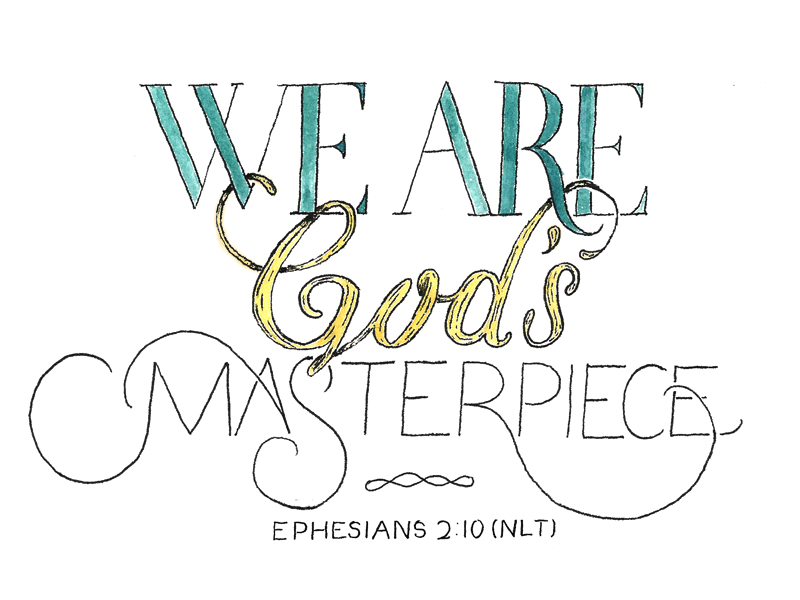
    "God's Masterpiece" by Dawson Vosburg
    “God’s Masterpiece” by Dawson Vosburg

    You were dead in your transgressions and sins, in which you used to live when you followed the ways of this world and of the ruler of the kingdom of the air… All of us also lived among them at one time, gratifying the cravings of our sinful nature and following its desires and thoughts… But because of his great love for us, God, who is rich in mercy, made us alive with Christ even when we were dead in transgressions… For it is by grace you have been saved, through faith—and this is not from yourselves, it is the gift of God—not by works, so that no one can boast. For we are God’s handiwork, created in Christ Jesus to do good works… (Ephesians 2:1–5, 8–10)

    Some say that Ephesians 2:1–10 is the best biblical summary of the gospel. As Paul moves in the previous chapter from an exultation of God through Christ on a cosmic level, he turns here to the level of humanity, showing how God has saved us from our sinful lives. He compares the old with the new: once we were dead, but now we are alive. Once we were ruled by the cravings of our flesh; now we are saved.

    This is pure grace. God in his mercy pulls us out of the graves we dig for ourselves, through lies, slander, bitterness, unbelief, or unforgiveness. He releases us from the tangles of these deathly cords and sets us onto a solid foundation. When we are placed firmly on the rock of Christ, we are then propelled into a life of good works. And lest we claim this goodness for ourselves, Paul reminds us that these works too are a gift from God. We are God’s craftsmanship, his handiwork, his workmanship; in short, we are his work of art. And we, fuelled by grace, find joy in the release from our sinful nature.

    Some people have had an amazing conversion story, having turned from a life of drugs, sex, or the occult. Others, like me, have been followers of Christ since they were children. Either way, we know that God is continually transforming us through his renewing Sprit, forming us into the glorious creation that he has always intended for us to be.

    Prayer: Lord, you are renewing me day by day. Shape me into your masterpiece.