Category: Identity

  • A letter to my goddaughter going to university

    Photo: liz west, flickr
    Photo: liz west, flickr

    Dear lovely goddaughter

    It’s the last week for you at home before you go off to university – and your life changes forever! I know that sounds daunting and exciting and nerve-wracking and scary but wonderful too.

    We have loved watching you (admittedly from afar) develop into such a wonderful young woman – one who knows and loves God, who seeks to deepen in her faith. That in particular gladdens my heart as your godmother. To me, I seek to keep my faith the most important factor in my life. With the triune God as your friend, you’ll be able to face the challenges and to rejoice in the joys in the days and years to come. He’ll never leave you. He’s always there, gently sending his nudges of grace and whispers of love. I hope you continue to learn to sense the ways he communicates with you.

    You going to university has made me think back to my leavings and beginnings, as I took the big step to leave high school and go to a Christian university, just a few miles from my parents’ home in Minnesota. I thought it was important to live on campus that first year, and so I did with two very close friends. Two blondes, in fact!  We had hard times and good times, and it was important for me to live away from home to establish my identity apart from my parents. To start thinking through issues of faith and belief – especially as I attended a Baptist university and grew up in the Roman Catholic church. And to learn how to live with roommates!

    My faith took an almighty hit my sophomore year, on October 15th to be precise, when one of my closest friends from high school was killed in a car accident. It was a shattering time, and I wondered how a good God could have allowed such a horrible thing to happen. To be honest, all these years later I can’t totally answer that question. Who can? But as I probed and sobbed and searched, I found hints to answers to that question – the mystery of evil and a broken world and yet a loving God who works to redeem and shower grace.

    My friend’s untimely death makes me think of one of the biggest pieces of advice that I can give you as you go off to university: Expect the unexpected. Now I pray so much that this will not mean not the death of a loved one – I definitely don’t wish that for you. But things probably won’t turn out the way you anticipate as you set off to your new home away from home, heart pounding, stomach a bit growly, your nerves a flutter.

    Things may not turn out the way you hope they will, but they can turn out in a better way! I for one would have never believed that I’d be living in the UK these almost 19 years later, nor that I would have lived in the amazing city of Washington, DC, for ten years, which started with a semester my junior year. God has mysterious ways of working and moving, and helping us to learn and love and change. Sometimes we feel the changes are welcome; sometimes unwelcome. But he’s always with us, and life with him is an adventure.

    So lovely goddaughter, know that we love you and will be praying for you. Your heart will be tugged in more directions now as you meet new friends and learn to love a new city. Come to visit us in London some weekend – you’re always welcome!

    With love from us all, Amy

  • A Dream Shopping Trip – An Abundant God

    dresses-155838_1280Have you ever gone on a dream shopping trip? Like one of those televised free-for-alls where someone can keep whatever they grab in thirty minutes? Well, I’ve not been on one of those – thankfully, I think, for I can only imagine the specter of my consumerist heart going mad. But a few years ago I got to go on an even better trip to the mall.

    “Let’s go shopping!” Lulu said.

    “Okay!” I responded, with a surge of joy and nervousness. My friend was a generation older than I, and in a different stratosphere financially. I sensed this wouldn’t be any ordinary shopping trip, but an amazing experience of grace and beauty.

    I had recently given birth to our second child and wasn’t feeling good about my body. The weight hadn’t magically melted after my daughter appeared; nor was it shifting in the months that followed. I felt I didn’t deserve the nice clothes Lulu might buy for me – I was lumpy, not svelte. Somehow I believed that gorgeous clothes should only be enjoyed when we are at our goal weight. Not when we’re way over.

    But Lulu wanted me to feel beautiful, extra pounds or not. She decided I needed some stunning business suits and dress clothes, with no cost spared. So we camped out in the fitting room of a high-class department store with a special salesperson at our beck and call. This woman dashed from one rack of clothes to another, finding the right sizes of sparkly shirts and well-cut trousers.

    As I glimpsed the expensive tags I started to worry. How, I wondered out loud, could she spend so much money on me when I wasn’t slim and trim? Lulu shushed me in a loving but firm manner. “Amy, I want you to look and feel good. Let me do this for you. Besides, when your size changes, you can always find a tailor.”

    Grace incarnate. Did I deserve the clothes? No. But do I feel good when wearing them? You bet I do (although for some I now need a tailor). What a gift, this lavish splurge on clothes. What an example of love and acceptance.

    I’m still not at the perfect weight, and my daughter is well into her primary school years. But instead of hating my body, I try to remember that God has formed me and created me. He doesn’t want me to look down at myself with despair, but to turn to him in praise and out to other people with love.

    He’s always sending his loving words to us, saying that he’s chosen us and not rejected us. That he is with us when we pass through the waters – they will not sweep over us. That we are precious and honored in in his sight.

    When I look to the Lord for love and affirmation, I gain a sense of well being – whatever the number on the scale. How about you?

  • Swapping Houses

    DSCN7187
    There’s so much to see in Minneapolis.

    Last year right about now, I was frantically getting the vicarage ready for a house swap. The four of us were headed to Minnesota, to the land of my people – yes, where “all the women are strong, all the men are good looking, and all the children are above average” in Garrison Keillor’s memorable words. A British family, who have settled in Minnesota, were coming here to London, and we were taking over their home, which is (amazingly) only a couple of miles from my parents’ house.

    Entering someone else’s setting for a week or two can feel surreal. The friend whom I swapped with and I chatted back and forth on a social-media site during the early days, comparing US versus UK ways of doing things, and both of us, I think, having a sense of, “This could be my life.” In fact, I so hadn’t emotionally disengaged from life in London that at first it felt difficult to stop the conversation. Then one morning I realized in prayer that I needed to be present where I was – and why wouldn’t I want to be? I had longed for this space to see family and friends again, and to experience the joys of things like amazing plumbing and Target. And I needed to bless my friend and let her get on with her time in the UK.

    The kids loved so much about living in someone else’s home for two weeks. CutiePyeGirl was thrilled that they had two girls; PyelotBoy not fussed, understandably. One of the kids’ favorite things each day was running across the (not busy) street to get the mail out of the mailbox. A novelty, to be sure.

    Can you imagine what your life might look like if you changed places with someone living a similar sort of life (similar job; similar ministry), but in a different country? Not an exercise to get hung up on, for the reminder to me is to give thanks for the life I do have. Especially as today in London the sun is shining.

  • Identity: At home in your skin?

    A line in a novel recently jumped off the page: “The people were pleasant enough, but Beth had felt judged in a thousand subtle ways, simply for wanting to be herself” (in Forbidden by Claire Wright with GP Taylor).

    Have you ever felt like that? Like you’re just that bit different than the “in” crowd? Or when you walk into a crowded room boasting a lot of unknown faces, you wonder whether you’ll be accepted or whom you’ll talk to?

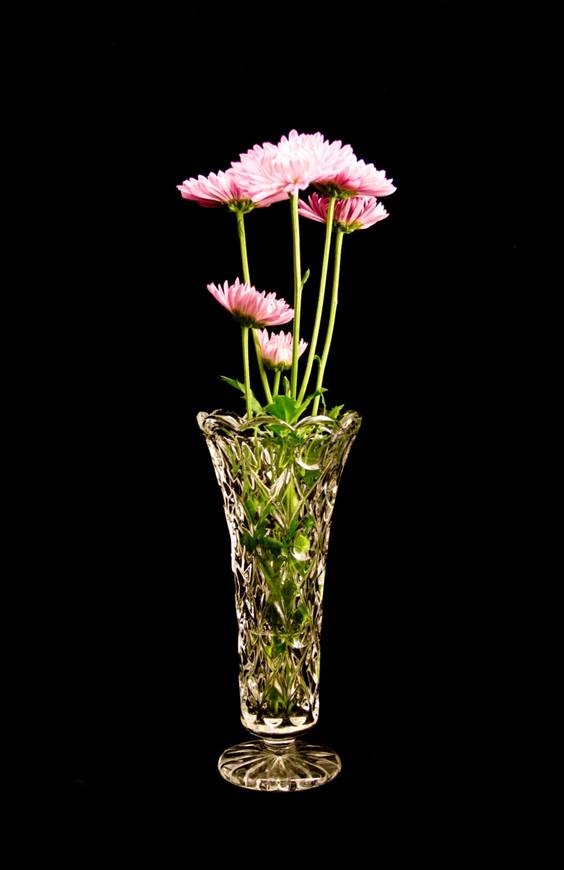
    VaseI have. But then I’m an introvert, and I haven’t always felt at home in my skin. I’ll probably always have to take a deep breath before entering new social or work situations. If I let the fear of the unknown get to me, I could easily descend into the muck of feeling like I’m the sad loner without friends. So, if I remember, I affirm a few truths with a simple breathing exercise. As I inhale deeply, I tell myself that I’ve been made in the image of God, and that through his Holy Spirit he dwells inside me. Then as I exhale, I shoot up an arrow prayer that God would lead me to just the right people to talk with – perhaps those who might be feeling on the edge of things themselves.

    That simple exercise reorients me, and I feel like I’ve put on a pair of God-infused glasses. All of the sudden I can see others as God’s amazing creations and I want to know more about them: what makes them tick; what they’re passionate about; how they find meaning. As the evening progresses, my smile grows and I may hear some astounding stories. All from stepping away from fear and stepping into the woman God created me to be.

    Of course, we live in an imperfect world, and sometimes the evening ends with me wondering why I didn’t have many God-encounters. Or why I still felt self-conscious, like I am watching myself from the outside. Or in the words of Forbidden, that novel I mentioned, “People just didn’t ‘get’ her. Rich hadn’t understood that part, but of course, he wouldn’t. His face already fitted.”

    If I take the time to reflect, I again realize that I have to root my identity in being God’s beloved. He has formed me as a beautiful crystal vase that reflects his light and glory. If I’m not receiving his love and affirmation, I might let the water inside the vase get stagnant or grey. But when I ask him to pour in his living water, he displaces all that is dirty and mucky. And in that vase he even places some gorgeous flowers from which waft his sweet fragrance.

    Do you feel at home in your skin? Why or why not? If not, what do you do to combat these feelings?

  • The Lord is my…

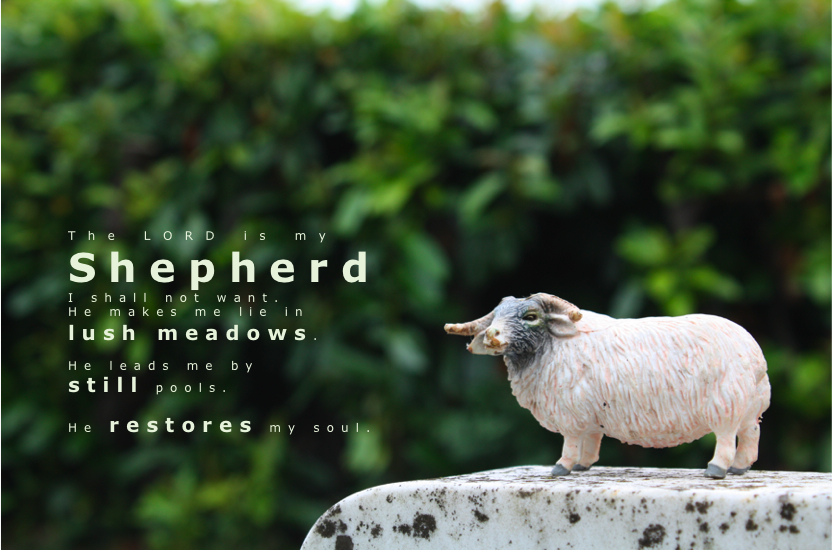
    What’s the Lord to you? Your Shepherd? Director? Boss? Father? Friend?

    Photo: Suzy Bower, flickr
    Photo: Suzy Bower, flickr

    Recently, when reaching the end of a retreat, I led a group of women in an exercise of engaging with Psalm 23. We talked through this beloved psalm of David, imaginatively placing ourselves in it, and asking such questions as: Is the Lord my shepherd? Do I graze with the flock? Does he lead me beside quiet waters? Can I fear no evil? Do I feast with the Lord? Do I live in God’s house? (I recommend giving this a try – you might be surprised by how God speaks to you through these familiar words.)

    Our exercise was to personalize Psalm 23. I read them my version from a writer’s point of view, but delighted in their creativity when, at the end of the exercise, they read me theirs. With permission, I reproduce two here:

     
    The Lord is my strength, I lack nothing
    He makes me lie down in green pastures
    He leads me beside quiet waters He strengthens me
    He guides my feet along the right path for His name sake
    Even when I go through difficult and trying times He strengthens me
    I WILL NOT FEAR FOR YOU ARE WITH ME YOUR PRESENCE AND PROMISES COMFORT ME
    You prepare a table before me in my times of doubt and fear
    You anoint my head with oil and my cup overflows
    Surely your goodness and love will follow me all the days of my life
    I will dwell in the house of the Lord forever


    The Lord is my closest Friend. 
    He knows everything about me.
    He draws me to a quiet place and refreshes me.
    He brings everything back into perspective and renews me.
    Even when I go through the storms of life He is right there beside me.
    He rescues me from evil, heals, comforts and restores me.
    He prepares a banquet before me in the presence of all my enemies.
    He anoints me with His precious Spirit and my cup overflows.
    Surely blessings and love will be with me all the days of my life and I will dwell in the Lord’s house forever.
     

    Why not, this weekend, take some time and write your own?

  • Living in shame, or living free

    I returned home from our wonderful week in Northumberland, feeling spent from a summer and autumn filled with good things: Our family’s five weeks in the States. Leading a meaningful and sun-filled retreat in Spain. A trip to the States to play with my high-school friends at the lake where they filmed Dirty Dancing and to celebrate family birthdays. And most recently our jaunt up to the wilds of the Northeast of England, venturing into the rugged coast and atmospheric castles.

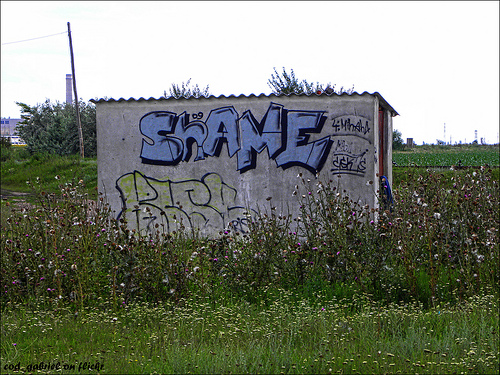
    Photo by cod_gabriel as found on flickr
    Photo by cod_gabriel as found on flickr

    Although I knew I was facing a first-world problem of exhaustion from too much fun and travel, I was wiped out. And so I wasted more time than I like to admit early this week watching episode after episode of Scandal, a drama based in my former home of Washington, DC. The storylines gripped me and I loved seeing the beautiful buildings of my former stomping grounds. But watching so many episodes when I should have been spending my time with more fruitful pursuits – gardening or decluttering would have been more fulfilling – left me with another shame hangover.

    Shame hangover – such a descriptive term, which Brené Brown employs in her acclaimed TED talks and book Daring Greatly. I spoke last week of my shame hangover related to my flapping mouth and unholy moments while at Holy Island, which many of you responded to with forgiving love and sometimes a knowing, “I’ve been there.”

    Shame can stick to us like a new set of clothes, ones we don that can become sealed into our skin. So familiar they can become that we don’t know how to operate without them. And so like Eustace Scrubb in CS Lewis’ The Voyage of the Dawn Treader, we need to remove them with God’s help, in a sometimes painful manner. Eustace, you may recall, had been turned into a dragon through his dragony greed and selfishness. He meets a lion (Aslan), who asks him to undress. Eustace peels off a few layers of dragon – of selfishness and pride – but remains a dragon. The only way to undragon is for Aslan to bring about a deeper cure – one that sinks deep to his heart and hurts greatly, but brings about a new person.

    I’ve been thinking lately about the old self and the new, for not only at our conversion do we shed our old self with its sinful practices and take on the new self. This process of putting on the new self is continual, as the apostle Paul writes to the church at Ephesus: “You were taught, with regard to your former way of life, to put off your old self, which is being corrupted by its deceitful desires; to be made new in the attitude of your minds; and to put on the new self, created to be like God in the true righteousness and holiness.” (4:22-24)

    His verbs are active in the Greek – we put off our old self and put on the new. Our new clothes are no longer the rags of shame, but the royal robes of daughters and sons. Indeed, we are clothed with Jesus himself. But we don’t always wear our new robes. We slink back to the rags, perhaps through exhaustion or weariness. When we tire of the shame hangover, we can release it over to God, asking for forgiveness and for him to fill us with his Holy Spirit, that we might be empowered to live the forgiven life.

    So as I get back to a structured routine, one not filled with countless episodes of spin-doctors, I come before God and ask him to help me wear his richly colored robes as I shed the ragged shame-inducing garments. Here’s to being forgiven!

     
    The New Name
     
    I will give you a new name
    Known only to you
    Contented will you be
    At peace; in rest; whole.
     
    I will give you a new name
    Complete; without needs
    Fulfilled; affirmed; fully clothed
    Named by my love.
     
    I have given you a new name
    Walk into it; accept it
    Wear it as a royal robe
    Adorned you are by my love.
     
    I have given you a new name
    Beloved you are
    Most precious to me
    Cherished; adored; redeemed.
     
    I have given you a new name
    My daughter in whom I delight
    With my presence, filled
    A vase reflecting my beauty.
     
    With your new name, go forth
    Embodying peace, joy and love
    For with you I walk, in front and behind
    Never to leave you, I promise; always here.
     
    © 2012 Amy Boucher Pye 
  • Twentysomething choices

    My niece is turning 20 soon, that wonderful decade of exploring identity, building relationships, entering into the world of independence and adulthood. It can be a time of searching and experimentation; a time of solidifying who we are. My smart and hard-working niece has known since she was 10 that she wanted to pursue a career in medicine, but when I was in college, I was a bit lost about what I wanted to do with my life. I knew I like words and writing. And I had enjoyed my dad’s computing, when as kids he would bring home a console and plug it into the phone for it to speak to the mainframe at Pillsbury, where he worked.

    Which way to turn? The way ahead, or that little cobbled trail to the right?
    Which way to turn? The way ahead, or that little cobbled trail to the right?

    So when I was wondering what to pursue at college, he encouraged me to be a technical writer. I signed up for some computer courses – Basic, Pascal, Fortran, and Cobol. I did okay at first, but when I got to Fortran I started to struggle. I went to see my professor when I was flailing around with the latest assignment. His words brought instant clarity: “You know Amy, I don’t think that writing code is something you really want to be doing in your free time.”

    He was right, and I felt relief in dropping the computer-science minor. But I don’t regret the classes in Cobol or even my political-science major that I later embraced. I find it funny that I studied poli sci, for I’m not a news junky or a politico (as my husband, who has these proclivities, will fully attest). But God used and redeemed my choices of studies at college – my political-science major meant that I went to Washington, DC, for a semester, which turned into ten years of amazing, challenging, eye-opening experiences. My internship including working for a fabulous British Christian writer. Who knew I would later live in Britain, writing and working in Christian publishing?

    So to those such as my niece who are moving into the next stage of life, I offer you blessings from a fellow pilgrim. Whether you have your path charted out or whether you aren’t sure which way to turn, may you feel freedom in taking the next step. May you feel the Father’s hand in yours, never constricting but always encouraging. May you experience joy in the journey.

    If you’re well past your twenties, let me ask you this: How did your experiences of that decade shape your life?

  • Becoming ourselves – Agnes Sanford

    I love hearing about heroes of the faith, especially those who might be overlooked today. One is Agnes Sanford, a pioneer in the healing-prayer movement in the twentieth century. Before she died at the age of eighty-four in 1982, Newsweek magazine hailed her as one of six people who shaped religious thought in the twentieth century. But before God used her so powerfully, she had to work through a painful journey of self-discovery and acceptance.

    Agnes Sanford photoAgnes grew up in China, the daughter of missionaries. Her struggle to release her true self came when she was living in the States, married to a pastor. Her husband Ted had been raised in a clergy household, and Agnes loved his parents, especially his mother. At first, Agnes modeled the role of minister’s wife on her mother-in-law, but doing so brought forth a crisis of identity:

    I had determined to make myself exactly like Ted’s mother, whom I adored. I would then be, I felt, the kind of wife that he liked. Therefore, I completely denied my original nature and devoted every moment to fruitless endeavor. And so I reached the depths because I was doing violence to my own soul. (Sealed Orders, p. 106).

    She thought she should be the perfect host and companion to Ted in his ministry. But in doing so, she was denying the deeply creative part of herself that wanted to give birth to new life, whether through writing, prayer, painting, or other artistic ventures. The false self was keeping her true self from thriving:

    My wounds were too deep to be healed so easily. And what were those wounds? If anyone had asked me at the time, I would have said, first of all, that the real part of me was simply not living, the creative one who longed, not only for children, but also for the children of the mind to be brought forth.

    The basic trouble was that I had forgotten whence I came, and I did not know the sealed orders with which I had been sent to this earth. I sensed my thwarted creativity. I wanted to be a writer, and I could not, for all of my time and thought and attention was upon being a wife and mother.

    … At this time I came very near to the deepest depths and could easily have drowned in them…. I could no longer see beauty. And when one can no longer see beauty, one can no longer see God. (pp. 101-102)

    After a long struggle, Agnes sought counsel with a neighboring minister, knowing she needed to find a way out of the strangling depression. He brought clarity where she had been covered by a suffocating cloud:

    “Don’t you see you have been trying to be a square peg in a round hole? To make yourself into something you are not?”

    … “But nobody will like me if I am myself!” I cried. “Not Ted nor his family nor the parish nor anybody!”

    “They won’t have you, unless you let yourself be yourself,” said Hollis. (p. 111)

    With this, Agnes began to throw off the cloak of the ill-fitting clothes. Ted’s mother may have been created to fulfill the role of the “perfect minister’s wife,” but that garment didn’t fit Agnes. She would only be the best wife for Ted – and his parish – when she was living out of her redeemed self, that creative person whom God had called her to be.

    God sent his healing, but he wanted her to be involved as well: “I find that God will heal us up to the point of our being able to think and to pray and to reason, and from then on, while He still helps us, we must nevertheless fight the battles of life ourselves. I was becoming a new person: the original person whom I was born to be. And this was the exact opposite of the person whom I had tried for some six years to make myself – a perfect minister’s wife.” (p. 118)

    As Agnes stepped into her new clothes, she became that person. A writer, a painter, a woman devoted to prayer for people and the earth. And the world will never be the same because she flung off her rags and put on her royal robe, tailored just for her.

    Do you have a new set of clothes just waiting for you to don?


  • Dual citizenship

    2013-07-03 10.21.49

    When I first moved to the UK, I felt so self-consciously American. Hyper aware of my accent, which immediately labeled me as foreign. Fifteen years later, I usually forget my “other” status, but sometimes – often when I’m out of London – someone will look at me with curiosity and ask me where I’m from.

    “North London,” I’ll say somewhat cheekily, fully knowing that’s not what they mean. “But from the States originally.”

    And again I’ll be jolted into an awareness of otherness. That sense of being a foreigner in a strange land. The longing for home, which God embedded into each of us, whether we live in an adopted country or not.

    A few months ago I wrote a poem expressing some of these feelings of heavenly citizenship, and to Whom we ultimately belong.


    We belong
    Attached
    To you
    To others
    We belong.
     
    The yoke
    It’s a light burden
    Making us free
    Releasing us to bolt
    Out from our pens
    The gates flung open
    Running to the Father.
     
    We belong
    Peace resides with us
    A home is ours
    With arms and legs
    Hearts and hands
    We belong.
     
    Freedom and joy
    Usher in light and peace
    Rooted in the earth
    Grounded we are.
     
    Foreigners and aliens
    Away from our home
    Longing for a country
    For a city and the throne.
     
    We belong to each other
    Needed for love
    Learning to see Jesus
    His presence among us
    We belong.
     
    © 2013 Amy Boucher Pye  
     

    What makes you yearn for home?


  • The identity of a writer

    In my university years, I was friends with a man who was intellectually gifted. I enjoyed our times together, but deep down, I never really felt myself with him; I somehow felt I was lacking. Not that I would have ever even named this vague feeling of dis-ease, but I can see it looking back through the lens of time.

    We often went on outings in the city where we lived. By mutual never-expressed agreement, neither of us was interested in the other romantically. This made for jaunts to restaurants or cultural happenings that were fun and generally easy. Until he would say something that felt like an underhanded critique.

    Such as one day as we were browsing in one of the city’s fine bookstores. As we were exiting, he said, “You know, Amy, maybe one day you could run a bookstore.”

    Startled by his pronouncement, I merely said, “You think?”

    writing books
    A selection of my books on writing. Some great ones in there; I especially recommend the one by Eudora Welty (One Writer’s Beginnings) and of course William Zinsser’s is a classic.

    His comment stung, because I had a deep-seated desire to be writing the books, not selling them. So I saw his remark as a putdown. I hasten to say that having been in the publishing business for so many years, I have met many a fine bookseller, marked by enquiring minds and wisdom. Now I wouldn’t see his comment as derogatory, even though I still prefer to be part of the creating process.

    And the creation of good books is what my career path has focused on. Mainly with me helping other people to write, rather than me being the one to do the writing. Only now – some twenty years later – am I in the process of writing a book that I hope will one day feature in a bookstore.

    Another comment by another intelligent man whom I respect (and a writer himself) brought me low a few years ago. When I told him that I wanted to be a writer, he said, “That’s something you can aspire to later on.”

    When he said that, I felt he was saying, some day you can try that. Later on, when you’ve learned more and become more wise. He is generous-hearted and probably meant nothing by the comment. But it wounded nonetheless.

    But most days I write, and the working days I enjoy most are those penning one thing or another. Part of being a writer – at least for me, with fledgling confidence – is accepting the moniker and growing into it. Knowing that I am a writer because I write; not because I’ve clinched a magical three-book contract (although that would be nice too). God can change my name. Not just Amy, the editor. But Amy, the writer.

    How about you? Is there some unaffirmed part of yourself that longs to be expressed? Have you had to grown into a new name?