What could be better than sinking into a great read this summer? The days are long and I hope you’ve got some space and time to enjoy a cozy novel or to dive into a mind-expanding nonfiction book. To help you, we at Woman Alive have devised the 2019 summer reading challenge. It’s an easy and fun way to be more intentional about broadening out what you read this summer.
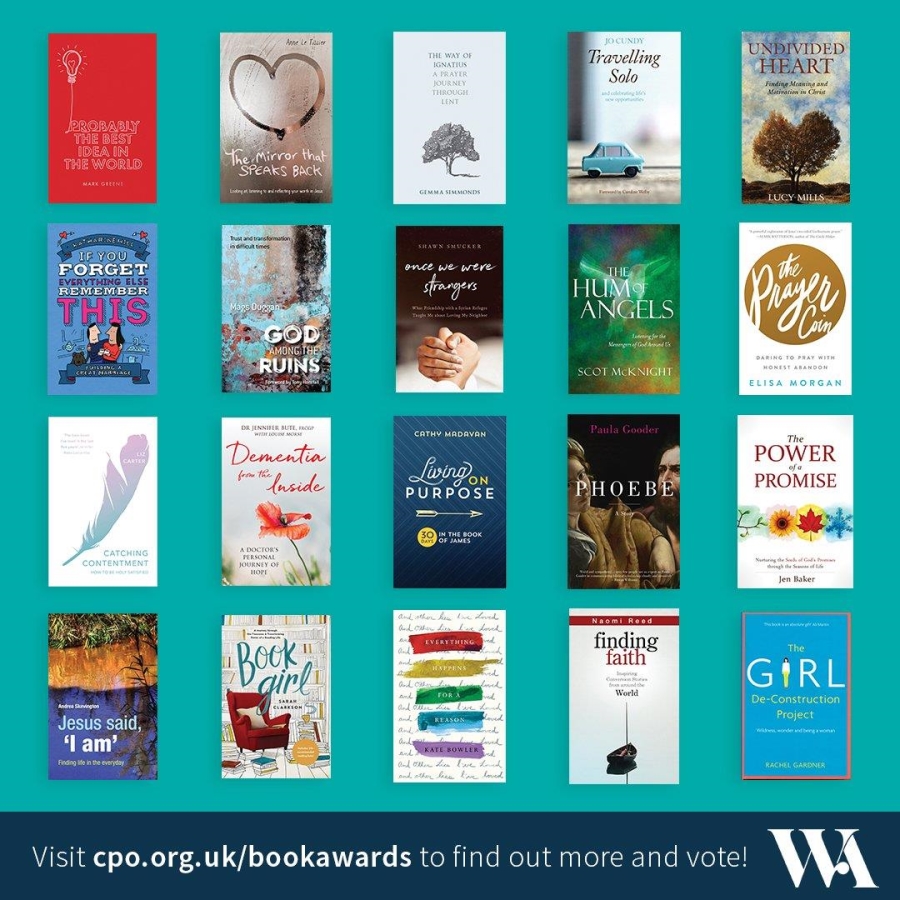
And please, if you haven’t already voted in the Woman Alive Readers’ Choice awards, please do so soon, as the closing date is 25 July. More details below.
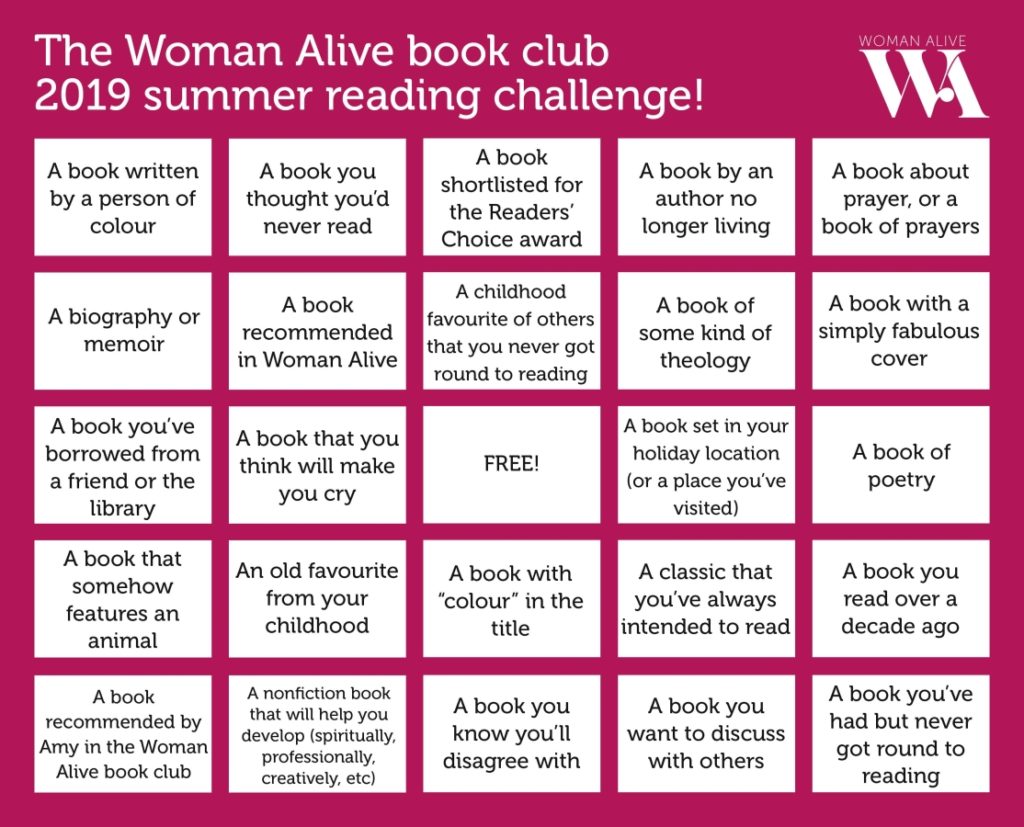
So the reading challenge… Above is a bingo card with options of what you can choose to read this summer. Be a winner by filling in the squares along one row, including diagonally, or be a super winner by filling all the squares. One book counts for only one square, please! Start now and aim to finish by the end of August, for we will do a roundup starting in September. You could make your own bingo card for any kids in your life to give them a fun summertime challenge too.
Find more details, including a list of all the books featured in Woman Alive over the last year, at the Woman Alive book club Facebook group.
We are also super excited about the Woman Alive Readers’ Choice awards. Jackie Harris, the editor of Woman Alive, and I have curated the list from books that have appeared in the magazine over the past year, and there are 20 great books to choose from. Please note we would like a short review of the book you’re voting for. You can find full details on the Woman Alive website so please join in. Your vote will make a big difference!
I was a commissioning editor at HarperCollins UK at the turn
of the millennium when I was given the delightful job of working with Michael
Green. It was Graham Tomlin, who was then at Wycliffe Hall with Michael, who spurred
him on to pen his reflections over what was then fifty years of ministry.
Michael came into the offices in Central London, his twinkling eyes and cheery
disposition shining. We hit it off, and I was so delighted to have the honour
of helping him shape his memoirs.
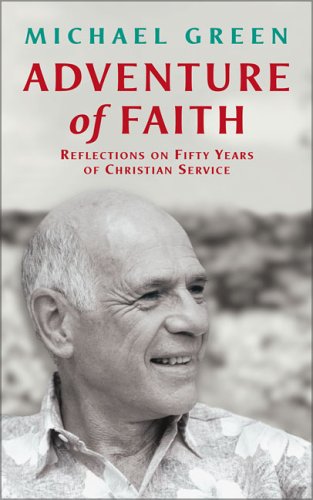
Adventure of Faith is a rich romp through fifty years of God’s faithfulness to Michael and Rosemary. He shares wonderful stories of being at the right place at the right time – such as how he published The Truth of God Incarnate, a response to the shocking TheMyth of God Incarnate in a mere 6 weeks! Or how he and Rosemary followed God’s call to the frozen north of Canada, what he called his adopted country, or later to help pastor a church in North Carolina. Of preaching on the streets and engaging in academia. Of writing book after book during a heyday of Christian publishing. Edward England was the visionary publisher at Hodder then, and he and Michael produced many a work that equipped Christians in being faithful disciples of Christ.
Often when I’m preparing a chicken I think of Michael – strange, but sometimes those seemingly little actions can communicate volumes. Mark Greene tells the story of Michael coming to dinner with his parents. They were struck by the care that Michael took in carving the chicken and remarked over it, to which he replied something along the lines of, this chicken gave its life for us; shouldn’t we be grateful and respect it?
The winner! Illustrated and designed by Vivian Hansen.
“Don’t judge a book by its cover.”
“A picture tells a thousand words.”
In the case of my first book, I’m happy if you judge it by its cover, because it’s just so darn good. When I first received the design, I loved pulling it up on my phone and watching the person’s face as they saw at it for the first time. Again and again, they would flash a smile and often they’d exclaim in delight. Here’s part one in how the cover came to be.
When I was a commissioning/acquisitions editor at two big corporate publishing houses, we had whole teams of designers working on the covers, designing them and/or hiring out artists or photographers to provide the original artwork and photographs. How many cover designs we’d receive per project would vary – sometimes we’d have three or four variations on a particular cover, but one Stateside designer was known for his huge creativity, giving us ten to fifteen completely different designs.
Times have changed, although I suspect the massive publishers continue in this fashion. But Authentic Media, the publisher of Finding Myself in Britain, didn’t have its own design department in-house, so was able to explore other options. The MD, Steve Mitchell, is innovative and creative, and follows the publishing trends and has a sense of what’s new and what’s possible in this strange new world. I’m so glad I followed his lead throughout the process.
The cover needs to be available about six months before publication, so the design process needs to start at least nine months before. I had previously shown Steve an amazing painting of our church that Steve Bjorkman had carefully crafted in a mind-blowingly rapid manner when he and his wife were visiting the UK one year, and Authentic-Steve wondered if a cover might emerge from it. Here’s one of the covers Authentic-Steve had designed with the painting by Artist-Steve, which although we thought was fun, we knew wasn’t exactly right.
Artwork by Steve Bjorkman. One of his paintings does appear in my book, which delights me.
So Authentic-Steve committed instead to have the design created through 99 Designs. I had heard him speak of the good experience he’d had in the design of other books, such as Chris Juby’s @BibleIntro, so knew a little of how the website works. The publisher signs up for a package – bronze, silver, gold, or platinum. The higher the package, the more expensive (but still reasonable), and the more designs you have to choose from. After the contest starts, any interested designer who is signed up with 99 Designs can submit a design within the 7-day window. When the contest is closed, the publisher/author chooses a design and can ask for tweaks. The winning designer then receives the fee.
I see a lot of benefits of this system, but admittedly they favor the publisher. One is having access to designers from all of the world. Another is the huge number and variety of designs that are submitted with only having to pay for a flat fee. But from the designers’ point of view, it’s a lot of work that you might not get paid for – I did feel bad for the stellar designs created that we didn’t use. Yet it gives designers the access to potential work that they’d otherwise not be considered for. For instance, we’d have never found the winning designer without this website.
My publisher put together the cover brief (you can see it here), which was a short summary of the book (a couple of paragraphs and an outline of the contents) and then for the design elements, he said:
We aren’t looking anything too twee or formulaic e.g. flags.
I wanted to put down more suggestions about what ways to take the cover visually, but Steve rightly pushed back, saying, “You’ve got to trust the process.” This is where authors need good and wise publishers – we think we know what’s best for our book-baby, but we don’t. I’m so glad we weren’t directive, and trusted the designers to do what they’re good at – designing. (And yes, the winning design does employ flags!)
We received 96 designs from 42 designers for the contest. Some of the covers made me cringe – one in particular made me think of 50 Shades of Britain – but many were excellent and a couple were outstanding. Of course, anything to do with art and creation is subjective, so what I thought was fabulous wasn’t always the same as what others thought. But we all agreed on the winning design.
I don’t think I should cut and paste over some of the designs that didn’t get selected because of copyright issues, but you can see examples here and here. Most of the designs have been taken down, but you get a feel for the diversity of options we had. I liked the feel of #92 and #90, but they are more typical of what one would expect for my book; the winner simply outshone them. Several of the people at my publisher liked the cover by LilaM, but I thought it looked twee (US: cringey), and like a woman during the thirties or forties.
In part two on behind the scenes of the cover design, I’ll interview the winner of the contest, Vivian Hansen.
I’m back from two wonderful but intense days at Christian Resources Together, a gathering for people in the Christian publishing, supplying, and retailing industry – and yes, that includes content creators such as writers. I’ve been in the Christian resources biz for over twenty years, nearly 18 of those in the UK. So for me it’s a rare time to see, greet, and hug familiar faces from the past (a few mates were playing STL Bingo during the award ceremony, which hints at their affection and humor, and will only mean anything for those in my industry).
This year was special because I moved officially from “publisher” to “author.” I’ve loved being an editor, launching all of those wonderful Christian books out into the world to be ambassadors for God’s good news. And I grateful now to be one of those authors too, with her baby arriving in the world. For Finding Myself in Britain was shipped directly from the printer to the conference centre, as the official launch doesn’t arrive until the first of October. In fact, my publisher, Steve Mitchell, saw it first there. For me, the feeling was surreal to walk into my room in Swanwick and to see my book there on the bed, complete with chocolate for the participants to savor and enjoy.
Fuzzy photo of The Book greeting me. Surreal! Wonderful! Yes, a ghastly bedspread!
I was captivated by Bishop John Pritchard’s talk in particular. Here are some of his quotes, worth pondering:
“God doesn’t know how to be absent.”
I agree, but many people feel the absence of God when they go through tough times. Do you find this a challenging or encouraging statement, or somewhere in between?
“In the Bible, water is always dangerous to the Jewish mind.”
I never knew this, and want to do some biblical investigation. What about Proverbs 25:25, “Like cold water to a weary soul is good news from a distant land”?
“Pray, but not as though God is an outsider. He’s here.”
Yes, I love this, and sense the influence of Tom Wright.
I also learned that Thomas Hardy became disgusted at the reaction to his novels so he gave up writing them and turned to writing a poem a day. Many are pedestrian, but some are brilliant. Hmm; maybe I should try to write a poem every day. I did that during Advent last year, and loved it. I learned other things too, but those nuggets seem worth sharing.
Lawrie Stenhouse, Authentic Media’s fab sales guy.
I came away exhausted but encouraged. What heartened me the most was the family-like atmosphere, with the organizers Mandy and Steve Briars called the “grandparents” of the group. How wonderful that we can laugh together and enjoy one another’s company, especially when times in the Christian resources business have been so tough.
If you’re a writer, how do you handle criticism? I’m guest posting today at the Association of Christian Writers’ website, sharing the story of how I felt when I received feedback on my book, Finding Myself in Britain. Not a pretty sight.
At Friday, 5pm, I met my deadline. Having pressed “send” to my dozen reader reviewers with my manuscript, I was pleased to finish the first draft. I’d done a fair bit of rewriting on the manuscript already, passing my chapters, one by one, to my publisher for comment and critique. He unearthed hidden agendas that needed axing and quirky ways of stating things that needed rephrasing. Surely, I thought, the worst of the rewriting was over.
On Saturday at 3pm, I spotted an email from one of the reviewers. As I opened it I glimpsed her warning for me to “buckle up,” for she said she didn’t take a measured, British approach in her critiques but would be straight with me – yet she thought my baby was beautiful and wanted it to fly. I skim-read her thirteen pages of comments, the anxiety building in my gut, and took myself to bed.
Lovely to feature this interview with Julie Klassen (originally published in Woman Alive), who just won the fiction award for the Minnesota Book Awards with her book The Secret of Pembrooke Park. This makes me happy on many levels, not least because Minnesota is where I grew up but also because I was a reader of her book when it was in manuscript form, reading it through quirky Anglican eyes!
When I look back, I see how God graciously led me to become an editor. I learned so much from working with other editors and talented authors – things that taught me not only about writing but about how to craft a full-length novel. I am thankful for my years with Bethany House Publishers. But, I am also thankful that I could hang up my editorial “red pen” and focus on my writing. Two benefits I’ve especially enjoyed are having time to read for pleasure and developing friendships with more authors.
I think many of us, regardless of our place of birth, are swept away by the romance and chivalry of Jane Austen’s time. In fact, when I visited the Netherlands last year, I met with members of the Jane Austen society there. And last autumn I attended the annual meeting of the Jane Austen Society of North America with attendees from several countries. Miss Austen (and Mr Darcy) fans are everywhere!
I have loved all-things-British ever since I read The Secret Garden and Jane Eyre as a young girl. But like so many women, it was seeing Colin Firth in Pride and Prejudice that inspired me to read all of Jane Austen’s novels and cemented my love of the Regency time period. I find it a romantic time – with gentlemen in tail coats and tall boots and women in those lovely gowns, the courtly balls, and the chivalry where the mere touch of gloved hands during a country dance sparked romance. Sigh. It was also a time when church attendance and family prayers were commonplace. (After all, Jane Austen herself was a clergyman’s daughter.) Whatever the reasons, I am thankful so many readers are drawn to the era as I am.
When I am up for an award, I am always anxious when awaiting the big moment. Of course it’s a thrill to win, but that emotion is rapidly overshadowed by amazement and gratitude. I believe God has given me this gift, and I’m so thankful to be able to use it for His glory.
When I first visited the UK,while other tourists were visiting the London Eye or Buckingham Palace, I dragged my long-suffering husband to places like the Worshipful Society of Apothecaries and the Museum of the Royal Pharmaceutical Society of Great Britain. After all, I was researching my second novel, The Apothecary’s Daughter. On our second trip, when researching The Maid of Fairbourne Hall, we focused on visiting houses with their servants’ areas intact, such as in Bath or Newport. We also visited Devonshire and Cornwall where I pinpointed the setting for The Tutor’s Daughter.
I finally have “a room of her own,” as author Virginia Woolf described as necessary for fiction writers. For years, I simply wrote wherever I could find a quiet place – the dining room, while the kids watched TV in the living room, or tucked upstairs in our bedroom. Indeed, I wrote my first several novels without my own room, so I don’t know that I agree with Virginia Woolf, but it sure is nice having my own space.
Julie Klassen is an award-winning author of historical fiction. She enjoys travel, research, BBC period dramas, long hikes, short naps and coffee with friends. She lives with her family in Minnesota.
On the 13th of every month I’m blogging over at the Association of Christian Writers’ blog. Here’s a taster of today’s entry. For last month’s, on riffing to Psalm 23, click here.
Photo: le vent le cri, Flickr
“Many have undertaken to draw up an account of the things that have been fulfilled among us… With this in mind, since I myself have carefully investigated everything from the beginning, I too decided to write an orderly account for you … so that you may know the certainty of the things you have been taught” (Luke 1:1-4, NIV, abridged).
My heart felt ripped open when my job as a commissioning editor at a large Christian publisher was eliminated. I loved my work in coaxing writers to pen their creations – books that only they could write – to God’s glory. But the international market couldn’t support my job and so I had to bid it – and my authors – farewell. As I was leaving, the head of publishing said, “You’ll never know how many people’s lives are touched through the books you worked on. They’re God’s ambassadors.”
I’ll never forgot his encouragement, for he gave me perspective during a painful time. And indeed, as writers we’ll never fully grasp the impact of our words. Sometimes a reader will share encouragement, but often we write and press “send,” not knowing if and how God will use our labors. Read the rest.
As I think about appearing on Premier Christian Radio tomorrow to celebrate World Book Day, I thought I’d share a few tips on how to give a great radio interview. I’m not a pro, but I’m much more comfortable behind the microphone than I was when I went the first time, shaking in my boots and nearly peeing my pants, to review the newspapers back a decade ago. That experience was a bit like baptism by fire, as I sat across from a tough interviewer who in Jeremy-Paxman style grilled me over opinions on issues I didn’t even know I had. Five days of that helped me overcome a lot of fear, and each day as I left the studios I breathed a sigh of relief, verily skipping my way back to the Tube station.
When my next interviews weren’t live but taped, I could hardly believe how fun and light the experience felt. Jeff Lucas and Ruth Dearnley invited me to their fab chat show “In Good Company,” which felt a dream in comparison to the live firing line. They talked; I listened; I chimed in… and we even could stop and go back and have bits edited out!
Imagine you’re talking with one person
This was my Best. Advice. Ever. I told a work colleague about my upcoming News Review interviews and he, an old hand at presenting on radio and television, imparted this wisdom. If we think of the potentially thousands of people who might be listening, we’ll clam up and sound stilted. Instead, imagine you’re having a conversation not only with your interviewer, but that one person from the audience is there in the studio with you. You’ll come across as much more personable.
Shut up!
Oh my goodness; I’ve learned this one the hard way. When I listen back to some of my early interviews, I cringe at how I would go on, and on, and on, and on. How boring for the listeners; how insensitive of me not to let the interviewer (or if you’re in a group, the others) to get a word in edgewise. I can see now that nerves were driving this drivel. Don’t be afraid to say your answer and then stop speaking; the interviewer, after all, is probably a seasoned professional and will carry the conversation. Your silence will also give her the opportunity to follow up on what you say or steer the conversation in another fashion.
Prepare – then let it go
You may be tempted to bring a load of detailed notes with you into the studio; don’t. Do prepare in advance, writing down your main points and even practicing some snappy lines or phrases that you’d like the listener to engage with. (Having a family member or friend conduct a mock interview is a good way to see if you need to practice more.) But if you are slavishly poring over your notes in the interview, you’ll probably sound scattered and disjointed.
Exude confidence – even if you don’t feel it
This is a tough one, for if our nerves are screaming at us and we’re live on air, we may feel anything but confident. Yet confidence breeds confidence, and as we slow down, take a deep breath, and focus on the interviewer and his questions, we’ll become more articulate and calm, maybe even exuding a sense of assurance. The interviewer too will gain in trust, knowing that he won’t be having to carry us in the interview.
Photo: Andréia Bohner, flickr
Smile
It may be radio (or television!), and you think the smile will be unseen, but what’s unseen matters (bigger spiritual principle alert). The smile in your voice will come through, and the listener will hear it.
After the fact, listen up
We can all learn from our experiences, especially with interviews. They get easier the more we do them, and we can learn from our triumphs and our missteps. Get a podcast of the interview and listen back in the privacy of your own home, cringing or smiling. What did you do well? What do you wish you would have said? When did you speak too much, or too little? Which ideas or words did you stumble over? Do you have any pet phrases that you seem to say all the time, or words such as “um,” that you utter too much? Don’t be too hard on yourself though – you’ll probably be a much harsher critic than those listening to you.
At the end of the day, give thanks. Any opportunity to share with others seems to me a gift from God, well worth returning thanks for.
My very first guest post! I’m thrilled to host the lovely writer and editor Evelyn Bence today, whom I know through the Christian publishing world. She lives in Virginia, where I used to live, though we didn’t know each other well when I lived there. Yet I can picture her in my former stomping grounds, the suburbs of Washington, DC, which makes me smile. Snarled traffic but warm hearts.
Photo: Jason Baker, flickr
Late spring: over coffee I was catching up with a former colleague named David. My news: “I’m just finishing a book manuscript. Fifty-two devotionals or meditations, about table hospitality. The setups are very anecdotal, from early planning and shopping to cooking, conversation, and cleanup. I’ve got forty-two. I’m not sure where I’m going to ‘find’ ten more stories, say nothing of insightful spiritual applications.”
“Fresh herbs,” he said, taking his conversational turn and describing his nightly foray before dinner, out into the yard to snip parsley, basil, rosemary, thyme for the vegetable or salad served up to his family. “The boys”—high school and college-aged—“roll their eyes at me. But I know they appreciate the taste, and, besides, I’m having fun.”
When he dropped me, back home, he recognized and pointed to the greenery in my porch boxes. “Remember the herbs. Parsley. Right there. Write about it.”
I knocked the idea around but couldn’t make it work. The final meditations jelled by other means, other themes.
Fast forward to a cold-weather Wednesday, late morning. An editorial job due on my desktop on Monday hadn’t yet arrived, but surely it would come in any moment now . . . or maybe not. Restless and unfocused, I flitted around the house, not able to settle on a new project or pick up an old, until my eyes rested on a bunch of thyme stems, grown out front, pruned way back, dried in a closet, and now pushed aside on a tabletop. David came to mind and his “remember the herbs.”
“Just sit,” an inner voice said. “Strip the leaves from a few stems.”
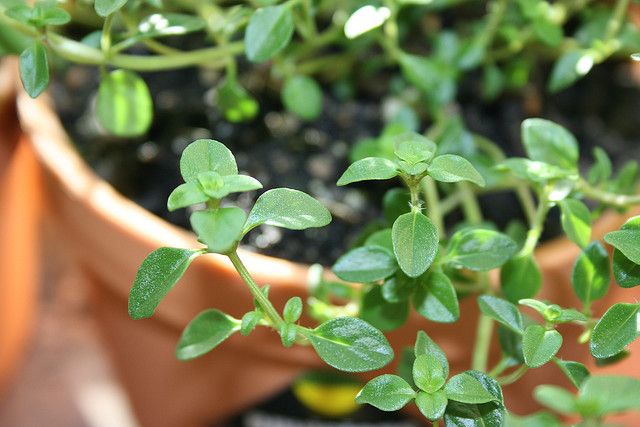
The hands-on—tactile—sensation focused me physically. Then the aroma! My spirit settled down. My restless thoughts turned to prayers, including thanks for David and the memory of our herbal conversation. I stayed with fragrant manual task until I had only two piles: barren stems for discard and tiny pointy leaves for my thyme tin.
I calmly checked my computer inbox. The job hadn’t arrived. But I felt as if I’d been graced—by choosing to redeem the time with thyme.
Evelyn Bence is author of Room at My Table: Preparing Heart and Home for Christian Hospitality.
Bob Hartman has been working for over twenty years as a performance storyteller for children, using his dynamic and interactive style to entertain audiences. He’s also the author of over sixty books. He and his wife have two grown children and three grandchildren, and they split their time between the UK and the USA.
Part of the reason I’m a writer is CS Lewis’s Chronicles of Narnia. I know everyone says that! But when I was at elementary school, every Friday afternoon Mr McKee would lower the blinds in our hundred-year-old classroom and read to us. The gloomy schoolroom would be filled with his voice and a special kind of magic. And I thought, “Yes, this is amazing!” Those books have always been at the heart of things for me.
My brother used to love puppets. When he was 9, he asked me to write him a script. I jumped at the chance and soon we were putting on shows regularly. I was usually the narrator and Tim did the puppets. I soon learned firsthand what it was that made an audience laugh.
It’s so sad that very few in the UK know Madeleine L’Engle’s A Wrinkle in Time. It’s fantasy shot through with faith but not in an overt fashion. It was one of the first science-fiction books with a strong female lead. We enjoyed reading it to our kids.
Angels, Angels All Around is my favorite of the books I’ve written, for it was the first time I felt I succeeded in bringing an original idea to life. It’s a series of stories; some are moving and some are funny. I worked really hard on that book, and I was allowed to play. My editor kept saying, “You can do it better; you can do it better.” So I kept rewriting, and in the end I felt like that book came out.
Tapestry, one of my books for children, has flowed out of my reading of Tom Wright’s Surprised by Hope; I have a lot of admiration for his ability to make theology sensible. Tapestry seems to be meeting a need. I met a woman recently who works in a bookshop whose brother died, followed by a close friend. She said my book was honest but not sentimental, and for me that that made all the difference in the world.
Frederick Buechner’s Telling the Truth: The Gospel as Tragedy, Comedy and Fairy Tale is amazing. When I first read it I was studying for the ministry. Previously I had an English major, and then began doing theology. Telling the Truth said you could do both – telling stories was telling the truth. This was before the whole narrative theology movement. I felt like he was saying, “Oh you can do it! Yeah; go for it!” So I did.
I don’t go to the beach much but I enjoy reading literary fiction. Such as Gilead by Marilynne Robison. Or The Road by Cormac McCarthy. The Times called it the novel of the decade and I think that’s fair enough.
People in my book club hate it when I pick the books because I always pick the heavy, sad, angsty, violent ones…. You know, those featuring post-apocalyptic cannibals. They hate me when we’re reading but eventually they love the books. But everyone nearly quit when we did Flannery O’Connor; they couldn’t make heads or tales of the story. She has a gift of pouring grace into the reality of life. Still, not everyone quite gets it. One guy just got up and left, saying, “I’ve had it.”





 Evelyn Bence is author of