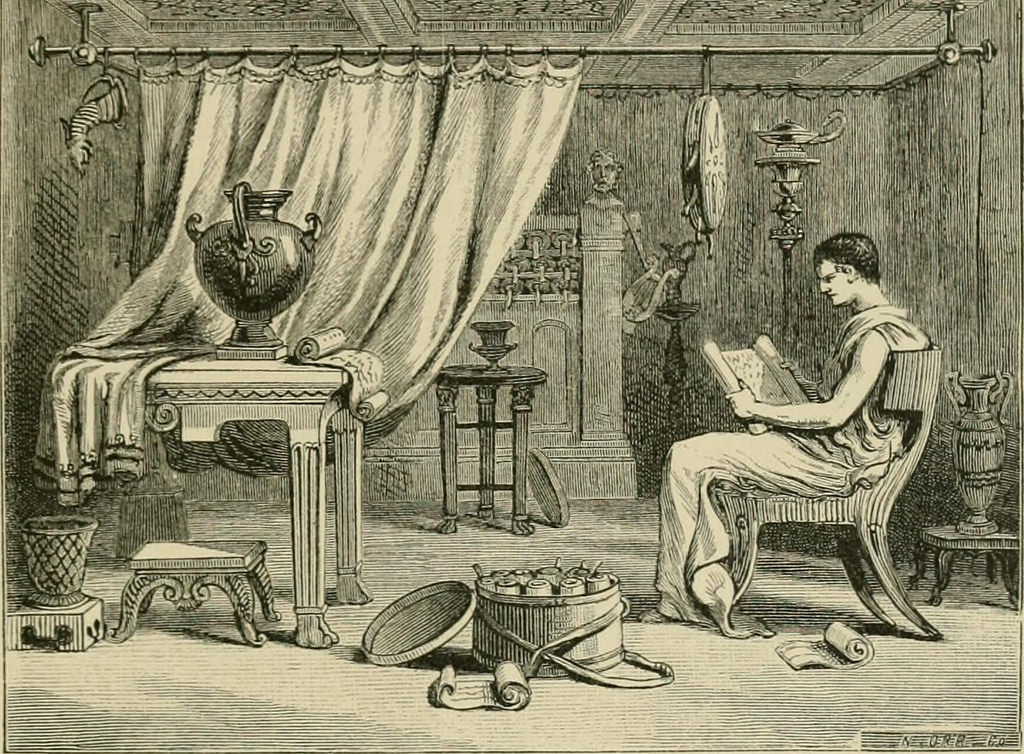
Image from page 40 of “The Epistle of Paul the Apostle to the Romans : with notes, comments, maps, and illustrations ..” (1888). Found on Flickr.
Many Christian figures in history named Romans as their
favorite book of the Bible. For instance, John Stott tells in his commentary
that the great reformer Martin Luther said of Romans that not only “should
every Christian know it word for word, by heart,” but that they should occupy
themselves with it “every day, as the daily bread of the soul.” William
Tyndale, a translator of the Bible, also urged his readers to learn it by heart,
for “the more it is studied, the easier it is; the more it is chewed, the
pleasanter it is.” Others who were affected by reading it were Augustine of
Hippo and John Wesley. (As cited in John Stott, The Message of Romans, IVP, 1994, pp. 19–22.)
Romans has been so important over the centuries because of
the deep and rich theological truths about salvation and sin that Paul shares
in it. And not only that, but the latter part of his letter contains practical
instructions on how to live. We can find much to stretch and encourage us as we
read what the apostle wrote to the church in Rome.
Paul had never visited this church, but heard of the
divisions in it, especially among the Jewish and Gentile believers that formed
it. He desired that they would find unity across their differences, and that
mutual respect and love would mark their lives. After all, they were all sinners in need of Jesus’ grace and
redemption. And they were all one in Christ.
When you read, keep in mind that Paul’s letter is half of
the story. We don’t hear the other side of the conversation – the issues that
he was addressing in the church there in Rome – but we can made an educated
guess. And although he wrote this letter such a long time ago to this
particular context and place, yet we can find God’s truth in it speaking to us
and to our situation.
The wrath of God is being revealed from heaven against all the godlessness and wickedness of people, who suppress the truth by their wickedness, since what may be known about God is plain to them, because God has made it plain to them (Romans 1:16–32 NIV).
The wrath of God – not a very cheery way to open up our set
of readings on Romans, now is it? As modern people, we often shy away from
speaking of God’s wrath, for it feels so hard and final, especially for us who
live in a relativistic society that rails against judgement and black-and-white
truth. But Paul doesn’t hesitate to name the major problem at the heart of the
human condition – we’re all sinners who need God’s redeeming love and grace (as
we will see in Romans 3:23: “for all
have sinned and fall short of the glory of God”). So although this passage can
make for uncomfortable reading, we also can find hope in it, for it names the
truth of what we know through our actions – we fail God and others and need the
Lord’s grace and help.
Paul in this passage explores what happens when people rebel
against God and his laws. When they follow their own desires and refuse to bow
the knee to their Maker, their minds and hearts become darkened and they become
fools (vv. 21–22). No longer are they infused with God’s wisdom and
understanding. As the Lord gives them over to their lusts, they become
imprisoned by these wrongful desires and become filled with wickedness and
evil, as we see in the list in verses 29–30: “envy, murder, strife, deceit and
malice. They are gossips, slanderers, God-haters, insolent, arrogant and
boastful…”
But we can escape the consequences of our sinful actions through Jesus’ sacrificial act on the cross. No longer are we defined as gossips or boasters, but as God’s redeemed who are filled with his Holy Spirit as they spread his love and grace. Thanks be to God!
For reflection: “My hope is built on nothing less, than Jesus’ blood and righteousness. I dare not trust the sweetest frame, but wholly lean on Jesus’ name” (Edward Mote, 1797–1874).
A few books on my to-be-read pile. I just enjoyed my birthday, receiving a few of these as gifts. Hooray!
It’s time for my annual round-up of books I read in the past year. You can find my offerings for 2017 (warning – long!), 2016 (8 great reads), and 2015 (another long list, including some I commissioned).
Reviewing the books we read in the year just gone can be
like a practice of examen. This spiritual exercise, as encouraged by Ignatius
of Loyola, helps us to look back over the day as we sense the movements of our
soul. Did I turn toward or away from God at various points of the day? Why?
In looking back over the 70 books I read in 2018, I see some trends. I endorsed six books (including the Bible – how cool is that!?), read 42 books published by Christian publishers, of which 8 were fiction and 34 nonfiction (prayer, theology, memoir, etc); read 28 books published by general-market publishers, of which 25 were fiction and 3 nonfiction.
That tells me that I read far too much commercial women’s fiction! Not that those books are bad in and of themselves, but as I reviewed the list I felt I escaped too much through this kind of fiction. In 2018 #myoneword was replenish; I was recovering from Too Much Work, but instead of embracing truly creative ventures, I read the equivalent of a lot of cotton candy (UK: candy floss). My notes to myself on the books reflect my dissatisfaction: “liked, but figured out the ending too soon” (Letters to Iris by Elizabeth Noble) or “meh, but good subject” (The Curious Heart of Ailsa Rae by Stephanie Butland) or “another Eleanor wannabe; didn’t warm to the protagonist” (The Cactus by Sarah Haywood).
Part of the reason for reading so many of these novels was escapism, but another factor was that I accessed them through NetGalley, the website that offers books to book reviewers; thus I felt compelled to read the books that I had requested. Because of the exercise of looking back to what I read in 2018, now in 2019 I am being choosier about the books I request through NetGalley.
On to the lists! I give you six books I was honored to
endorse, six top picks published by Christian publishers, six top
general-market books, and six general-market mentions.
6 wonderful books I endorsed
80 Reflective Prayer Ideas by Claire Daniel (BRF). I’ll let an excerpt from my foreword share my thoughts about this lovely book:
I warmly recommend Claire’s 80 Reflective Prayer Ideas, a book that I hope many people will embrace. She provides a variety of ways to engage our senses with themes that are firmly rooted in the Bible as she leads us to reflect on God’s word, nature, the church community, our journey of faith and our personal walk with God. She starts each exercise with a passage from the Bible as she helps us ponder its meaning and how its truth might apply to us before leading us into a conversation with God. Feeling the soil in between our fingers while planting seeds or hearing the pop of the bubble wrap or smelling the coffee or tea will help us to enter more fully into the experience of meeting with God, being present and receptive to how he speaks into our lives….
I’m
grateful for how Claire helps us to foster an encounter with God through the
living Christ and the empowering Spirit. May 80 Reflective Prayer Ideas be used by God to plant and grow many
seeds that will bear fruit in his name.
Journey with Me by Catherine Campbell (IVP). A year-long devotional by a wonderful author. What I particularly love about Catherine’s writing is how she delves deeply into the Bible. She looks at stories both in the Old Testament and the New, not ignoring one over the other. Her strong trust in God shines through these pages and will lead the reader to trust God more too. She wrote this devotional day by day throughout a year, and the passing of time is reflected in the pages in a way that reflects God’s truth. My endorsement:
This year-long journey, as walked daily by Catherine Campbell,
reverberates with the presence of God. Join her deep explorations into God’s
Word and find God’s encouragement and wisdom.
Note there is a Facebook group you can join to discuss the day’s
reading – just get in touch with Catherine on Facebook and she will add you.
The Making of Us by Sheridan Voysey (Thomas Nelson, coming in March). So many people have loved Sheridan’s books and writing (and speaking and broadcasting) over the years. I know his book Resurrection Year has touched people deeply regarding the broken dreams they’ve had to face, and how to find God in the midst of the disappointment. Here’s his next book which is a similar melding of memoir with theology. My endorsement comes from the following:
Having faced a broken dream with
courage, Sheridan Voysey set off on pilgrimage, searching to find his calling.
What he discovered – amid blisters, aching muscles and broken nights of sleep –
was a truth deeper than which project to tackle next. What he found was his
identity as a child of God; that glorious knowledge of his place in the world,
which informs everything from his career choices to how he treats his wife and
the person serving him in the corner shop. He invites us to join him on
pilgrimage, walking in the ancient Celtic way while pondering deep truths.
Whether or not you can strap on your walking boots, you’ll find Sheridan a warm
and winsome companion with whom to delve into the matters of identity, calling,
and hearing God’s voice. One to savor, ponder, and share with others. I loved
it!
Brave by Debbie Duncan (Monarch). Debbie has been busy writing as well as settling into life in a new city, and she turns next to penning some children’s books. Here’s my endorsement for her book Brave:
Debbie Duncan is an ordinary woman following an extraordinary
God. She and her family have faced illness, bereavement and other hardships
that seem staggering from the sidelines. How has she coped? Through being brave
and resilient, with the help of the Holy Spirit. In Brave she shares stories and tips from her extraordinary journey,
which will encourage and strengthen your faith in God.
Grenfell Hope by Gaby Doherty (SPCK). I was honored to help connect Gaby with her publisher after seeing some of her posts on social media and thinking she should extend them into a book. Her stories of being part of the Grenfell Tower community after the horrific fire in the summer of 2017 were wrenching but yet filled with hope. My endorsement:
From her bedroom window, Gaby Doherty watched,
horrified, as Grenfell Tower burned. Although stunned, she sprang into action
in her community, sharing with others the grief, outrage and pain caused by the
fire. Grenfell Hope contains not only
her heartfelt account but gives voice to those often overlooked or misrepresented
in the media. She shares stories of hope and transformation as ordinary people
unite in extraordinary ways. And she reveals how neighbours bear each
other’s burdens in Christ and how God reveals his presence in times of great
pain. Don’t miss this previously untold story.
NLT Anglicised Bible (SPCK) How chuffed was I to give an endorsement for none other than God’s word! I know, the cheek. He doesn’t need my endorsement. But I was happy to commend the NLT Anglicised version of the Bible. I used the NLT regularly when writing for Our Daily Journey, and found it engaging and easy to read. Here’s my endorsement:
If you’ve read one Bible
translation for some time, I recommend trying the new Anglicised NLT for a
refreshing change. It’s an easy read with trusted scholarship supporting it.
6 winsome Christian books
Five of the six of these books I featured in the Woman Alive book club – it’s a wonderful community based around the reading and discussing of books. Do join our Facebook group if you fancy.
Love, Henri by Henri Nouwen (Hodder). I adored this compilation of letters by Henri Nouwen, selected from the 16,000 he wrote. His love is so evident in them. Read my full review here.
As Kingfishers Catch Fire by Eugene Peterson (Hodder). I found it so moving to read this book of sermons by a well-loved pastor after learning that he was close to death. As I read this book on a plane to Singapore, it sparked an interesting discussion with a man who had recently relinquished his Mormon faith. Read the full review here.
The Woman of Easter by Liz Curtis Higgs (Waterbrook). The subtitle gives a good idea of what Liz engages with in this thought-provoking and encouraging book: “Encounter the Savior with Mary of Bethany, Mary of Nazareth, and Mary Magdalene.” I simply love Liz’s writing. She’s compelling, warm, and sassy – in a good way. As a writer, I also love her scholarship. When I was researching Mary and Martha for leading a retreat, I found loads of inspiring insights and wisdom in this book. I warmly recommended this book.
Book Girl by Sarah Clarkson (Tyndale). A book about books and the wonders of reading, including many thought-provoking lists of books to read. Full review here.
Once We Were Strangers by Shawn Smucker (Revell). The story of a man in Pennsylvania who learned to love his neighbor when he became friends with a Syrian refugee. Warming, encouraging, and gently convicting. Full review here.
Everything Happens for a Reason and Other Lies I’ve Loved by Kate Bowler (SPCK). Yes, I cried while reading Kate’s book about life with terminal cancer, but I also felt she kept the reader a bit at a distance. Many people LOVED this book – it was on Bill Gates’s summer reading list, for instance. Did you read it, and if so, what did you think? Full review here.
6 top general-market reads
Purple Hibiscus by Chimamanda Ngozi Adichie (Fourth Estate). After I read Chimamanda Adichie’s magnificent Half of a Yellow Sun, I bought a copy of Purple Hibiscus, an earlier novel by her. Yet it sat unread for many years until my local book club decided to read it. Again I was transported to Nigeria by Adichie’s vivid writing – I could smell the heady scent of the flowers and feel the sweat running down my back as the hot African sun beat down on me. Our book club found so much to discuss in this book, including the dysfunction of Kambili, the protagonist’s family home versus the freedom she felt at her aunt’s house, how the book acts as a coming-of-age story of Kambili, how religion can be used to oppress, and many other subjects. I recommend this book, especially if you can discuss it with some friends.
The Invention of Wings by Sue Monk Kidd (Tinder Press). Another book by an author I’ve enjoyed – I loved her The Secret Life of Bees, which I’ve read a couple of times. The characters and setting of The Invention of Wings captured me, and I didn’t want to leave them or it. Sarah Grimke is an outsider in her family, one of many children who is given a slave for her 11th birthday. She refuses ownership, thinking that her daddy will approve. But the legal document she drafts appears outside her door, torn in two. For years she thought her mama tore up the document, but it was her father. This incident represents the coming-of-age journey Sarah and the other characters travel throughout this novel.
I didn’t realize how much of the narrative is based on history. The story came alive in the author’s hands, for she writes poetry in prose. I found it a fully enjoyable read, and I especially appreciated the detailed author’s notes at the end.
So Brave, Young and Handsome by Leif Enger (Quercus). A novel that recounts the journey of a stymied author who tasted success with his first book but whose inkwell has run dry. His home is Minnesota (my home growing up) and the year is 1915. His journey includes a getaway, a rodeo, a Western shoot-out, the river, and the making of boats. Not sold yet? It’s also a journey of discovery and longing, and the filling of his coffers. I enjoyed this book – Leif Enger’s prose pulses with poetry – but with the protagonist a male and all of the main characters also men, I felt a distance from them.
Summer at the Comfort Food Café: I adored this. A strongly painted protagonist in the first person, Laura, is trying to rebuild her life two years after her husband dies unexpectedly at the age of 35, with a teenaged daughter full of angst and pain and a preteen son torn between grief and wanting to play. They upend their life in Manchester for a summer in Dorset on the coast, with Laura working at the Comfort Food Café for Cherie, a bright and welcoming character full of quirks.
I loved the journey of all of the characters as they are
embraced by this community on the coast. I could picture the seaside and the
café, and also Laura’s slow awakening from the numbing experience of grief. A
perfect summertime read – engaging and easy to read, but with plenty to ponder.
Sunshine at the Comfort Food Café: The second I’ve read in Debbie Johnson’s Comfort Food Café series, and I enjoyed it as much as I did the first. It’s chick-lit, but she doesn’t hesitate to tackle tough issues, such as the protagonist Willow caring for her mum who has Alzheimer’s. The characters are quirky and engaging, and I cheered them throughout the story. Definitely a feel-good read, but one that doesn’t leave you feeling empty afterward. Having said that, the denouement was remarkably similar to the other one I read…
The Other Us by Fiona Harper (HQ).What would life be like if… We all wonder about that question at times. What if I’d married? What if I’d not married? What if I’d married him? The protagonist Maggie finds out in this story of her
jumping between alternative realities. That’s the only sci-fi part of the
novel, that she knows she won’t stay living in each of the scenarios for very
long – and that she can’t control switching between them. I could just about
handle this level of suspending disbelief.
Ultimately, the book is a study in what love is. True love,
that is, not the heady moments of first-love intrigue, but the sacrificial and
self-giving love that is not often vaunted in society today. Maggie through
switching her lives finds out what it means to love in this way.
A bit mind-bending at times, with one or two hard to
reconcile products of this type of plot, but ultimately a book to ponder. I loved
conversing with the author about the what-if’s in the plot – she was gracious
to chat with me about it.
6 special mentions
A list of some books I read and didn’t make the top list, but I thought I should mention as they have been around in the cultural conversation lately. Did you read any of them? If yes, what did you think?
The Keeper of Lost Things by Ruth Hogan (Two Roads).An enjoyable novel, but not one that I’ll remember in time. I liked the idea of Anthony finding and cataloging lost things, but the level of lost things seemed to push the believability factor – a hair clip, for instance, or a lost glove. Laura was his PA whose inheritance of the lost things – and his house – gives her a new life and purpose, which was redemptive. And Sunshine, the neighbor girl, shone. But the introduction of the ghosts was unnecessary, and the parallel story of Bomber and Eunice confusing.
Three Things about Elsie by Joanna Cannon (The Borough Press). Again, not a book that will stay with me for a long time. I liked Florence, and enjoyed hearing about her life as an octogenarian in the residential care home. But I figured out one of the main plot devices early on, which reduced some of the reading enjoyment for me.
Educated by Tara Westover (Windmill Books). We had a good discussion about this memoir of a girl’s growing up in the reclusive Idaho Mormon community in my book club. I was glad I read it, but I didn’t rave about it. I wondered if the author should have waited a few decades to write her memoir rather than do it when she was so young.
The Handmaid’s Tale by Margaret Atwood (Vintage Classics).I generally don’t like to read the book after I’ve seen the film adaptation, but as our book club chose this one, I gave it a go. I did have Elisabeth Moss in my head as Offred, but Margaret Atwood’s strong writing filled out my imagination in this harrowing story of oppression.
The Guernsey Literary and Potato Peel Society by Mary Ann Shaffer and Annie Barrows (Bloomsbury). I read this book years ago when it first came out, and read it again when it was selected for my book club. I enjoyed reading it again, especially as the setting was a beach in Spain. The film was lovely too, even though I understand it wasn’t glorious Guernsey but rather Dorset!
Thank you for making it to the end of my books-in-2018! If you have not yet read my own books, of course I would love it if you could. Reviews are the life-blood of authors too; we are so grateful when you spread the word.
Finding Myself in Britain: Our Search for Faith, Home & True Identity(Authentic Media) My through-the-year look at life in the UK from an American’s point of view, from Harvest to Wimbledon, with themes of faith, identity, and home woven in. Won several awards!
The Living Cross: Exploring God’s Gift of Forgiveness and New Life (BRF) If you are on the lookout for a book for Lent, my daily guide is a biblical engagement equally from the Old Testament and the New on the theme of forgiveness, complete with prayer activities and questions for reflection.
By Leo Boucher. Used with permission; all rights reserved.
We finally had our first snowfall of the winter in London yesterday. Big gloppy chunks of snowflakes, which I knew would melt immediately. I should have forced myself to go out for a walk in it, for that is one of the pleasures in life. But I didn’t, and of course most of it is now gone.
Take a few moments with this picture. Maybe it’ll bring to mind moments of cross-country skiing, like the ones I have of being simultaneously shivering while also sweating. Maybe you’ll want to pause to transplant yourself into the picture, imagining the scenery around you as you take a deep, fresh breath and see the evergreens and the trail in front of you.
Oswald and Biddy with their daughter Kathleen. From https://utmost.org/oswald-chambers-bio/
As I read more of Oswald Chambers’ works, he the Scottish Baptist minister who died a hundred years ago at the age of forty-one, I appreciate increasingly one of his often-repeated insights – don’t interfere in what God is doing in the life of another. Instead, trust that God through his Holy Spirit will work in that person’s life. God’s influence will be so much stronger than our moral bludgeoning of them.
As Oswald says:
Our Lord’s counsel to His disciples is, “Be as the lily and the star.” When a man is born from above he is inclined to become a moral policeman, one who unconsciously presents himself as better than others, an intolerable spiritual prig. Who are those who influence us most? Those who “buttonhole” us, or those who live their lives as the stars in the heaven and the lily of the field, perfectly simple and unaffected? These are the lives that mould us, our mothers and wives and friends who are of that order, and that is the order the Holy Spirit produces. If you want to be of use, get rightly related to Jesus Christ and He will make you of use unconsciously every moment you live; the condition is believing on Him.*
I find this challenging, for I can be quick to make
pronouncements or reach conclusions about another’s actions or beliefs. But I
don’t have the whole story. I can’t see into their heart like God can. Instead,
I’ll be a better influence if I’m right with Christ, as it were; if I am
pouring myself out in intercession for that person, asking God to work his ways
with them.
What do you think of this exercise of influence?
I am taking part in the #fiveminutefriday community. To write your own and link up with the other writers, you can do so here.
I contributed a chapter in Utmost Ongoing about the influence of Oswald and Biddy Chambers, which you can buy in the UK and US. (affiliate link)
* Oswald Chambers, Studies in the Sermon on the Mount, found in The Complete Works of Oswald Chambers (Grand Rapids, MI: Discovery House, 2000), p. 1459. I’ve slightly updated the language.
In May 2013 I posted my first blog here, fearful that having a website would be a “hungry monster” that would require constant feeding. I suppose there’s some truth to that fear, but over the years I’ve found the regular practice of posting to be more of a source of joy rather than a burden. Here I can write what I want, when I want. Here I can try out new ideas. Here my devotional writing was seen by a wonderful worldwide devotional publisher who asked me to pitch a few articles. Here I have hosted some fantastic writers in several blog series. Here I share with you my dad’s wonderful artwork.
One of my projects at the beginning of 2019 is to ponder what’s working with the website and what I should tweak. In doing so, I’ve come across some of the fantastic statistics that my website provides. Yes, I know; I should have explored this earlier.
I’ve made a list of the all-time top ten articles below. I should explain that other parts of my website have received more hits than these, such as the landing page or the pages about my books, but these are the top ten articles. Skip ahead, or read on for some of my musings about them.
My most-read post ever… discussion questions for Redeeming Love by Francine Rivers. Not surprising when this book is so widely popular, years after its publication (and deservedly so). I wrote the questions as part of a book-club retreat I led in Spain, and was happy to share with the many other book clubs and small groups who have read her wonderful fictional retelling of the book of Hosea.
Second place goes to “Sleeping with the vicar,” which I find rather amusing. Is this a case of a great title catching attention? The article outlines my feelings about being a VW (vicar’s wife) while giving advice to clergy spouses and those who want to support their ministers and families.
A selection of my many devotional series take third, fourth, and seventh places, which cheers me as I enjoy sharing these articles based on the Bible.
I write occasional articles about relationships and people I love, one of which takes fifth place. It celebrates the short life of my friend Sue Weavers, who died when we were only 19. Just out of the top ten, but worth a special mention, is the article I wrote celebrating my parents’ fiftieth anniversary. Their quiet love inspires me.
I’m thrilled that the “Forgiveness Fridays” series rates so highly in the top ten as well, with places six, eight, and nine. For instance, Claire Musters was so vulnerable in her article, sharing how her own past betrayal had required her humble confession and her husband’s generous forgiveness. I know many were touched and moved by her article, and those by Carol Bostock and Penelope Swithinbank (among others).
In tenth place, I’m glad to see the list of what I read in 2017. That was a Very Long List indeed, with some good picks (and a few “meh” selections too). I still intend to write my 2018 list, but think I’ll go for a top ten or twelve…
Thank you for being part of this journey with me over the past five or so years! Looking forward to the next five.
By Leo Boucher. Used with permission; all rights reserved.
Blue January can still be beautiful, right?
Take some time to walk in this painting, imagining that you’re in this atmospheric scene. Are you alone, or is someone with you? What do you sense and feel? Where is God?
“I’m going to be the better person here and let that comment slide…”
Better. It’s a strange word when you stare at it too long. And it can so easily have negative connotations – threats, negative comparisons, and so on. The Israelites used it in their grumbling:
“Didn’t we say to you in Egypt, ‘Leave us alone; let us serve the Egyptians”? It would have been better for us to serve the Egyptians than to die in the desert!’” (Exodus 14:12)
“Why is the Lord bringing us to this land only to let us fall by the sword? Our wives and children will be taken as plunder. Wouldn’t it be better for us to go back to Egypt?” (Numbers 14:3)
But better, as
with so many words, can be used for praise, too. It’s not only negative. I love
these verses from the Psalms that can fill our mind with worship and song:
“Because your love is better than life, my lips will glorify you” (Psalm 63:3).
“Better is one day in your courts than a thousand elsewhere; I would rather be a doorkeeper in the house of my God than dwell in the tents of the wicked” (Psalm 84:10).
When you speak today, what words will you utter, and for what use?
(I am taking part in the #fiveminutefriday community. To write your own and link up with the other writers, you can do so here.)
By Leo Boucher. Used with permission; all rights reserved.
Scenes such as this one make me feel a bit nostalgic, for
they are commonplace in Minnesota, where I grew up. Whereas winter in London
means a bracing wind, soaking rain, and radiator heat at set times in the day.
I don’t miss the freezing temperatures, but I fancy the
thought of a walk in the snow, boots sinking down with each step, feeling warm
under the layers from the exertion of the amble.
I should have posted this final devotional in the 1 and 2 Timothy series long ago! Odd to be doing so at the beginning of January, when it’s time for a fresh start, but life can be like that, can’t it. Sometimes we have to finish off the old things before we can embrace the new. Happy new year!
For I am already being poured out like a drink offering, and the time for my departure is near. I have fought the good fight, I have finished the race, I have kept the faith. Now there is in store for me the crown of righteousness, which the Lord, the righteous Judge, will award to me on that day – and not only to me, but also to all who have longed for his appearing (2 Timothy 4:6–8).
When one of my mentors died, I saw it as a severe mercy.
Never filled with glowing good health, and longing for heaven, she felt she had
come to the end of her earthly life. She had completed her mission – having
passed over her Christian organization to other gifted people – and was ready
to die. I imagine she could have echoed with Paul about having been “poured out
like a drink offering” as the time for her departure grew near.
When he was writing this letter, Paul must have known that
he wouldn’t escape imprisonment and that he would soon be executed. He again
employs the language of an athlete as he says he’s finished the race and fought
the good fight, and that soon he will receive the crown of righteousness. He
seems content even though his earthly life is drawing to a close.
As we conclude our fortnight with Paul, with him writing
right before his death, consider how in our culture we often do all that we can
to avoid thinking about dying – including employing such terms as someone has “passed
away” or “gone to be with Jesus.” We may feel ambivalent about dying, or would
be sad to not fulfil our dreams if we were to die soon. But we can ask the Lord
for peace and reassurance, and that like Paul, we’ll one day be able to echo
that we’ve run the good race and finished our mission. May it be so.
For reflection: “The Spirit and the bride say, ‘Come!’ And let the one who hears say, ‘Come!’ Let the one who is thirsty come; and let the one who wishes take the free gift of the water of life” (Revelation 22:17).
You can find the rest of this series on 1 and 2 Timothy here.
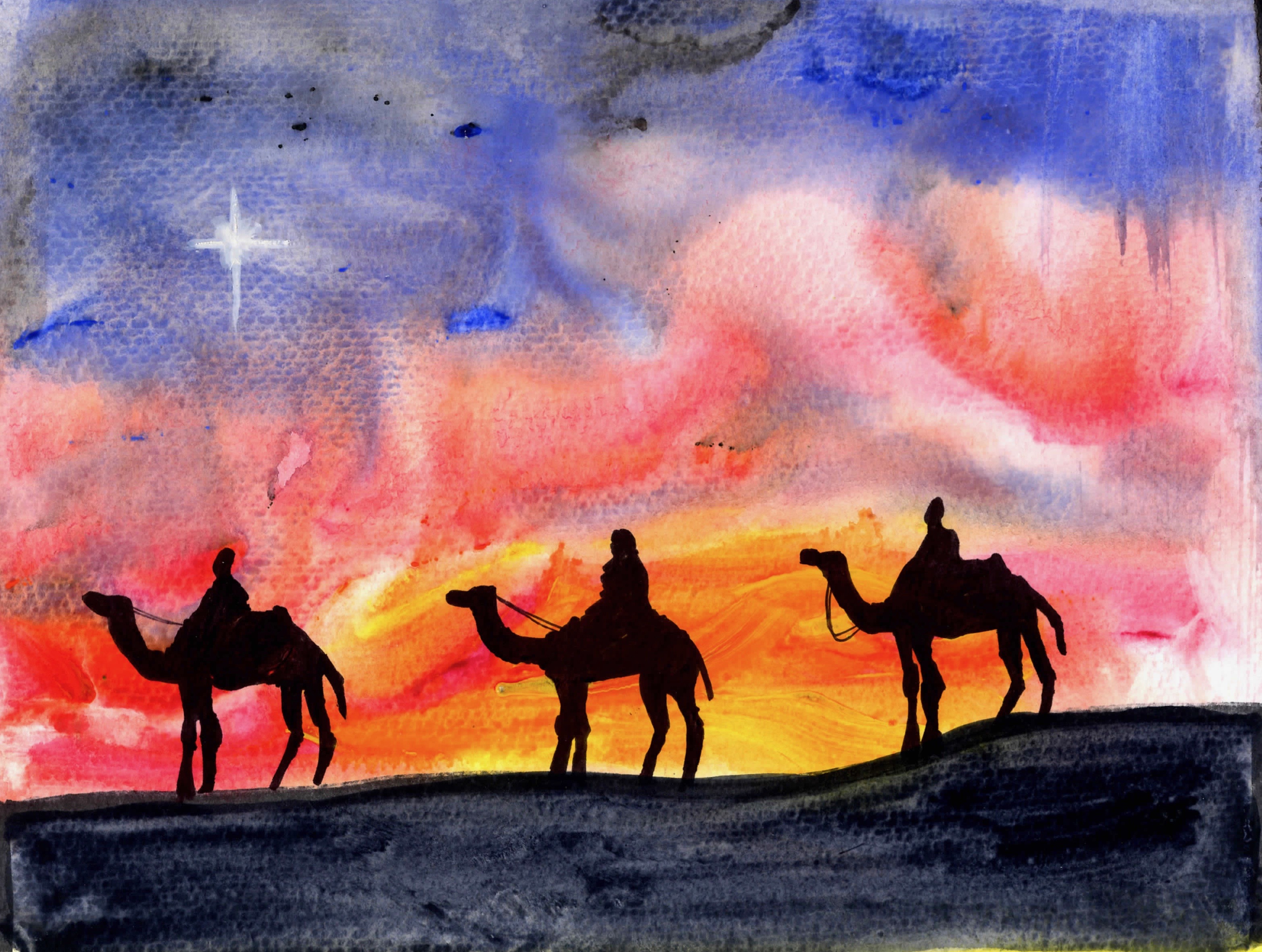
One of my all-time favorite paintings by my dad, Leo Boucher. Used with permission; all rights reserved.
Happy Epiphany!
The wise men have made their journey to the toddler Jesus, bringing their gifts of gold, incense, and myrrh. I learned a few things today from our youth worker’s sermon – the Western Church believes there were three wise men (because of the three gifts they brought), but the Eastern Church says there were twelve. Our preacher also made the good point that these visitors were the first outsiders to visit Jesus, thus marking the God-Made-Man’s mission to reach everyone in the world with his message of love, grace, and forgiveness.
Thank you for journeying with me through the twelve days of
Christmas! I pray you’ll have a blessed and joyous Ephipanytide.