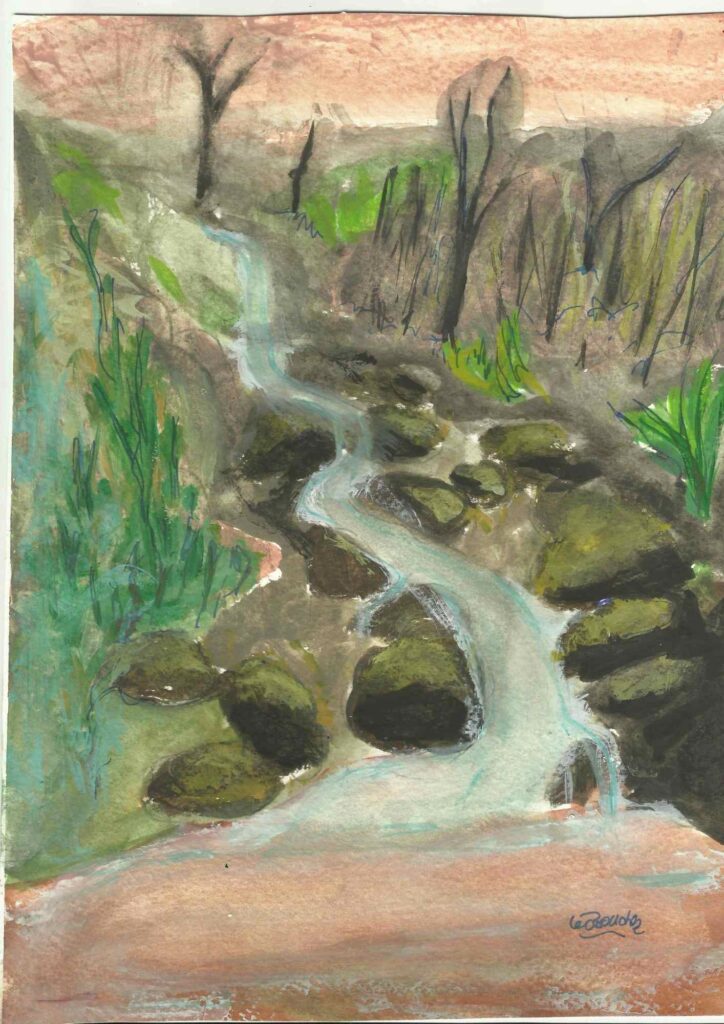
By Leo Boucher. Used with permission; all rights reserved.
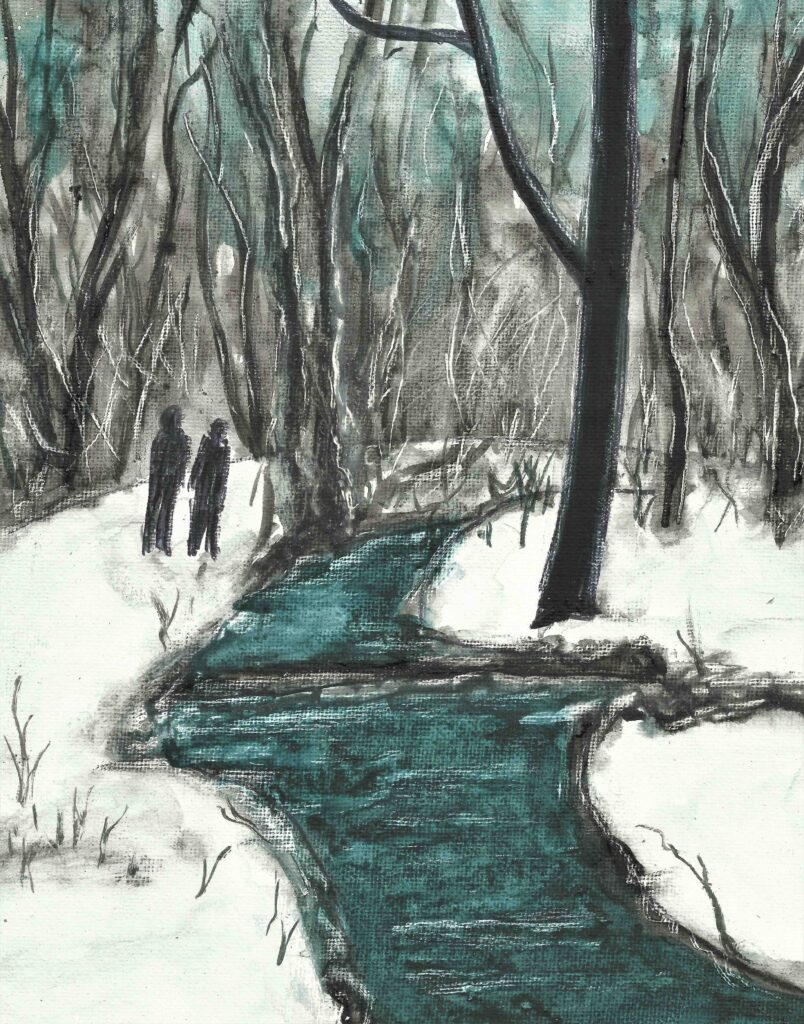
Last week I was surrounded in beauty – the gorgeousness of people encountering God through prayer and the wonders of creation with sea, streams, and sky. This week my view is definitely smaller, down to two rooms in our vicarage as I isolate from the family to avoid spreading covid. But I can look at my dad’s amazing art and use it as a pointer for prayer.
I love his abstract take on this stream – I can verily hear the water gurgling along as I inhale deeply. Why not join me in pausing to pray while using a passage from Scripture to focus your mind and heart:
On the last and greatest day of the festival, Jesus stood and said in a loud voice, “Let anyone who is thirsty come to me and drink. Whoever believes in me, as Scripture has said, rivers of living water will flow from within them.” (John 7:37–38, NIV)
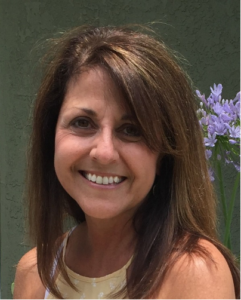
Michelle and I may be many miles apart, from California to London, but her warmth and encouraging words make her feel close. She shares movingly about the power of prayer in an unlikely place as she and her son experienced it. Her post is a bit longer than some, but I think you’ll want to brew a cuppa or grab an iced tea as she shares her story…
In the last several years, God has helped me to know His presence with me and within me in ways I wouldn’t have imagined as a young girl. I don’t doubt He’s with me – listening, communicating, doing all that He has planned in my life. He’s with me even in the middle of my waiting, in my anger and sorrow, as He takes my hand and tells me He loves me.
Amy Boucher Pye’s 7 Ways to Pray: Time-Tested Practices for Encountering God has taught me new prayer practices and made some practices I didn’t even realize I was doing more intentional and meaningful. For instance, in John 15, through the story of the vine and its branches, Jesus tells us of our connection to Him and the Father. Amy shares it like this:
Consider how the vine needs the branches, and the branches need the vine: without branches, the vine won’t produce fruit, and without the vine, the branches won’t receive the necessary nutrients to live. This image points to one of the amazing truths of the Christian faith: that God through Christ condescends to make His home in us. That is, although He is all-powerful and all-knowing, He restricts Himself to working in and through us with all of our limitations and failings” (p. 48).
This truth has helped me to see that God is with me – in me and in others – encouraging us to yield to His Spirit so we can produce the sweetest of His fruit.
Being the mother of my son, my gift from God (neurodiverse, now 24 years old, and the most awesome person I could ever hope to know), has nurtured practicing the presence of God and the practice of examen in my life. As happened one day at the DMV (Department of Motor Vehicles)…
I took in the dingy, crowded space filled with many. Standing. Sitting. Waiting. We were grateful the sun was shining, shedding a little bit of sparkle and warmth on this otherwise somewhat chilly government building. My then 19-year-old son, Jared, was taking his driver’s permit test. And life being the mixed bag of joy and sorrow that it is, this event was an occasion for both. As a parent of child with learning and developmental differences, I’ve experienced a brand of the joy/sorrow blend that is all its own. Joy and sorrow are inextricably linked. They are not only each other’s ally, they are life-long pals. And you just never know when they will show up to the party, even when the party is at the local DMV.
We were both a little twitchy – a frighteningly lovely mix of excitement, trepidation, hope, and fear that accompanies adventures and new endeavors. Having forgotten the umpteenth piece of documentation the DMV requires to verify we really are who we say we are required us to run home. “I’ll save your spot,” the employee said. We thanked him and hoped our doubtful facial expressions didn’t belie our optimistic gratitude. We reentered the building and the stern-faced, kind employee who said he would save our scheduled appointment time was true to his word. With an almost imperceptible, expectant smile he waved us forward as if he had been looking for us to walk through the front door. We thanked him from the bottom of our hearts but didn’t want to make a fuss.
On to the next gentleman employee, proudly clad in a USC t-shirt with the low hum of Earth, Wind and Fire playing in the background. “My cousin went to USC,” Jared offered. “Oh yeah? My son goes there.” My son’s simple words opened the door to a conversation that linked us beyond the impersonal to connection. The employee could see we enjoyed his choice of music and took us under his wing.
Now you may be thinking this is all a bunch of hooey. After all, who gets taken care of so lovingly at the DMV? Well, you don’t know my son. In him resides THE SON, Whose Love covers all and bridges any gap. Even between joy and sorrow. Even between the minutiae and most important. Even at the DMV. And Jared’s heart – a willing and reliable vessel for the Love of Jesus – spilled all over the DMV that day.
With a pointing finger, our friend shuttled us to the unforgiving folding chairs that would be our perch for the better part of the day. Here we sat nervously waiting for Jared’s number to come up. Finally, it was his turn. “Good luck, my love. You’re gonna do great!” I said with a touch of confidence and hesitant hope. “Thank you, Mom,” he delivered with a look of both “Duh” and “Do you really think so?” Life. Mixed bag, indeed.
As he settled in front of the computer, Jared asked questions and sought assurance from the employees who offered answers and comfort without reservation. Being neurodiverse, Jared processes information in his own timing, which can sometimes be perceived by others as slow. But this just gave him time to make more friends with the employees. They had already formed an informal rooting section and he hadn’t even started the test. By the end of several hours, complete with a malfunctioning computer, he had a cheering section who sent him smiles, prayers, and good vibes. The patience, kindness, gentleness, and encouragement of these employees was palpable.
As I waited for my son to complete the test, our USC t-shirt-wearing friend left his post to see if Jared was doing okay. He asked me “if he could comprehend, because he seems like he can comprehend.” I was taken aback because we’d established a connection with him, and his words left me feeling oddly betrayed. Comments like that still sting – and I’ve been fielding them now for 24 years. I viewed this gentleman from my lens of frustration, impatience, sorrow, and yes, my own bias. But he was genuinely interested and cared. It wasn’t him. It was lifelong pals, Joy and Sorrow being themselves; doing their thing; working in my corner of the world.
After I blinked back the tears and refocused, I could see it for what it was – an opportunity for the fruit of the Spirit to enter in. Aah yes, so nice to see you, Joy. Thank you for rejoining your friend, Sorrow. Who just blindsided me, by the way. Maybe it’s just me, but it seems like she’s always doing that, though she means no harm. These two gave me yet another chance to share the truth humbly and gently about neurodiversity and cognitive processing skills. Slower processing doesn’t mean nonexistent. And an individual’s seemingly halting verbal skills often don’t match his limitless capacity for understanding and expression. Jared is the poster boy for these truths.
As joy and sorrow work together, they always manage to give way to the ultimate – the joy of Jesus through His Holy Spirit that shines through my son. The Holy Spirit and my son conspire regularly and manage to bring out the best in darn near everyone. My son invites each person he encounters to be a better version of themselves. He engages with others expecting the best and I’ve witnessed over and over how people rise to this loving expectation. Jesus, through my son, transforms people right before my eyes and I get to be a part of the miracle – God’s lifesaving, limitless, all-inclusive Love that produces in each of us the fruit of His Spirit – “love, joy, peace, patience, kindness, goodness, faithfulness, gentleness, and self-control” (Galatians 5:22–23). Our DMV experience was no exception.
After a long day, Jared and I walked back into the sunlight, a mom with her permit-wielding son, proud and relieved. On this day, in the DMV, God created for me yet another opportunity to know joy and sadness a little more intimately. Yes, I mourn at how my son (and others with special needs) is seen and not fully understood and appreciated by much of the world. But I delight in the way, without fail, he, through the love of Jesus, brings a smile to the people with whom he interacts. I lament at how much harder he works than his neurotypical peers, but I rejoice in how his efforts gather a cheering section and unite people in encouragement, kindness, patience, gentleness, and support. And most of all, I weep with joy in the great undeserved blessing our Holy Father has given me at being able to share this side of heaven with my Spirit filled, joy-generating Jared!
Michelle Vergara gratefully shares life with Derek, her husband of 30 years, and Jared, her son of 24 years, both of whom make her laugh and help her daily to be who God intends her to be. She also enjoys the fun and sometimes loud company of her 6 Italian brothers and sisters, nieces, and nephews. Michelle has worked for 35 years in education with children ages birth through college who are neurodiverse with developmental and learning differences. She currently works at Stowell Learning Center, a private cognitive educational program in Southern California. The children and families she has the privilege of working with always inspire her. Michelle enjoys her time with Jesus; spending time with her husband, son, and extended family; singing; reading (especially about health, wellness, nutrition, and the brain); writing; and spending as much time as possible at the beach.
Order 7 Ways to Prayhere, including in the US, UK, and Australia. You’ll also find lots of resources for small groups – videos and a leader’s guide – here.
I’m currently praying so much for a friend going through a devastating time. You may be too. I’ve found such help in Ros’ gentle description of a way of praying for others that helps us release them fully to Jesus and his love. I hope you too will try out this way to pray.
I was brought up to pray wordy prayers. There was a lot of repetition, stock phrases that everyone used. “If it be Thy will” was one, along with “In Jesus’ name, Amen.” When I joined a Brethren assembly at the age of sixteen, they added another: “If our Lord tarry.” I got quite excited the first time I heard that one. Were they really expecting Jesus to come back before the event that we were praying for? I remember feeling a thrill of excitement that these people really thought Jesus might return in the course of the next week. Sadly, I came to realise it was just a formula of words, not something that anyone really expected or was preparing for.
This pattern of prayer continued into my adulthood, but over time I found myself facing situations that no amount of words, still less formulaic ones, could adequately express. How to pray for the young friend whose wife of two years was dying of cancer? Or my own severely disabled child as she faced yet another operation? Or the childless friend who would have given her eye teeth to parent a severely disabled child, or indeed any child?
Reading Proverbs one day I had a moment of revelation. Proverbs 18.10 says, “The name of the Lord is a strong tower. The righteous run into it and are safe.” It was a verse I already knew – we sang a song based on it at church. But reading it that day, it suddenly dawned on me that the name of Jesus is not something we append to our prayers. It is a place, a strong tower, a place of safety from inside which we can pray effective prayers. Did Jesus not tell us to ask “in my name”? “Whatever you ask in my name, I will do.” (John 14.13)
I began to pray differently, using my imagination under the Holy Spirit’s direction. I would visualise a strong, impregnable tower, to which I was granted admission. I would enter the tower, close the door and sit in silence. As I pictured this, I would focus on Jesus whose name this tower was. I would stay in silence and stillness, occasionally interrupted by an expression of praise or love to Him.
When I had a complete sense of being in that place of safety, of His presence there with me, I would picture whoever I wanted to pray for. I would see myself leading them into the strong tower and holding them there with me inside it. It was as if, in that place of safety, I was silently presenting them to the One who knew far better than I did what they needed. No words were necessary. I was asking on behalf of that person within the name of Jesus, and I knew I was heard and answered. No formula, just a place where God hears and answers prayer. It has been my preferred way of praying for people ever since.
Ros Bayes is a writer, a former teacher and mother of three daughters. In June of last year, 9 months after her marriage to Keith Dakin, she retired from her work as Training Resources Developer at Christian disability charity Through the Roof. Ros has written A level textbooks on Philosophy and Ethics, publications for churches on disability, devotional books and a novel, The Well is Deep, based on the story in John 4 of Jesus’ encounter with the Samaritan woman at Jacob’s well.
Order 7 Ways to Prayhere, including in the US, UK, and Australia. You’ll also find lots of resources for small groups – videos and a leader’s guide – here.
By Leo Boucher. Used with permission; all rights reserved.
As we continue to wrestle with the news out of Ukraine, our hearts are heavy and burdened. That there would be a Russian air strike on a maternity and children’s hospital is barbaric. As you cry out to God, you might want to pray alongside some pictures of a photographer who is currently in Ukraine. He manages to capture moments of beauty in the midst of these bleak scenes.
Or you can use my dad’s winter painting of a stream that flows in stark surroundings. Let your eye wander and settle as you ask God to help you notice something in the painting or in your heart. You could ponder the words of Jesus, which he shares with his friends after they shared their last supper together:
“I have told you these things, so that in me you may have peace. In this world you will have trouble. But take heart! I have overcome the world.” John 16:33
In fact, you may wish to read the whole of John 16.
May God strengthen our hearts to believe that what he says is true. And may his peace break out all around the world.
Prayer with movement – I so appreciate how Anna shares different ways for us to engage with God through our bodies. After all, as she notes, we might well be using certain physical motions to pray anyway, such as folding our hands or closing our eyes. I’m looking forward to trying out her ideas, and hope you will too.
Connecting prayer and movement together can seem out of the box, but we already always use movement in our prayers. Do you close your eyes? Bow your head? Clasp your hands? They are all intentional movements that you do as you come into the presence of God for a conversation.
I love sharing with others how they can encounter more of God through adding movement to their prayers and relationship with God. At UC Grace, a Christian Dance Company that I run, we define prayer movement as…
Your body’s reaction to drawing closer to God. The external display of an internal feeling and preparation for a conversation. Its nuances that only you and God know. Fleeting moments when you choose to acknowledge your connection and conversation with God. The reality of moving through life sometimes 100 miles an hour but still always doing the same thing when you choose to pray. To have that conversation and allow intention into the time of response with God.
Put simply, prayer movement allows us the chance to pray without words, letting movement tell the story instead. Sometimes this can be influenced with music, while other times music isn’t necessary to capture and share what God is speaking through the movement.
Here are two ways that I have found useful to develop my practice of prayer movement. It can take a while to get into the rhythm of doing it, so give it time and allow God to move and work bit by bit.
Write it, learn it, move it
Think about one thing that you would like to pray for currently. Write it down into a simple written prayer. It’s important to use key words that describe what the issue is, any emotions involved, and any encouraging words. Don’t make it complicated.
Next, take the time to learn that prayer off by heart. This helps it to become ingrained so you can anticipate what is coming next. When you speak, you naturally emphasise certain words, so start to recognise the words that you are emphasising. These are your movement starting points.
Begin to put specific movements to the words that stand out to you in your prayer and practice them one after the other. The movements can be a literal interpretation of the word or something abstract. Only you know it’s meaning; it doesn’t matter what anyone else thinks it is.
For example, a prayer I regularly pray is about patience, energy and joy. Three things I can struggle with daily. ‘Father God, equip me with patience to withstand the day, energy to sustain all that I need to do and joy to flow in conversations and relationships.’ I emphasise those three words I mentioned previously doing the following movements –
Patience: Standing feet in neutral (hip width apart), inhaling a deep breath and opening my hands out to receive.
Energy: Bringing my hands together and rolling them over each other, taking them above my head and then opening them out into a high V shape.
Joy: Swinging my arms down from high into a figure of 8 and doing some hops.
This is my movement prayer. That’s how simply you can build yours. I can spend some time doing this slowly, fast, big, small, anyway I want. Sometimes I will speak the words, other times I won’t. but I treat it as an offering and invitation for a conversation with God.
Let a song be your prayer dance
Words in songs can be very powerful. Often you might find yourself either picking up on one or two key phrases or becoming enveloped in the song completely. Worship songs bring a different layer to our prayers. Many are written as heartfelt prayers, words directly from scriptures or specific words from God. This can be a natural way move your prayer.
Think about some of the songs that you love – what parts of them are your prayer right now. Take some time to respond to those words, and, just like I mentioned above, learn them. Then in those moments when you need to remember that prayer you can simply move it – without the need for music.
As I’ve journeyed with prayer movement, I’ve experienced a closeness with God that’s hard to describe. Praying can sometimes be hard work. But when I choose to use movement instead, I feel freedom, a change in the atmosphere, and a joy that sparks a desire to keep seeking Jesus.
I hope you enjoy have the chance to experience this too.
Anna is dancer, teacher, choreographer and writer. She has two crazy children and a husband in the military. Anna is the author for Jesus for Kids: Teaching Dance and Sharing Faith, and Movement, Prayer and Scripture is due for release at Easter. Anna’s passion is to teach and share her knowledge about the interaction between dance and movement and how that exploration helps us to have a deeper conversation with God. She runs regular trainings, workshops and dance weekends and blogs at www.ucgrace.co.uk/Blog. She loves the outdoors, growing her own food and sewing clothes. You can find her on Instagram, Facebook and at her website.
Order 7 Ways to Prayhere, including in the US, UK, and Australia. You’ll also find lots of resources for small groups – videos and a leader’s guide – here.
By Leo Boucher. Used with permission; all rights reserved.
Our thoughts turn to those in Ukraine, and those who have left their beloved country, as we hear continued news of war. And we are hearing of resistance from many in Russia too.
We cry:
Lord, have mercy. Christ, have mercy. Lord, have mercy.
I offer this painting of my dad’s as a prayer prompt as we intercede for all those struck by war and conflict. What’s pictured is actually a slice of Prague, not Kyiv, but perhaps considering the Velvet Revolution may spur our prayers.
You might want to join many Ukrainians who are praying through Psalm 31. Here’s a video Bible Society has put out, which I find moving:
1 In you, Lord, I have taken refuge; let me never be put to shame; deliver me in your righteousness. 2 Turn your ear to me, come quickly to my rescue; be my rock of refuge, a strong fortress to save me. 3 Since you are my rock and my fortress, for the sake of your name lead and guide me. 4 Keep me free from the trap that is set for me, for you are my refuge. 5 Into your hands I commit my spirit; deliver me, Lord, my faithful God.
6 I hate those who cling to worthless idols; as for me, I trust in the Lord. 7 I will be glad and rejoice in your love, for you saw my affliction and knew the anguish of my soul. 8 You have not given me into the hands of the enemy but have set my feet in a spacious place.
9 Be merciful to me, Lord, for I am in distress; my eyes grow weak with sorrow, my soul and body with grief. 10 My life is consumed by anguish and my years by groaning; my strength fails because of my affliction,[b] and my bones grow weak. 11 Because of all my enemies, I am the utter contempt of my neighbors and an object of dread to my closest friends— those who see me on the street flee from me. 12 I am forgotten as though I were dead; I have become like broken pottery. 13 For I hear many whispering, “Terror on every side!” They conspire against me and plot to take my life.
14 But I trust in you, Lord; I say, “You are my God.” 15 My times are in your hands; deliver me from the hands of my enemies, from those who pursue me. 16 Let your face shine on your servant; save me in your unfailing love. 17 Let me not be put to shame, Lord, for I have cried out to you; but let the wicked be put to shame and be silent in the realm of the dead. 18 Let their lying lips be silenced, for with pride and contempt they speak arrogantly against the righteous.
19 How abundant are the good things that you have stored up for those who fear you, that you bestow in the sight of all, on those who take refuge in you. 20 In the shelter of your presence you hide them from all human intrigues; you keep them safe in your dwelling from accusing tongues.
21 Praise be to the Lord, for he showed me the wonders of his love when I was in a city under siege. 22 In my alarm I said, “I am cut off from your sight!” Yet you heard my cry for mercy when I called to you for help.
23 Love the Lord, all his faithful people! The Lord preserves those who are true to him, but the proud he pays back in full. 24 Be strong and take heart, all you who hope in the Lord.
What a moving account by Ruth of moving from a prescribed prayer life to one of freedom and grace. I’m sure you’ll be encouraged by her blogpost. You might consider spending a few moments charting out your own prayer journey, in the fashion she illustrates.
One of my earliest memories. Two little hands – mine pressed together, my eyes squeezed shut. I’m about three, in Sunday School at prayer time, sitting at the front. I turn round, craning my neck to see my three special friends. They never sit behind me, where all the big children go. They’re always standing together in a group by the wall, ready to come over if I need them.
No-one else can see them. They are my imaginary friends, Charles, Jenny and Ruth.
I know all about Jesus, who is also my special friend. I can’t see Him, but there are pictures of Him around the room, His kind face smiling at me. I am glad He loves me and I like singing the songs about Him loving all the children of the world, me included.
Until the age of fourteen, when I turn my back on church, my prayer life is ordered by others. I’ve been taught that Jesus is always listening, but at home, we parrot the same grace before each meal and say the same prayer before bed every night. Freestyling is not encouraged.
When I become a Christian aged twenty-six, I renew my acquaintance with Jesus. I start to pray in what I hope is the correct way, thanking him for what he’s done for me, interceding for others and only at the end of my prayer asking Him for what I need. I’m still a child, copying what others do and trying to be good. I haven’t yet realised that He wants me to be extravagant and honest with him, to pour out my heart and invite Him fully in.
Aged thirty-five, I have a mini-breakdown. I am struggling with undiagnosed depression and my way of dealing with it is to pack my life with achievement. Sitting in my office in London, I burst into tears, overwhelmed by all the things I have to do. Desperate, I consult two close friends at church who suggest that we pray into my unhappiness.
To my amazement, words of knowledge, verses of scripture and prophecies come pouring from these two ladies. God knows me, He knows what I need and all I have to do is ask.
Here I am in my new writing studio aged fifty-five. I wake every morning to spend time with my Saviour and I ask Him for protection against the enemy. Fears and anxieties and demons swirl around me but I am safe, covered in prayer. Once upon a time, I would have read these words and been utterly baffled, but now, finally, I know even if I can’t see my Friend, I can feel the warmth of His love through prayer.
These days, the words that fly up to Heaven are mine and it’s more of a conversation. I hope that the second half of my life is more about freedom in praise and prayer – I don’t put my hands together and squeeze my eyes shut these days, and I haven’t seen my imaginary friends since my sister was born, but the comfort of knowing that I’m never alone nestles deep in my heart.
Ruth is a novelist and freelance writer. She is married with three children, one husband, assorted poultry and a kitten. She is the author of The Diary of Isabella M Smugge, The Trials of Isabella M Smugge and is currently writing The Continued Times of Isabella M Smugge. She writes for a number of small businesses and charities, reviews books for Reading Between the Lines and blogs at ruthleighwrites.co.uk. Ruth has abnormally narrow sinuses and a morbid fear of raw tomatoes, but has decided not to let this get in the way of a meaningful life. You can find her on Instagram, Facebook, Twitter and TikTok at @ruthleighwrites and at her website.
Order 7 Ways to Prayhere, including in the US, UK, and Australia. You’ll also find lots of resources for small groups – videos and a leader’s guide – here.
By Leo Boucher. Used with permission; all rights reserved.
In the typical fashion of island weather, I’m sitting here enjoying the sunbeams streaming into my study. But this morning I walked to the gym in pelting, cold rain. It was a bit miserable, the experience at least woke me up.
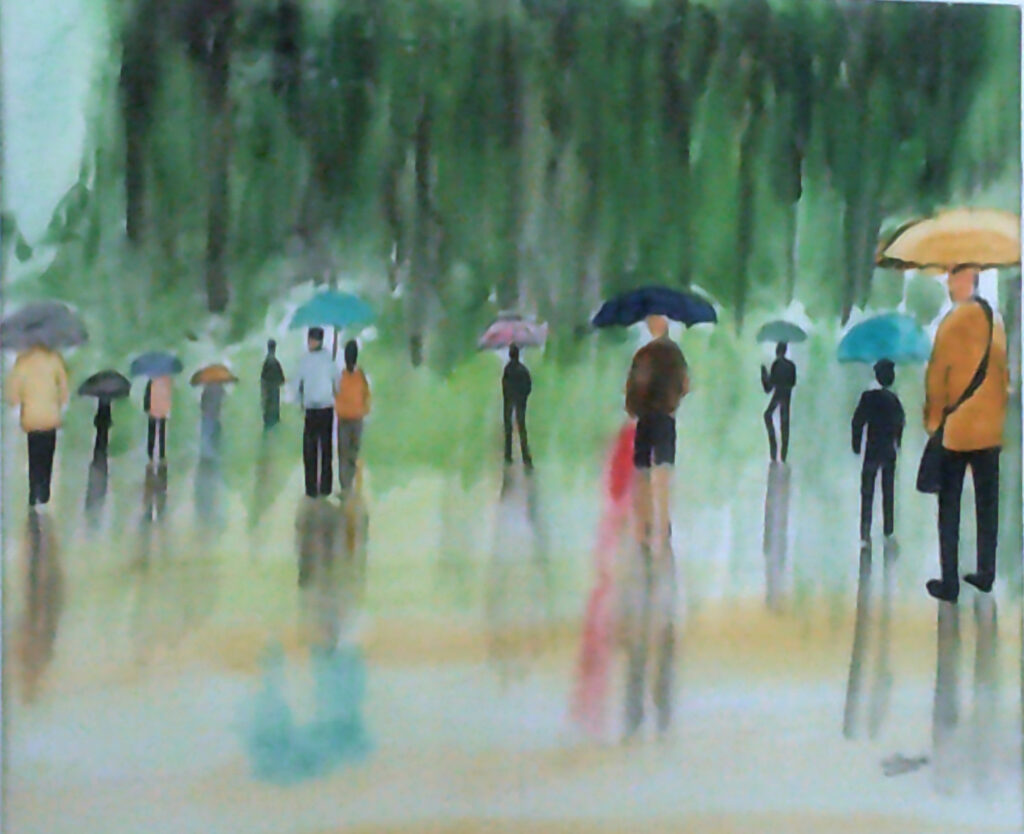
I love this painting of Paris in the rain by my dad. He says it’s a large canvas and as it met with my mother’s approval, it hangs in their kitchen. I find it so evocative.
Might you use it as a springboard for prayer? Here are a few verses from Scripture (the NIV) you could ponder as you pray:
Sow righteousness for yourselves, reap the fruit of unfailing love, and break up your unplowed ground; for it is time to seek the LORD, until he comes and showers his righteousness on you. (Hosea 10:12)
“You heavens above, rain down my righteousness; let the clouds shower it down. Let the earth open wide, let salvation spring up, let righteousness flourish with it; I, the LORD, have created it. (Isaiah 45:8)
As the rain and the snow come down from heaven, and do not return to it without watering the earth and making it bud and flourish, so that it yields seed for the sower and bread for the eater, so is my word that goes out from my mouth: It will not return to me empty, but will accomplish what I desire and achieve the purpose for which I sent it. (Isaiah 55:10–11)
Anita offers some wonderfully engaging creative ways to pray. I love how she involves her body in praying and worshipping God, and how she outlines the practice of slowing down to pray with a passage of Scripture through coloring. I hope you’re inspired to try something new.
Being able to go on retreat has really helped me to connect with God on a deeper level, particularly during lockdown. A friend, a member of the Lay Community of St Benedict, leads an annual creative prayer retreat, usually at Worth Abbey. Then lockdown hit, so retreats have moved online instead. These were such a blessing that a monthly online creative prayer group was formed, connecting Christians across the UK and Europe.
Discovering Worship through Sign Language
As a visual learner I’ve found signing songs a powerful way to come closer to God in sung worship, particularly when we were unable to sing in church throughout lockdown. It somehow engages my heart more with God’s and adds another dimension, other than my brain, to worship. I’ve only learned a handful of signs (and sometimes made up my own!) but this kind of worship has helped me through the ups and downs of the lockdown. God moves and blesses us as we use our bodies to express ourselves to Him. Some churches have embraced this signing during worship, some long before lockdown began, and not just in the kids’ songs, making church more accessible to all. We’ve also learned how to sign the Lord’s Prayer and the actions can be more thought-provoking and visually expressive than saying the words alone.
Bible Journalling as a Way to Pray
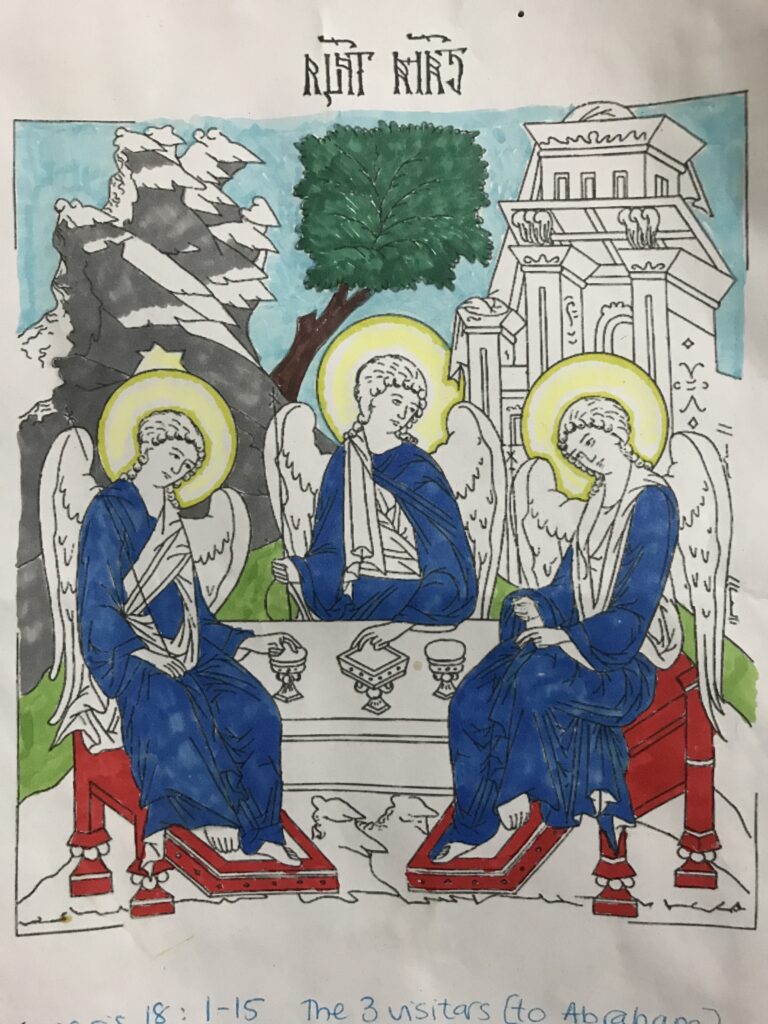
Art can also be a way to express our prayers to God, drawing out our praises or what we’re thankful for. As Amy touches upon in her chapter in her book, 7 Ways to Pray, on praying with the Bible, creative Bible journaling has also opened up a new way to meditate and pray through illustrated bible verses. As I colour in the different parts of the pictures, God may show me something new about that word or verse, and the colours I choose may be symbolic of what I see, e.g. red for Jesus’ blood poured out or blue to represent the Holy Spirit.
We were sent some icon pictures to colour in at the 2021 online retreat. The one I was drawn to was Rublev’s icon of the Holy Trinity. Whilst staying at a retreat centre, I was unsure where this story came from in the Bible, so looked it up. Having found a relevant book on this icon, I discovered the passage was from Genesis 18:1-15. Abraham greets 3 strangers who visit his tents and invites them to a meal. It mentions the Lord as one of the visitors, but by inference Rublev interprets them as God the Father, Jesus the Son and the Holy Spirit. The way that each one looks out towards the viewer, invites us to take a seat at the table where they sit. As I contemplated this, I imagined myself sitting there with Them, I poured out my heart to Them, as They listened and talked with me. It was a chance to just sit and be in God’s presence, away from the hubbub of life for a while. An opportunity for some Ignatian prayer, too, as I imagined myself in the picture.
Today, is there a new way you can be creative in your prayers? YouTube has some signed worship songs, e.g. God Is my Refuge by Kat Mills. Why not choose one to watch and have a go at signing too as you worship? Or try Bible journaling, listening to God as you colour and contemplate His words? You can look online for a relevant Bible journal picture/ words to colour if you don’t have access to a Bible journal.
Anita Kelly is a mental-health awareness trainer and writing-for-wellbeing facilitator. She lives in North West London and blogs on Christianity and mental-health issues.
She discovered her love of writing whilst completing an MA at Kings College London and is writing her first book, a mental-health memoir. As a creative, she enjoys writing, doodling and going for walks in nature.
Order 7 Ways to Prayhere, including in the US, UK, and Australia. You’ll also find lots of resources for small groups – videos and a leader’s guide – here.
How can we hear God? Jo Acharya shares helpfully how she’s been making space for God through silence, minute by minute at first. I especially appreciate her explanation of how she’s been learning to discern when it she’s hearing God and when it’s ‘just her’.
In prayer, as in life, I’m a talker. For as long as I can remember, I’ve had conversations with God – by which I mostly mean one-way monologues from my lips into his endlessly patient ear. There’s some value in this. It’s helpful to process my thoughts in God’s presence. But no relationship can thrive when one person does all the talking. A sheep needs to stop bleating in order to hear her shepherd’s voice.
God has all kinds of ways to get through to me, of course. But lately I’ve started bringing short times of silence into my time with him, to create intentional space and invite him to speak.
Silence is hard. In the beginning I only managed two or three minutes. Pitiful, I know, but I found I didn’t know what to do with it. Think about God or not think at all? Accept the thoughts that come to mind or push them out? As I’ve practised it’s become easier, and the time has stretched a little longer. The quiet is like a bath for my mind. A sweet pause, a ‘save and close’ for all the tabs I have open on the computer in my head. I think silence is something I’ve craved without knowing it.
As I sit, the clutter gradually moves to the sidelines and makes way for something else. For someone else. And the truth is that when I give God my focused attention, just for those few minutes, he usually does speak. Into my mind will come a line from a song, or a snippet of scripture. These are like clues from a treasure hunt. When I read the full passage or lyrics they come from, relevant themes often emerge which guide or answer my prayers.
Sometimes words or sentences come into my head. These I find difficult to distinguish from my own thoughts, which used to bother me. Are they really from him, or from me? But Paul says in 1 Corinthians 2:16, ‘We have the mind of Christ’. I suppose the longer we walk faithfully with God, the more intertwined our thoughts become. Perhaps in these moments, things I have already learned and absorbed are simply brought to mind by the Holy Spirit at work in me. In his book, How to Pray, Pete Greig suggests evaluating what we hear from God with two questions: ‘Is this like Jesus?’ and ‘What’s the worst that could happen if I got this wrong?’ I find that reassuringly sensible advice.
But there’s still something unnerving about this process. Dallas Willard observes in his book Hearing God that that many of us ‘fully intend to run our lives on our own… The voice of God would therefore be an unwelcome intrusion into our plans.’ I know that one part of me is nervous of what God might say, and another part is afraid he might not say anything at all. Those twin fears: What if I hear something? What if I don’t? unsettle me each time I sit down to listen, and sometimes they get the better of me.
And yet I keep going. Because I do want his guidance and his encouragement, his correction and help. So I continue these faltering steps to make space in my busy day and my even busier mind. And I listen for the still, small voice of the one who knows me better than I know myself.
Jo Acharya is a writer and music therapist who is passionate about inviting God into every part of our everyday lives. She lives with her husband Dan and posts regularly on Facebook and Instagram. You can read more of Jo’s writing at ValleyOfSprings.com, where you can also buy signed copies of her new book, Refresh: a wellness devotional for the whole Christian life, an interactive weekly journal with beautiful photography by Dan.
Order 7 Ways to Prayhere, including in the US, UK, and Australia. You’ll also find many resources for small groups – videos and a leader’s guide – here.